Credit Score Factors
The Definitive Guide to Algorithmic Underwriting, Utilization Mechanics, and FICO Optimization
A credit score is a statistical number that evaluates a consumer's creditworthiness and is based on their historical credit profile and debt repayment behavior. Lenders utilize credit scores to rigorously evaluate the mathematical probability that an individual will repay their unsecured and secured debts in a timely manner. In modern global financial systems, a credit score is not merely a passive reflection of past behavior, but a highly active, predictive algorithmic tool utilized by commercial banks, mortgage lenders, property landlords, and even corporate employers to systematically assess financial reliability and default risk.
Historically, lending was a highly localized and deeply subjective process, relying heavily on personal relationships, implicit biases, and manual underwriting by human loan officers. This opaque system was revolutionized in 1989 with the introduction of the first general-purpose FICO score by the Fair Isaac Corporation, which standardized creditworthiness into a rigid, objective, three-digit numerical spectrum (typically ranging from 300 to 850). Today, while there are multiple credit scoring models competing globally—such as FICO and the increasingly prominent VantageScore in the United States, or CIBIL and Experian models in international markets—the underlying mathematical factors governing these proprietary scores remain remarkably consistent.
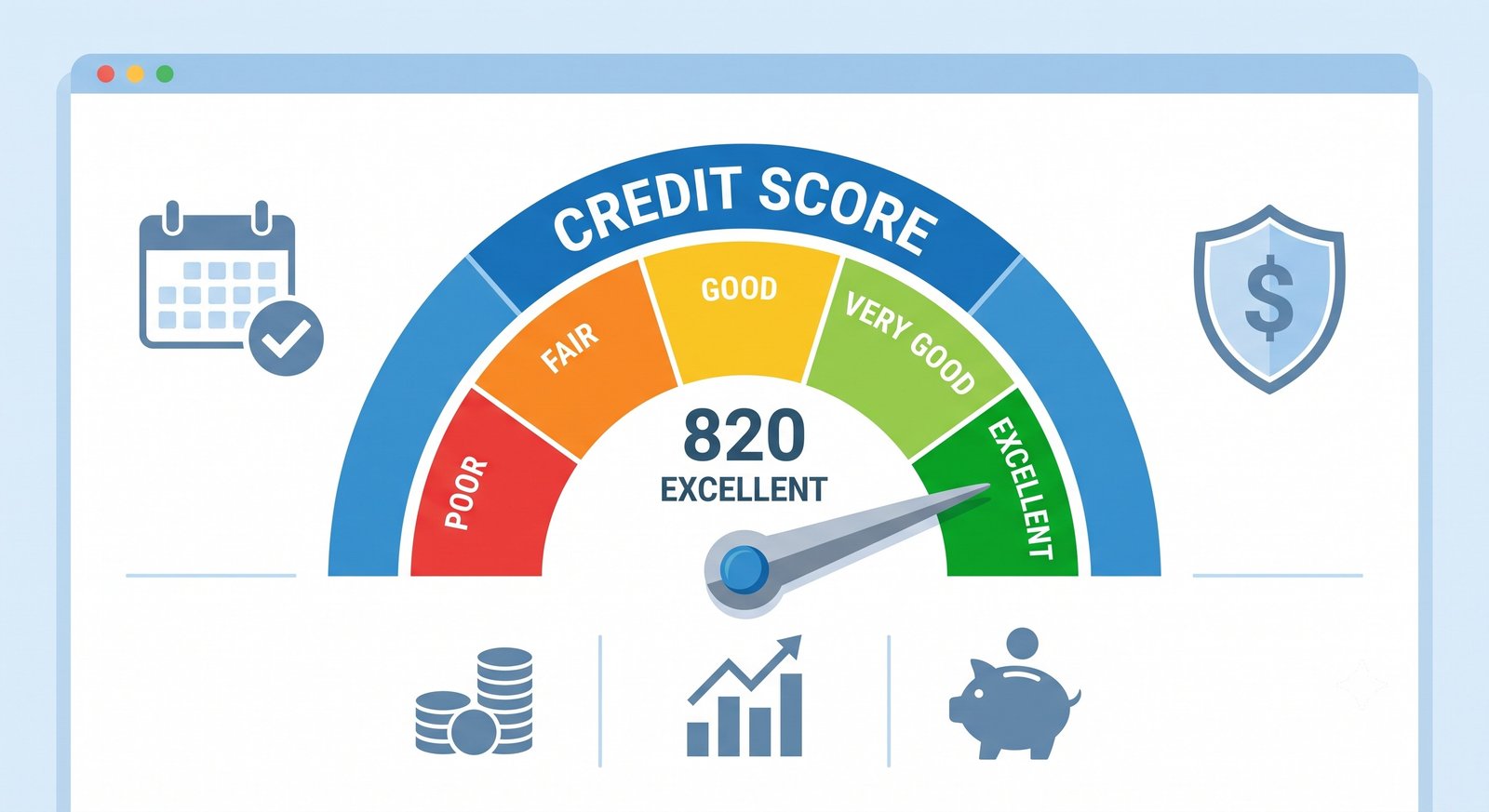
The algorithms weigh specific categories of financial behavior, assigning a rigid percentage value to each category based entirely on its historical, empirical correlation to loan defaults. The difference between a "Fair" score of 620 and an "Exceptional" score of 800 can translate to hundreds of thousands of dollars in saved interest over the lifecycle of a 30-year residential mortgage. Understanding the precise mathematical components that construct a credit score allows individuals to strategically reverse-engineer their financial habits to maximize their creditworthiness, capture the lowest possible interest rates, and secure massive borrowing leverage.
1. Payment History (35%): The Foundation of Trust
Payment history is universally recognized as the single most critical factor in virtually all major credit scoring models, typically accounting for approximately 35% of the total algorithmic score. This category strictly measures whether an individual has paid their past and current credit accounts on time, without deviation. Because the primary, existential concern of any institutional lender is whether they will eventually recoup their deployed capital, an individual's past payment behavior serves as statistically the most accurate predictor of their future payment performance.
In the world of credit reporting, precision is paramount. When a payment is missed by a few days, it is not immediately reported to the major national credit bureaus (Equifax, Experian, TransUnion). Generally, a consumer's payment must be a full 30 days past the contractual due date before it triggers a formal derogatory mark on their credit file. However, once reported, these late payments are ruthlessly categorized into escalating severity buckets: 30-day late, 60-day late, 90-day late, and 120-day late. The further an account falls into delinquency, the more severe the mathematical penalty applied to the credit score, effectively signaling to future lenders a compounding refusal to honor debt obligations.
- Recency of Delinquency (Time-Decay Algorithms): A 30-day late payment that occurred last month will plummet a credit score much further than a severe 90-day late payment that occurred four years ago. The scoring algorithms utilize a strict time-decay model for derogatory marks; as the negative event ages, its mathematical weight against the total score gradually diminishes, allowing consumers to recover over a 7-year horizon.
- Frequency of Delinquency: An isolated 30-day late payment on a flawless five-year-old account is viewed by the algorithm as a minor, likely accidental anomaly. However, multiple late payments spread across different accounts (e.g., a late auto loan and two late credit cards in the same quarter) definitively suggest systemic financial distress or a severe cash flow crisis.
- Severity of Derogatory Marks: Beyond standard late payments, "Charge-offs" (where the lender legally writes the toxic debt off as a permanent loss), third-party collections, vehicle repossessions, residential foreclosures, and personal bankruptcies are the most destructive elements that can exist within a payment history. These events often cap a consumer's score entirely in the sub-prime tier, completely overriding other positive factors for several years.
2. Credit Utilization Ratio (30%): The Metric of Credit Reliance
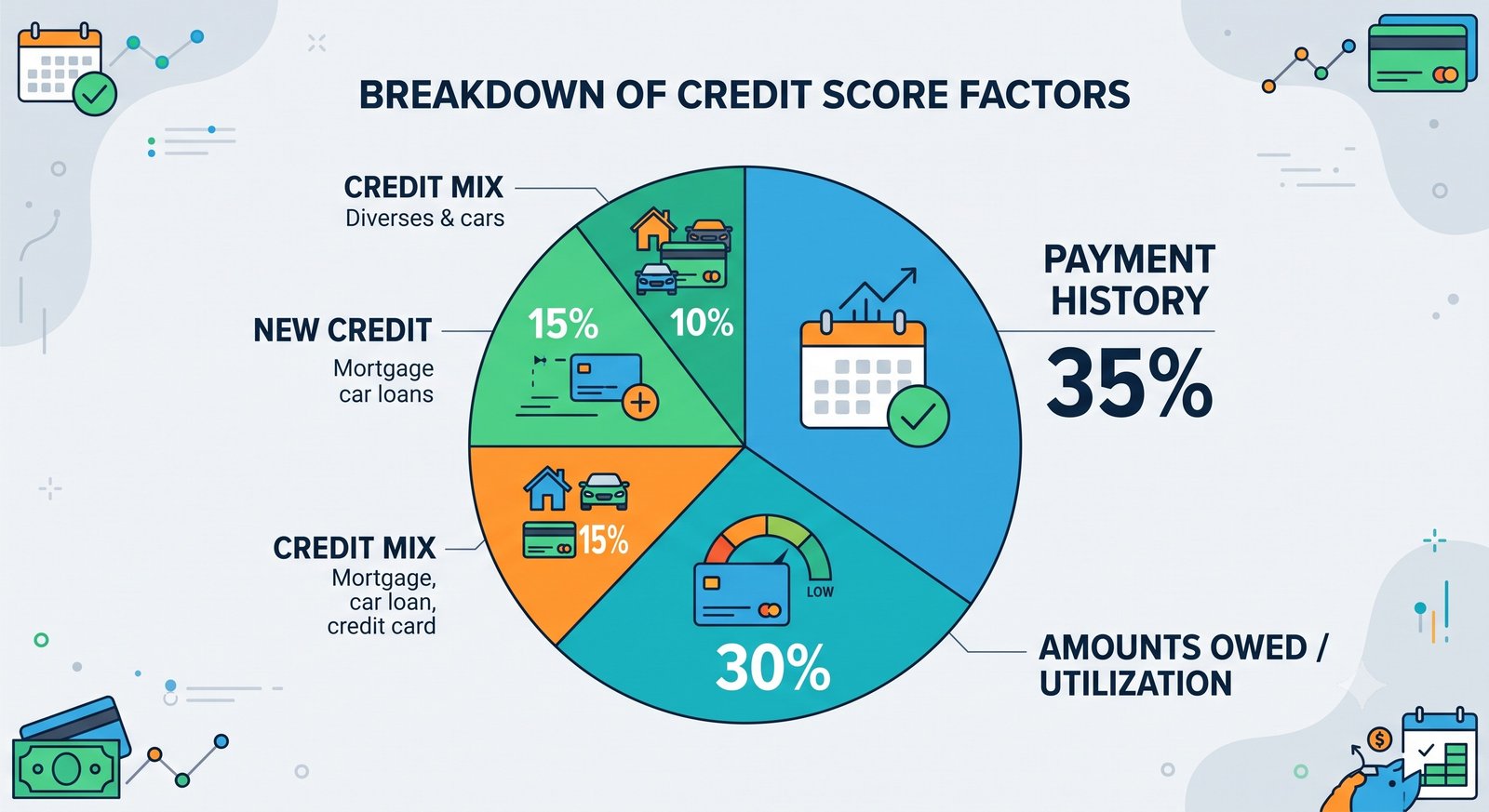
Accounting for roughly 30% of a credit score, the Credit Utilization Ratio is the second most influential factor, and crucially, it is the most highly volatile, allowing for rapid score manipulation. This metric exclusively evaluates the total amount of revolving credit (credit cards and lines of credit) a consumer is currently using relative to their total mathematically available revolving credit limits. It is a pure mathematical expression of credit reliance and liquidity constraint. High utilization strongly indicates to algorithmic risk models that a borrower may be dangerously overextended, living beyond their liquid means, and at a significantly higher risk of defaulting if they experience an unexpected financial shock (such as a sudden medical bill or job loss).
Credit Utilization Formula:
Utilization % = (Total Revolving Balances / Total Revolving Credit Limits) × 100
The utilization ratio is calculated in two ways simultaneously: on a "per-card" basis and in aggregate. For example, if an individual possesses two credit cards, each with a $5,000 limit (totaling $10,000 in aggregate available credit), and they carry a $2,000 balance on one card and a $0 balance on the other, their aggregate utilization is 20%. However, their per-card utilization on the first card is 40%, which may trigger minor scoring penalties. Generally, mainstream financial experts recommend keeping total revolving utilization strictly below 30% at all times. However, for sophisticated consumers seeking to engineer and optimize their scores into the elite top 1% tier (800+), keeping aggregate utilization intentionally hovering between 1% and 9% yields the highest possible mathematical benefit.
The Reporting Timing Loophole: It is absolutely crucial to understand that credit bureaus calculate this ratio based on the snapshot balance reported by the card issuer on the statement closing date, not necessarily the amount of interest being paid or the balance on the actual due date. Therefore, a highly responsible consumer who pays their credit card balance in full every single month to avoid compounding interest can still suffer a heavily penalized credit score if their statement continuously closes with a high balance before that payment is physically made.
3. Length of Credit History (15%): The Temporal Landscape
Comprising approximately 15% of the total FICO score, the length of a consumer's credit history provides risk algorithms with a temporal landscape of their financial behavior. Algorithms and underwriters cannot confidently assess risk on a "thin file" individual who has only utilized a single credit card for six months. A longer, thoroughly established history provides a far deeper, more robust data set, allowing lenders to see exactly how the consumer managed their debt through varying macroeconomic cycles, recessions, and personal financial phases.
This temporal factor meticulously evaluates three specific metrics:
- The Age of the Oldest Account: The absolute establishment date of your very first credit line. This sets the maximum length of your credit profile.
- The Age of the Newest Account: Opening multiple new accounts rapidly drives this metric down, indicating recent credit-seeking behavior.
- Average Age of Accounts (AAoA): Calculated by taking the total age in months of all open (and properly closed) accounts and dividing by the total number of accounts. An AAoA exceeding 7 to 9 years is typically required for elite 800+ credit scores.
The Myth of Closing Old Accounts: This category is precisely why fiduciary financial advisors frequently caution against arbitrarily closing a consumer's oldest credit card. While FICO scoring models generally keep closed accounts in good standing on a credit report (and factoring into AAoA) for up to 10 years, VantageScore models may drop them much sooner. When a significantly aged account eventually falls off the credit report, it can drastically lower the consumer's Average Age of Accounts (AAoA) and simultaneously reduce their total available credit limits (spiking utilization), subsequently causing a "double-penalty" where the credit score drops severely.
4. Credit Mix and Diversity (10%): Proof of Management
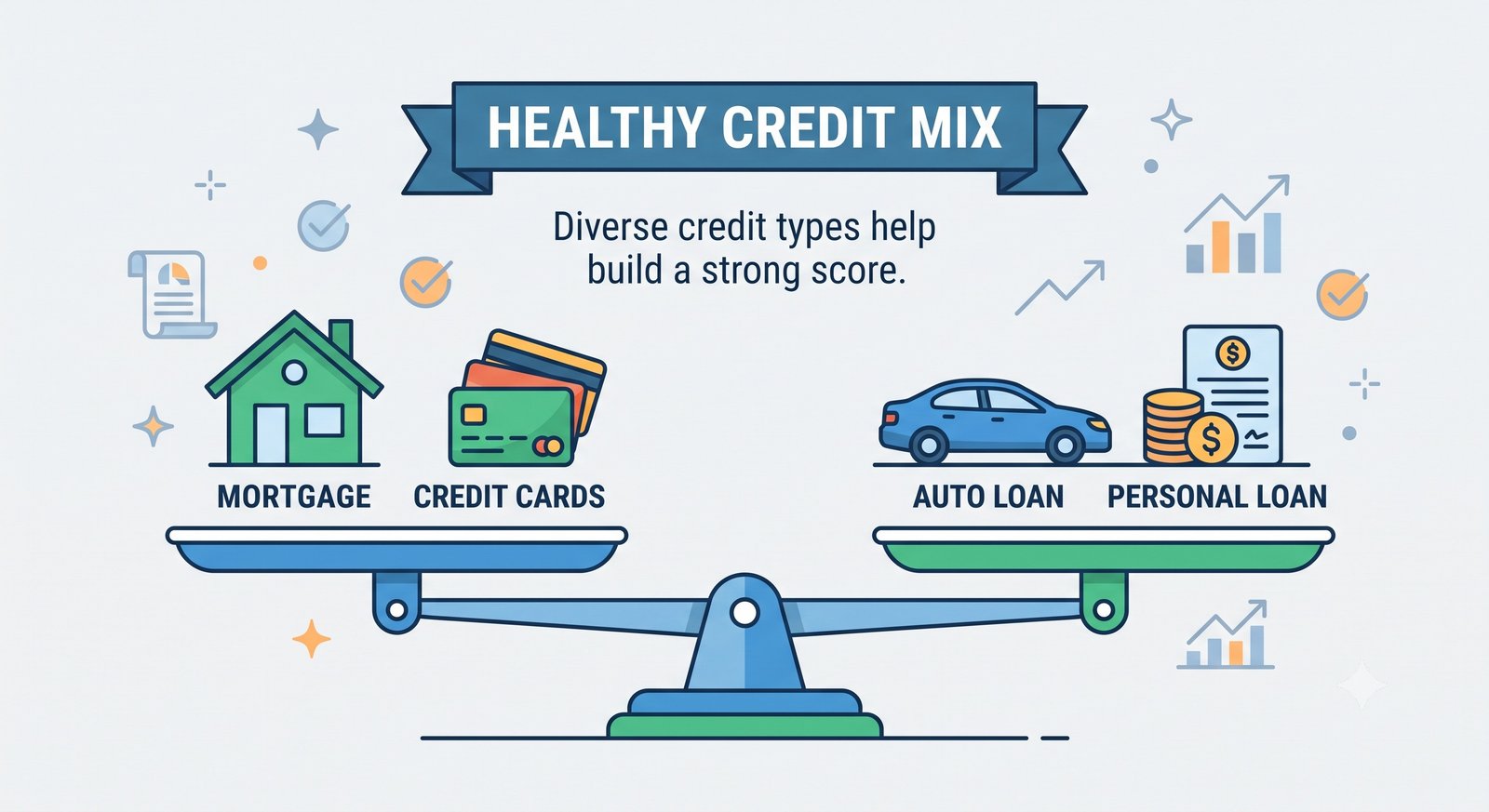
Accounting for roughly 10% of the proprietary scoring models, Credit Mix evaluates the structural diversity of the consumer's financial portfolio. Underwriters and lending institutions want to see empirical proof that a borrower can competently handle various types of complex debt structures simultaneously. A consumer who only possesses a single revolving credit card presents a slightly higher unknown risk profile than a sophisticated consumer successfully managing a 30-year fixed mortgage, a 60-month auto loan, and multiple revolving credit lines concurrently.
Credit accounts broadly fall into two distinct mechanical categories:
- Revolving Accounts: Instruments that allow the consumer to borrow flexibly up to a maximum limit, repay it, and borrow again fluidly. Examples include credit cards, retail store cards, and Home Equity Lines of Credit (HELOCs). These require disciplined, variable monthly payments.
- Installment Loans: Contracts for a massive, fixed principal amount distributed upfront, with a rigid, non-variable monthly amortization schedule over a set duration. Primary examples include residential mortgages, auto loans, student loans, and fixed personal loans.
While achieving a diverse portfolio mix is mathematically beneficial to pushing a score to its maximum potential, fiduciary experts strongly caution that consumers should never take out unnecessary installment loans and pay unnecessary, compounding interest strictly for the sake of improving this minor 10% category. Perfecting payment history and utilization provides vastly superior ROI.
5. New Credit Inquiries (10%): The Velocity of Credit Seeking
The final 10% of a standard credit score is determined by new credit activity, evaluating the velocity of credit-seeking behavior through Hard Inquiries. Whenever a consumer officially applies for a new line of credit, the prospective lender must pull their official credit file from a bureau to assess risk. This authorized action is permanently recorded as a "hard inquiry" or "hard pull."
Statistically, consumers who aggressively apply for multiple new credit accounts in a heavily compressed timeframe represent a drastically higher risk of default. Rapid, high-velocity credit-seeking behavior is historically recognized by algorithms as a severe red flag indicating underlying financial distress, impending job loss, or a massive cash flow crisis where the consumer is attempting to survive on borrowed capital.
A single hard inquiry will typically drop a credit score by 2 to 5 points. This mathematical penalty usually fades entirely within a few months, though the inquiry itself will legally remain visible on the credit report for up to two full years. Importantly, modern scoring algorithms are deeply intelligent and designed to recognize rational rate-shopping behavior. If a consumer is applying for a large installment loan like a mortgage or an auto loan, multiple hard inquiries originating from different lenders within a tightly clustered temporal window (usually 14 to 45 days, depending on the FICO version) will be mathematically grouped together through "deduplication logic" and treated as a single inquiry to prevent punishing the consumer for prudently seeking the best competitive interest rate. Note: This rate-shopping deduplication does not apply to credit card applications.
6. FICO Score vs. VantageScore 3.0: Structural Comparison
While the Fair Isaac Corporation (FICO) holds a near-monopoly in the mortgage underwriting space (used in over 90% of lending decisions), the three major credit bureaus (Equifax, Experian, TransUnion) jointly developed the VantageScore algorithm to compete. It is critical to understand the mechanical differences between the two, especially since most free consumer credit monitoring apps (like Credit Karma) provide VantageScores, which often differ significantly from the FICO scores lenders actually use.
| Algorithmic Metric | FICO Score 8 (Industry Standard) | VantageScore 3.0 (Consumer Tracking) |
|---|---|---|
| Minimum Credit Age Required | At least 6 months of credit history to generate a score. | Only 1 month of credit history required to generate a score. |
| Closed Accounts in Good Standing | Remains on report and benefits AAoA for 10 full years. | May be removed from AAoA calculation immediately upon closure. |
| Paid Collection Accounts | FICO 8 continues to penalize paid collections heavily. | VantageScore 3.0 entirely ignores collection accounts once paid in full. |
| Late Payment Impact | Treats all late payments severely, regardless of loan type. | Penalizes late mortgage payments much more severely than other debt types. |
7. Empirical Case Studies in Score Manipulation
To fully comprehend the mechanics of these algorithms, we must examine their application in specific, real-world credit scenarios.
Case Study 1: The Statement Date Illusion (The Hidden Utilization Trap)
Scenario: Michael earns $150,000 annually. He has a single credit card with a $10,000 limit. He runs all of his monthly living expenses ($8,000) through this card to earn travel points. Every month, strictly on the due date (the 25th), Michael pays the $8,000 balance down to $0. He has never paid a cent of interest. However, when he applies for a prime-rate mortgage, he is shocked to find his FICO score is an abysmal 660, disqualifying him from the lowest tier rates.
The Mechanics of Failure: Michael confused the Due Date with the Statement Closing Date. The credit card issuer snapshots the balance and reports it to the bureaus on the Statement Closing Date (which was the 20th). On the 20th of every month, Michael's balance was $8,000. Therefore, the credit bureaus calculated his utilization at 80% ($8,000 / $10,000). The FICO algorithm severely penalized him for maxing out his revolving credit, utterly blind to the fact that he pays it off five days later.
The Resolution: Michael alters his payment schedule. He begins paying $7,900 on the 18th (two days before the Statement Closing Date), allowing a minuscule $100 balance to report to the bureaus on the 20th. He pays the remaining $100 on the actual due date (the 25th). The bureaus now calculate his utilization at an elite 1%. Within 30 days, his FICO score surges by 85 points to 745.
Case Study 2: Strategic Rebuilding via "AZEO" After Delinquency
Scenario: Sarah suffered a severe illness two years ago, resulting in a 90-day late payment on a personal loan. Her score crashed from 750 to 580. She needs to lease an apartment in six months but property management companies require a 650 minimum score.
The Execution: Sarah cannot erase the 90-day late payment; it will remain on her file for 7 years. However, its mathematical penalty decays over time. To forcefully counteract the drag, she executes the AZEO (All Zero Except One) strategy. Sarah has four credit cards. She pays three of them down to absolute $0 balances before their statement dates. On the fourth card, she leaves a tiny $15 balance to report. This signals to the algorithm that she is actively using credit (better than 0% overall utilization), but doing so with absolute, microscopic control. By perfectly optimizing the 30% utilization category, she squeezes every available point out of the algorithm to offset the 35% payment history penalty. Within five months, combined with the time-decay of the late payment, her score successfully breaches 665.
8. Actionable Strategy Guide: Engineering an 800+ FICO Score
Mastering the algorithms behind credit scores requires treating your credit file not as a passive extension of your income, but as an active, strategic asset to be managed and engineered. Implement this step-by-step blueprint to force the algorithm into awarding top-tier points:
- Step 1: Eliminate Payment Volatility (Autopay). Since 35% of your score is dictated by payment history, human error is unacceptable. Configure absolute minimum automated payments on every credit card and loan you possess, drawing from a central checking account with a thick liquidity buffer. Even if you manually pay in full later, the autopay ensures a 30-day late mark is functionally impossible.
- Step 2: Micro-Manage Statement Dates (Utilization). Locate the exact "Statement Closing Date" (not the due date) for every revolving account. Pre-pay your balances 48 hours before this date to forcefully dictate the utilization ratio reported to the bureaus. Aim to keep aggregate utilization strictly between 1% and 9%.
- Step 3: Artificially Expand Limits (The Denominator). Utilization is a fraction (Balances / Limits). You can lower utilization by decreasing balances, or by actively increasing the limits. Every 6 to 12 months, request a Credit Limit Increase (CLI) from your card issuers. If they offer "soft pull" increases, accept them. If you double your credit limit, your utilization ratio mathematically halves instantly, boosting your score.
- Step 4: Protect the Anchor Account (Age of Credit). Identify your oldest active revolving credit account. This is the structural anchor of your Average Age of Accounts (AAoA). Never close this account. If it has an annual fee, downgrade it to a no-fee product. Place a small, recurring subscription (e.g., Netflix) on the card and set it to autopay to prevent the issuer from closing it due to inactivity.
- Step 5: Quarantine Hard Inquiries. Only apply for new credit when mathematically necessary. By allowing accounts to age naturally and severely limiting the pursuit of new, unnecessary credit, you perfectly secure the remaining 35% of the score. If you must rate-shop for a mortgage, compress all applications into a 14-day window.
Through disciplined, algorithmic adherence to these mathematical boundaries, any consumer can steadily construct and permanently maintain a top-tier credit profile, unlocking access to prime lending rates and premium institutional financial products.
9. Frequently Asked Questions (FAQ)
Q: Does checking my own credit score lower it?
Absolutely not. When you personally check your credit report through an app, a bank, or AnnualCreditReport.com, it is classified as a "Soft Inquiry" (or soft pull). Soft inquiries have zero mathematical impact on your credit score, regardless of how frequently you check them. Only "Hard Inquiries"—which occur when you explicitly apply for new credit and a lender evaluates your risk—penalize your score.
Q: Will paying off a collection account immediately fix my credit score?
Under older, widely used FICO models (like FICO 8), merely paying a collection account does not remove the derogatory mark; it simply changes the status to "Paid Collection." The severe mathematical penalty of having gone to collections remains. However, under newer models (like FICO 9, FICO 10, and VantageScore 3.0/4.0), paid collections are ignored and will instantly boost your score. If a lender uses FICO 8, you must negotiate a "Pay-For-Delete" agreement with the collection agency, where they agree to entirely remove the tradeline from your report in exchange for payment.
Q: Why did my credit score drop when I finally paid off my auto loan or mortgage?
This is a highly frustrating, counter-intuitive quirk of the credit algorithms. When you pay off a massive installment loan, that account is officially closed. By closing the loan, you eliminate an active, positive, on-time monthly payment from your current mix. Furthermore, you reduce your overall "Credit Mix" (if it was your only installment loan). The algorithm momentarily punishes you for having less active, diverse debt. This drop is usually temporary (15 to 30 points) and recovers organically over a few months.
Q: If I carry a small balance and pay interest every month, does it improve my score faster?
This is one of the most toxic, pervasive myths in personal finance. Carrying a balance and paying compounding interest to a bank does absolutely nothing to improve your credit score. The credit bureaus only care about the balance reported on the statement date (Utilization) and whether the minimum payment was made on time (Payment History). They do not track or reward you for paying interest. You should always pay your statement balance in full to avoid interest while still reaping 100% of the credit score benefits.
Q: How long does a bankruptcy stay on my credit report?
It depends on the legal structure of the bankruptcy. A Chapter 13 bankruptcy (which involves a court-mandated reorganization and partial repayment of debts) remains on your credit report for 7 years from the filing date. A Chapter 7 bankruptcy (which involves total liquidation and the wiping out of unsecured debts) remains on your credit report for a devastating 10 years from the filing date. During this time, accessing prime credit is virtually impossible, though the mathematical impact on the score lessens as the filing ages.
See also
- Loading related topics...