Debt Consolidation Strategies
The Definitive Guide to Restructuring Liabilities, Reducing Interest Burdens, and Achieving Financial Solvency
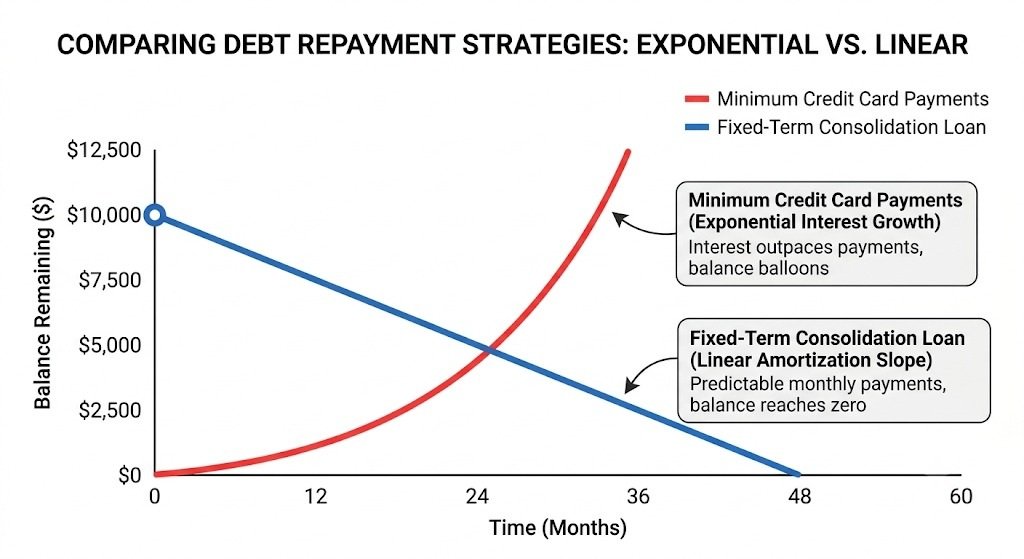
Debt consolidation is a sophisticated financial restructuring maneuver designed to streamline multiple concurrent liabilities into a single, manageable financial obligation. In the modern macroeconomic environment, characterized by the aggressive proliferation of unsecured revolving credit, "Buy Now, Pay Later" (BNPL) micro-loans, and dynamic risk-based pricing, retail consumers frequently find themselves managing a highly fragmented portfolio of debt. This fragmentation not only leads to administrative exhaustion but often traps borrowers in high-interest compounding cycles that mathematically erode their net worth over time.
At its core, debt consolidation is an arbitrage strategy. It capitalizes on the spread between the exorbitant interest rates charged on unsecured consumer debt (such as credit cards or payday loans) and the comparatively lower rates available through structured term loans, secured credit facilities, or promotional balance transfer offers. By systematically refinancing high-cost debt into a lower-cost vehicle, borrowers can accelerate principal reduction, improve their monthly liquidity, and establish a definitive timeline for achieving total solvency.
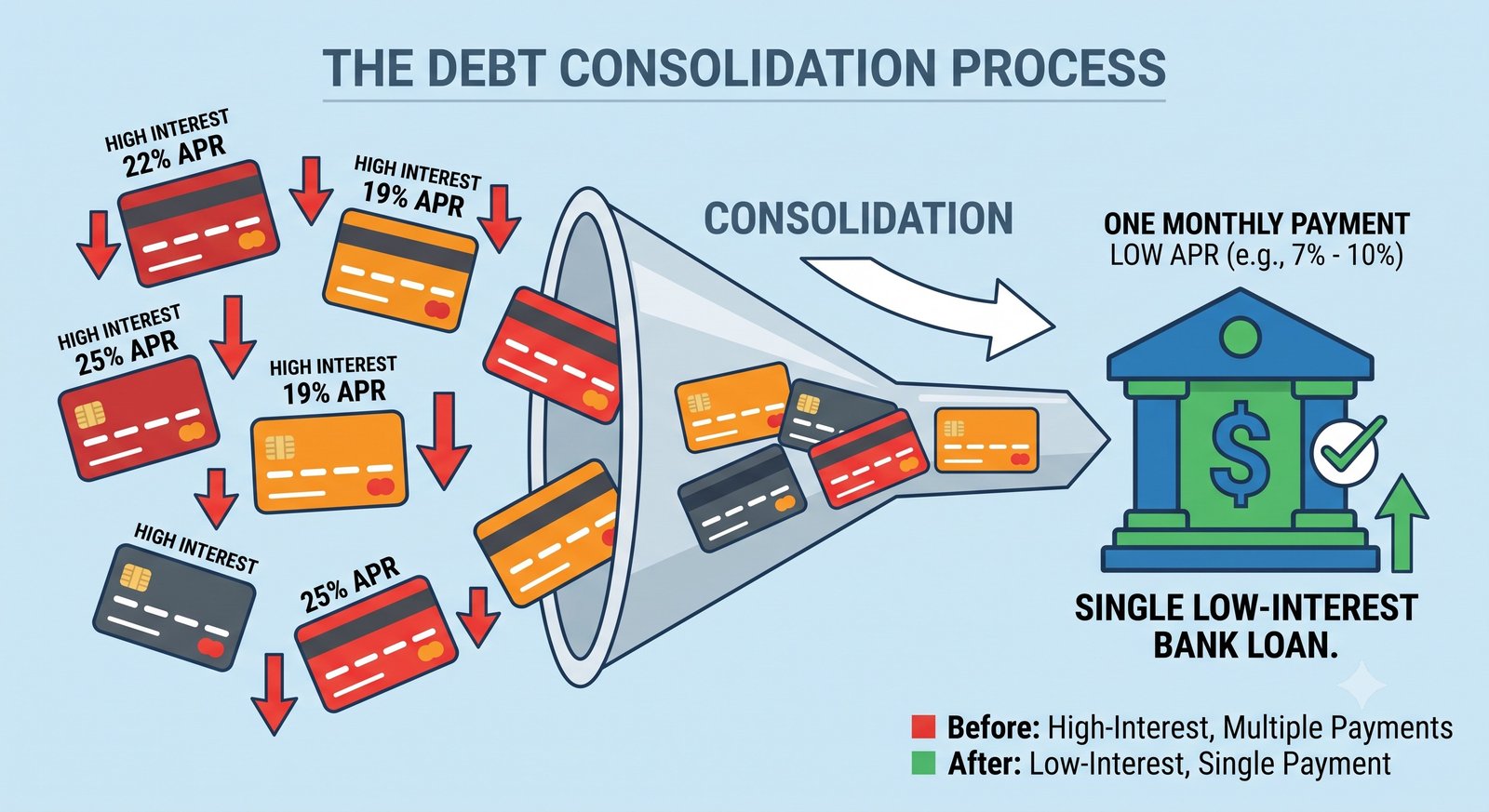
However, executing a successful debt consolidation strategy requires more than simply securing a new loan. It demands a rigorous understanding of the underlying mathematics, specifically the Weighted Average Interest Rate (WAIR), the macroeconomic factors influencing borrowing costs, and the acute behavioral finance risks associated with freeing up existing credit lines. Without stringent behavioral modifications, consolidation can tragically lead to "debt recidivism," where a borrower accumulates new debt on their cleared credit cards while simultaneously servicing the new consolidation loan—a scenario known in the financial industry as "debt doubling."
The Mathematics of Consolidation: Calculating Your WAIR
Before pursuing any consolidation facility, a borrower must quantify their existing baseline. The fundamental metric used to evaluate a fragmented debt portfolio is the Weighted Average Interest Rate (WAIR). Unlike a simple average, WAIR accurately reflects the proportional impact of each loan's balance against its specific Annual Percentage Rate (APR).
The formula for WAIR is expressed as:
$WAIR = \sum_{i=1}^{n} (r_i \times \frac{B_i}{B_{total}})$
Where $r_i$ represents the interest rate of the individual debt, $B_i$ is the outstanding balance of that specific debt, and $B_{total}$ is the sum of all outstanding debt balances. If a proposed consolidation loan offers an Effective Annual Rate (EAR)—factoring in origination fees and closing costs—that is strictly less than the calculated WAIR, the consolidation represents a mathematically sound restructuring.
For example, consider a portfolio consisting of a ₹1,00,000 credit card balance at 36% APR and a ₹3,00,000 personal loan at 14% APR. The simple average of these rates is 25%. However, because the lower-rate loan carries a significantly heavier balance, the true mathematical burden (the WAIR) is only 19.5%. A borrower incorrectly using the simple average might accept a consolidation loan at 22%, mistakenly believing they are saving money, when in reality, they are increasing their overall cost of capital.
Macroeconomic Influences on Consolidation Feasibility
Debt consolidation does not occur in a vacuum; it is deeply tethered to the prevailing macroeconomic environment. The feasibility and pricing of consolidation loans are dictated by central bank monetary policies, yield curves, and systemic liquidity. When a central bank (such as the Federal Reserve or the Reserve Bank of India) engages in quantitative tightening and raises benchmark interest rates (like the Repo Rate or the Fed Funds Rate), the cost of capital across the entire financial system escalates.
In a high-interest-rate environment, the spread between a borrower's existing fixed-rate debt and newly originated consolidation loans narrows significantly. Banks and Non-Banking Financial Companies (NBFCs) price unsecured personal loans using a formula comprising the Risk-Free Rate + Operating Premium + Default Risk Premium. If the risk-free rate spikes, the baseline cost of the consolidation loan jumps accordingly. Consequently, during periods of rapid inflation and monetary tightening, executing a mathematically favorable consolidation becomes exceptionally challenging, making specialized vehicles like secured loans or promotional 0% balance transfers highly sought-after, yet fiercely heavily underwritten.
Primary Debt Consolidation Architectures
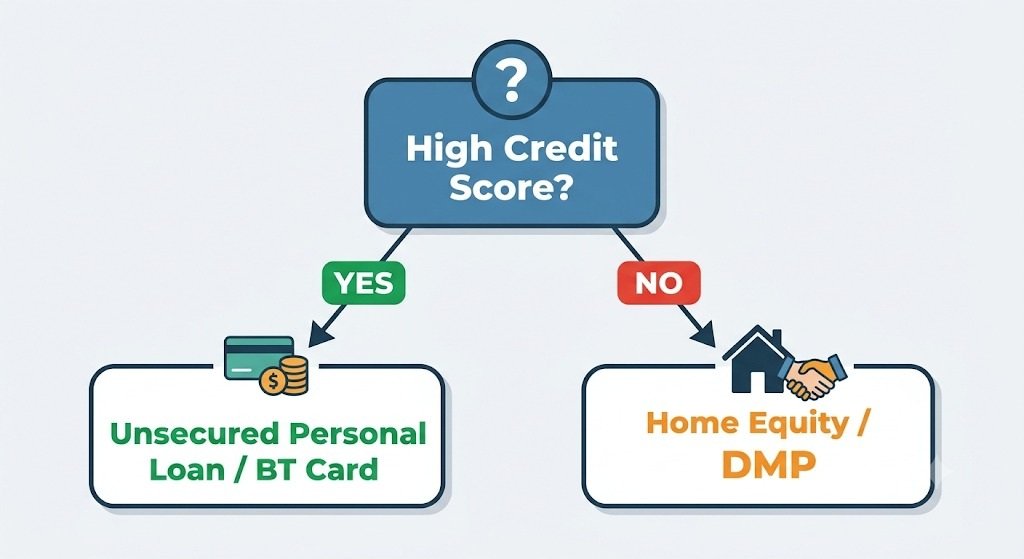
The financial markets offer four primary vehicles for executing a debt consolidation strategy. The optimal choice depends entirely on the borrower's credit profile, existing liquidity, asset ownership, and discipline.
- 0% APR Balance Transfer Credit Cards: This strategy involves moving existing high-interest debt onto a new credit card that offers a promotional 0% Annual Percentage Rate for a highly defined period (typically 12 to 21 months). The primary advantage is the total elimination of interest accumulation during the promotional window, allowing 100% of payments to attack the principal balance. The critical risks involve upfront balance transfer fees (usually 3% to 5% of the transferred amount) and punitive retroactive interest clauses if the debt is not fully liquidated before the promotional period expires.
- Unsecured Debt Consolidation Loans: These are fixed-rate, fixed-term installment loans provided by banks, credit unions, or fintech lenders. The borrower receives a lump sum to pay off fragmented creditors, replacing revolving credit with a predictable, amortizing schedule. Because these loans lack collateral, lenders rely heavily on FICO/CIBIL scores and Debt-to-Income (DTI) ratios. Borrowers must be acutely aware of origination fees, which are often deducted from the loan disbursement, effectively raising the true cost of borrowing.
- Secured Consolidation (HELOCs and Home Equity Loans): For homeowners with sufficient equity, collateralizing the debt is mathematically the cheapest consolidation route. By securing the loan against real estate, the lender's risk profile drops dramatically, resulting in significantly lower APRs compared to unsecured options. A Home Equity Line of Credit (HELOC) acts as a revolving facility, while a Home Equity Loan provides a lump sum. The existential risk here is severe: defaulting on unsecured credit card debt ruins your credit score; defaulting on a secured home equity loan results in foreclosure and the loss of your primary residence. Furthermore, recent tax reforms in many jurisdictions have eliminated the tax-deductibility of interest on home equity loans unless the funds are explicitly used for home improvements.
- Debt Management Plans (DMPs): Orchestrated by non-profit credit counseling agencies, DMPs are designed for borrowers whose credit profiles have deteriorated to the point where they cannot qualify for new commercial loans. The agency negotiates directly with creditors to lower interest rates and waive penalty fees, consolidating payments into one single monthly deposit made to the agency. While DMPs do not reduce the principal owed (unlike debt settlement), they effectively restructure the amortization. Entering a DMP requires closing existing credit lines, which temporarily damages the borrower's credit utilization ratio and overall credit score.
Realistic Case Studies in Debt Restructuring
To fully grasp the mechanics, pitfalls, and successes of debt consolidation, we must examine these strategies through quantitative real-world applications.
Case Study 1: The Balance Transfer Horizon Trap
Arjun has accumulated ₹4,00,000 in credit card debt distributed across three cards, with a WAIR of 38% annually. His minimum payments are consuming his liquidity, covering barely any principal. Arjun applies for a premium Balance Transfer Credit Card offering a 0% APR for 12 months, carrying a 4% upfront balance transfer fee.
He transfers the full ₹4,00,000. A fee of ₹16,000 is immediately added to his new principal, making his starting balance ₹4,16,000. Because the interest is 0%, all of his monthly payments will directly reduce this principal. Mathematically, to emerge debt-free before the promotional period ends, Arjun must pay exactly ₹34,666 per month ($4,16,000 \div 12$).
However, Arjun lacks a disciplined budget. He continues to pay only ₹15,000 per month. At the end of the 12-month promotional window, he has paid down ₹1,80,000, leaving a residual balance of ₹2,36,000. On month 13, the promotional rate expires, and the card's standard "go-to" rate of 42% APR aggressively kicks in. Because the residual balance is now subject to compounding interest at a higher rate than his original debt, Arjun is caught in the horizon trap. The strategy failed because his liquidity capability (₹15,000/month) did not match the strict amortization horizon (12 months) of the financial instrument.
Case Study 2: Strategic Unsecured Term Amortization
Meera holds ₹6,00,000 in fragmented debt: a personal loan of ₹2,00,000 @ 18% and multiple retail credit cards totaling ₹4,00,000 @ 34%. Her calculated WAIR is 28.6%. She is currently paying roughly ₹25,000 across minimum payments, struggling to track due dates, and facing late fees.
Meera opts for a 48-month unsecured Debt Consolidation Loan. Because her credit score is strong (760), she qualifies for a fixed APR of 14% with a 2% origination fee. The bank originates a loan for ₹6,12,244 (to cover the ₹6,00,000 payoff plus the ₹12,244 fee embedded into the principal). The lender directly disburses the funds to her creditors, ensuring the revolving accounts are brought to zero.
Her new fixed monthly payment drops to ₹16,730. Not only has Meera reduced her monthly cash outflow by over ₹8,000, but she has also secured a fixed, predictable amortization schedule. Because she has cut up her old credit cards (preventing debt doubling) and halved her interest rate, she will save hundreds of thousands of rupees over the next four years compared to making minimum revolving payments. Her credit score initially dips due to the hard inquiry and new account origination but rapidly climbs over the next six months as her revolving credit utilization ratio drops to zero.
| Consolidation Vehicle | Ideal Borrower Profile | Primary Advantage | Critical Disadvantage / Risk |
|---|---|---|---|
| 0% Balance Transfer Card | Excellent credit; High monthly liquidity to clear debt rapidly (12-21 months). | 100% of payments target principal; zero interest accrual. | Upfront transfer fees (3-5%); retroactive interest cliffs if unpaid by deadline. |
| Unsecured Personal Loan | Good credit; Needs predictable, fixed amortization over 3 to 5 years. | Fixed monthly payments; definitive end date; no collateral required. | Origination fees dilute loan value; rates rely heavily on unsecured credit scores. |
| Home Equity Loan / HELOC | Homeowners with substantial equity; Large debt volumes requiring extended terms. | Lowest absolute interest rates; extended repayment horizons (10-20 years). | Converts unsecured debt to secured debt; total risk of home foreclosure upon default. |
| Debt Management Plan (DMP) | Struggling borrowers facing default; Poor credit preventing commercial refinancing. | Professional creditor negotiation; waiving of late fees; stabilized interest. | Requires closure of all revolving credit lines; damages short-term credit profile. |
Actionable Strategy Guide: Executing a Flawless Consolidation
Achieving structural financial reform requires precise, methodical execution. Treat debt consolidation not as a magic cure, but as a rigid corporate restructuring. Follow these sequential steps to ensure mathematical and behavioral success.
- Step 1: Perform a Comprehensive Portfolio Audit. Before applying for any facility, catalog every single liability. Document the creditor name, outstanding principal balance, exact APR, minimum monthly payment, and any early termination/prepayment penalty clauses. Calculate your exact total debt load and your overall Weighted Average Interest Rate (WAIR).
- Step 2: Optimize Your Credit Profile Pre-Application. Consolidation rates are highly sensitive to credit scores. Before triggering a hard inquiry, verify your credit reports across all major bureaus (Experian, Equifax, TransUnion, CIBIL). Dispute any inaccuracies. If possible, pay down a small balance to drop your Credit Utilization Ratio (CUR) below the critical 30% threshold to secure a lower interest tier.
- Step 3: Solicit Pre-Approvals via Soft Pulls. Do not blindly apply for loans, as multiple hard inquiries will decimate your credit score. Utilize platforms and lenders that offer "pre-qualification" or "soft pull" rate checks. This allows you to evaluate real APRs, origination fees, and repayment terms without damaging your credit profile.
- Step 4: Execute a Net-Benefit Mathematical Analysis. Compare the prospective consolidation loan against your existing WAIR. Crucially, factor in all transaction costs. Add the balance transfer fee or loan origination fee to the new loan principal. Calculate the total interest paid over the life of the new term versus the status quo. Only proceed if the Effective Annual Rate (EAR) proves a definitive cost reduction.
- Step 5: Enact Strict Behavioral Ring-Fencing. This is the failure point for 70% of consolidators. Once the consolidation loan clears your revolving credit card balances, you are left with zero balances and thousands in available credit. Do not use those cards. Lock them in a safe, freeze them via your banking app, or delete them from your digital wallets. Utilizing freed-up credit while servicing a consolidation loan is financial suicide.
Frequently Asked Questions (FAQs)
Q: Does debt consolidation permanently damage my credit score?
In the immediate short term, you will likely see a minor dip in your score. Applying for a consolidation loan requires a hard inquiry, which drops your score by a few points. Additionally, opening a new credit account reduces your "average age of credit" metric. However, in the medium to long term, debt consolidation aggressively improves your score. By using an installment loan to pay off revolving credit cards, your Credit Utilization Ratio (the second most heavily weighted factor in FICO and VantageScore algorithms) immediately drops to zero percent, leading to a substantial score boost.
Q: Should I close my old credit cards after consolidating their balances?
Generally, no. Closing old credit cards removes their available credit limit from your overall profile, which immediately spikes your overall Credit Utilization Ratio on any remaining debt. Furthermore, closing your oldest accounts eventually deletes their rich payment history, shortening your average credit age. Unless a specific card charges an exorbitant annual fee, or you lack the behavioral discipline to stop using the cleared card, it is mathematically wiser to cut the physical card up and leave the account open and dormant.
Q: What is the exact difference between Debt Consolidation and Debt Settlement?
These are fundamentally opposite mechanisms. Debt Consolidation is the process of taking out a new legal loan to pay your creditors in full (100% of the principal), simply restructuring the interest rate and timeline. It protects your credit. Debt Settlement, conversely, involves intentionally defaulting on your payments, holding cash in escrow, and negotiating with creditors to accept a lump sum payout that is significantly less than what you owe (e.g., settling a $10,000 debt for $4,000). Debt settlement will catastrophically destroy your credit score, invite aggressive litigation from creditors, and the forgiven debt volume is often legally considered taxable income by the IRS or relevant tax authority.
Q: Are origination fees on personal consolidation loans negotiable?
In the automated retail lending sector, origination fees are rarely negotiable as they are hardcoded into algorithmic risk-based pricing models. Lenders use these fees (typically 1% to 8% of the loan value) to immediately monetize the transaction, hedging against the risk that you might pay the loan off early, thereby depriving them of interest revenue. The only way to "negotiate" is to shop across multiple competing lenders or credit unions prior to accepting terms, seeking the lowest Effective Annual Rate (EAR) that combines both the APR and the fee structure.
Q: Can I consolidate my federal or private student loans into a general personal loan or balance transfer card?
While technically possible with certain private lenders, it is almost universally a disastrous financial decision. Federal student loans carry unique, legally protected statutory benefits, including income-driven repayment plans, extended deferment and forbearance options, and avenues for total public service loan forgiveness. The moment you pay off a federal student loan using a commercial personal loan, you permanently strip away all of these federal protections, converting highly flexible debt into rigid commercial debt.
See also
- Loading related topics...