Debt Snowball vs Avalanche
1. The Macroeconomic Context of Consumer Debt Management
In the modern financial landscape, consumer debt has evolved from a rare necessity to a ubiquitous element of personal finance. With the proliferation of unsecured credit facilities—ranging from high-yield credit cards and personal loans to modern "Buy Now, Pay Later" (BNPL) micro-financing—individuals frequently find themselves managing multiple distinct debt profiles simultaneously. This fragmentation of debt, characterized by varying principal balances, compounding interest rates, and distinct amortization schedules, creates a highly complex cash flow challenge.
When a borrower reaches a critical mass of debt where monthly minimum payments consume a disproportionate percentage of their discretionary income, standard repayment ceases to be effective. This threshold requires the implementation of an accelerated, structured debt elimination strategy. The financial planning industry generally recognizes two primary, diametrically opposed methodologies for accelerated debt elimination: The Debt Snowball Method and The Debt Avalanche Method.
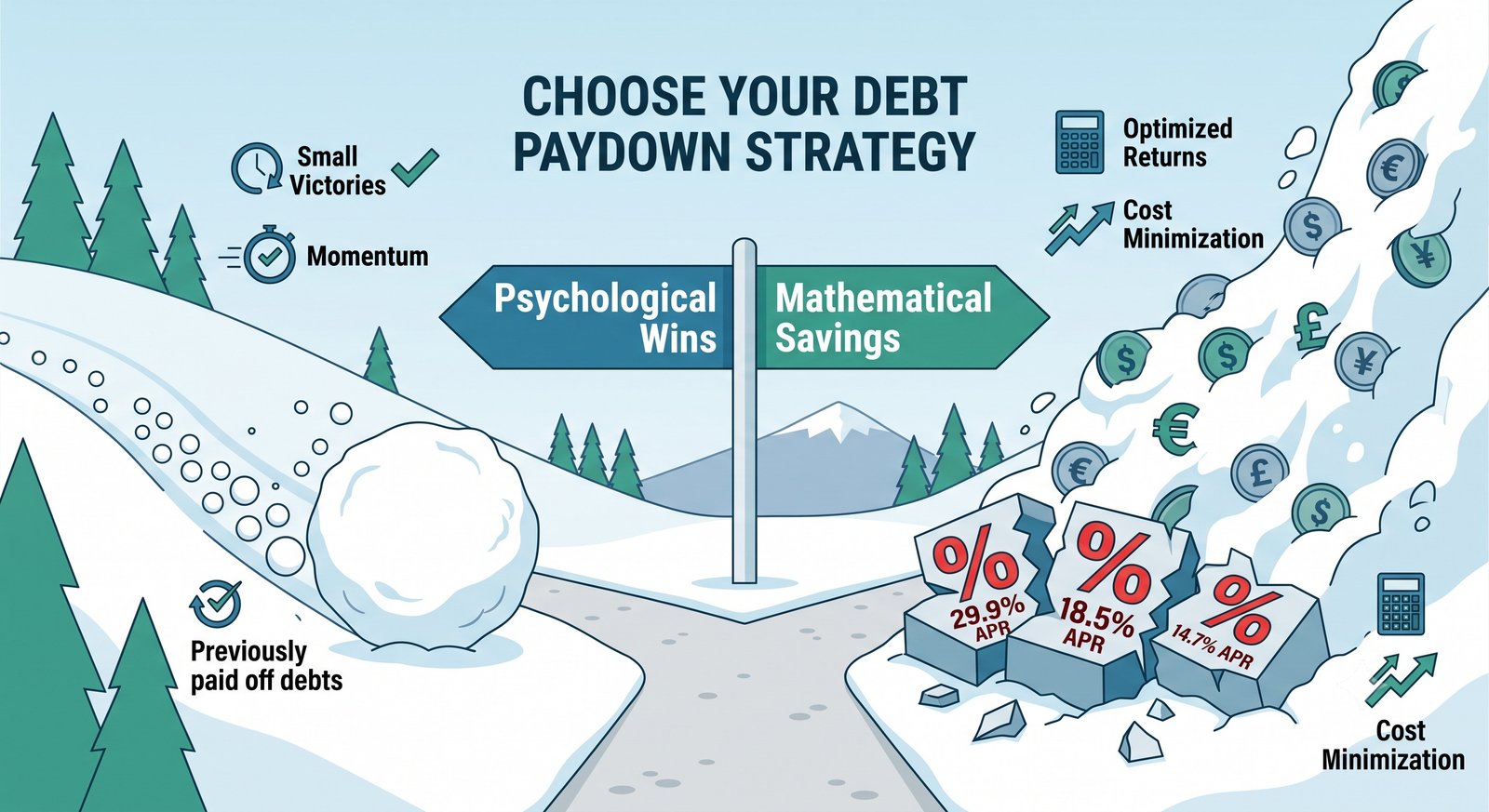
While both strategies share the foundational rule of maintaining minimum monthly payments across all active credit accounts, they diverge radically in how they allocate surplus capital (extra payments). This divergence is not merely a mathematical discrepancy; it represents a fundamental debate between classical economic theory (which assumes humans act as perfectly rational, math-optimizing agents) and behavioral economics (which recognizes that humans are emotional, motivation-driven creatures susceptible to psychological fatigue).
2. Deep-Dive: The Mechanics of the Debt Snowball Method
The Debt Snowball method, widely popularized by personal finance personalities and behavioral economists, prioritizes psychological momentum over mathematical efficiency. The strategy demands that the borrower completely ignores the Annual Percentage Rate (APR) attached to their debts. Instead, the focus is placed entirely on the total outstanding principal balance.
The mechanics are executed through a strict sequential process. First, the borrower lists all non-mortgage debts in ascending order, from the smallest total balance to the largest total balance. Second, the borrower ensures that the minimum mandated payment is made on every single account to prevent defaults, late fees, and credit score degradation. Third, the borrower allocates every available dollar of surplus cash flow directly toward the principal of the smallest debt until it is completely eradicated.
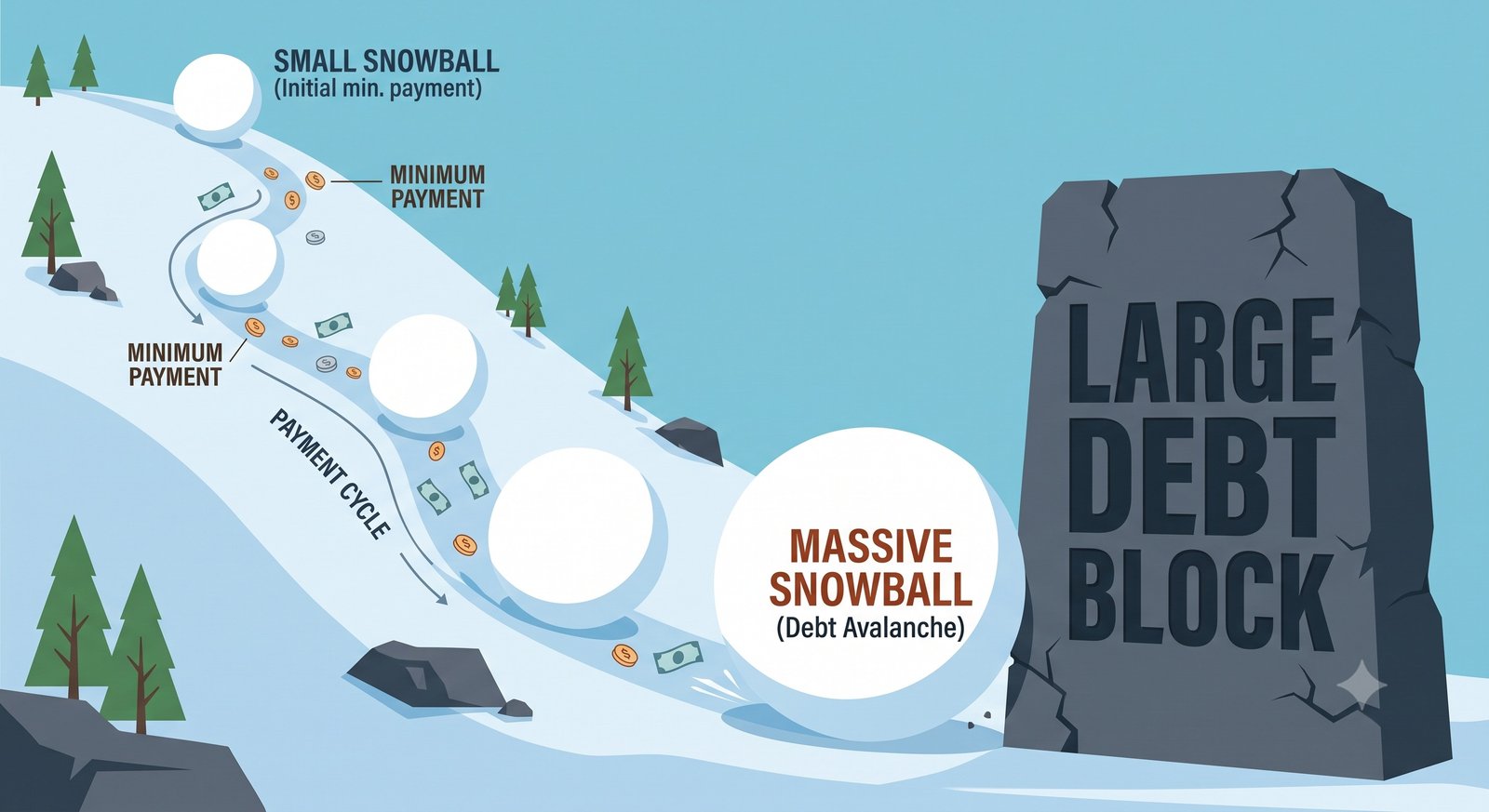
Once that first, smallest debt is eliminated, the psychological magic of the "Snowball" effect activates. The borrower takes the minimum payment that was previously being routed to the first debt, adds it to their surplus cash pool, and aggressively attacks the second-smallest debt. As each subsequent debt is paid off, the freed-up cash flow rolls into the next payment, creating an increasingly massive "snowball" of capital that accelerates the repayment of the larger, final debts.
- Behavioral Economics Justification: Human beings suffer from "decision fatigue" and require positive reinforcement. A landmark study published in the Journal of Consumer Research found that consumers who successfully closed out a small debt account experienced a significant surge in motivation, making them substantially more likely to stick to a long-term debt elimination plan.
- The "Nearness to Goal" Effect: Closing a small $500 balance provides an immediate, tangible victory. This dopamine release trains the brain to associate debt repayment with success, overriding the delayed gratification fatigue that often causes borrowers to abandon their financial plans.
- Cash Flow Simplification: By rapidly eliminating the smallest accounts, the borrower reduces the sheer number of creditors they must interact with. Fewer accounts mean a reduced cognitive load, fewer due dates to track, and a lower probability of accidental late payments.
3. Deep-Dive: The Mechanics of the Debt Avalanche Method
In stark contrast to the emotional approach of the Snowball, the Debt Avalanche method (also known as "debt stacking") relies entirely on pure, unadulterated mathematical optimization. This strategy is built on classical financial theory, which dictates that a borrower should seek to minimize the total aggregate interest paid over the lifetime of the debt portfolio.
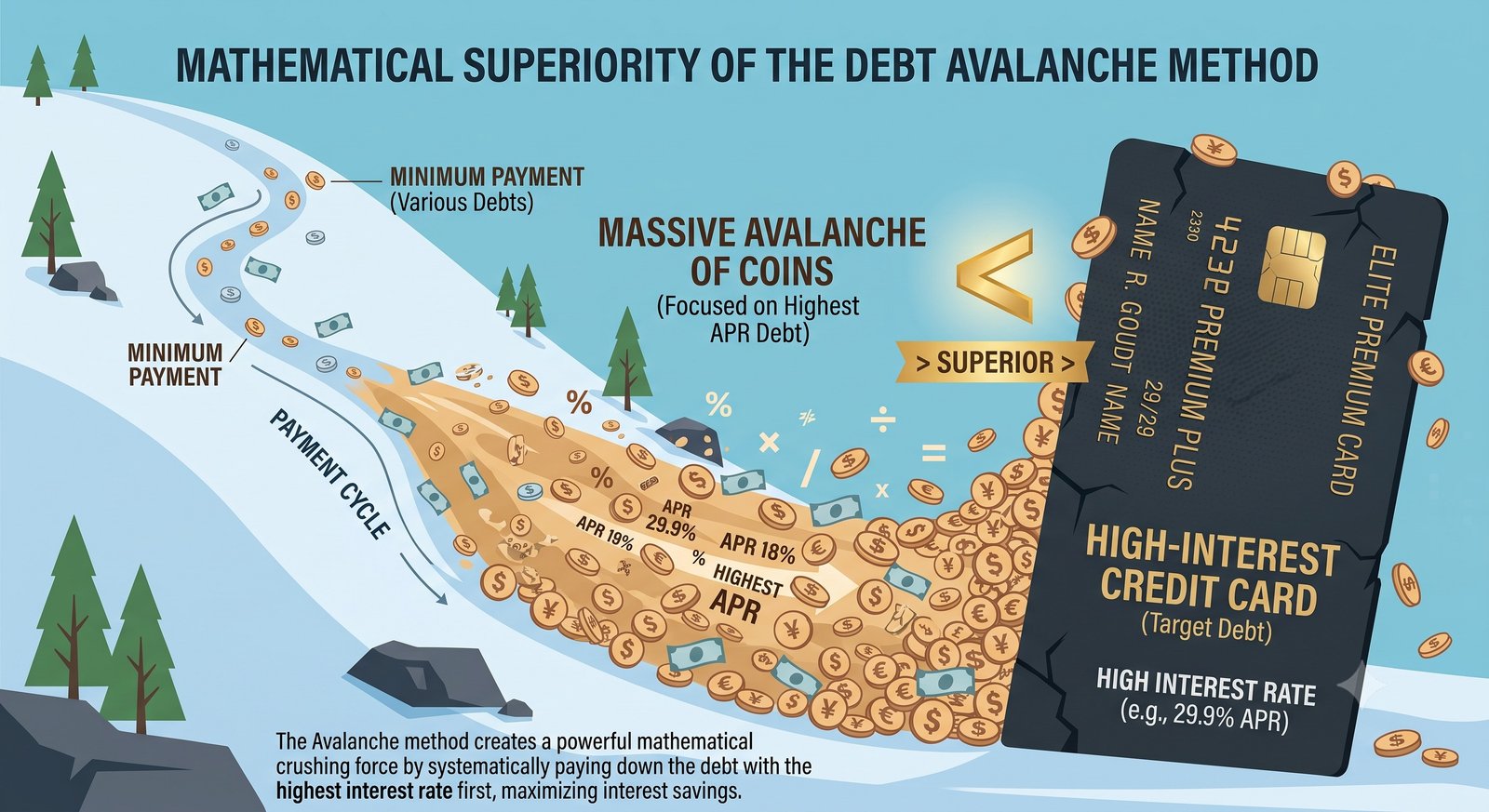
The execution of the Avalanche method ignores the principal balance entirely. Instead, the borrower lists all debts in descending order based strictly on their Annual Percentage Rate (APR)—from the highest interest rate to the lowest. After making the minimum payments on all active accounts, the borrower channels all surplus cash flow forcefully into the debt carrying the highest APR. Once the most toxic, highest-interest debt is destroyed, the total payment amount rolls down the mountain, striking the debt with the second-highest APR.
To understand why the Avalanche method is mathematically superior, one must understand how revolving credit (like credit cards) accrues interest. Interest is generally calculated using the Average Daily Balance (ADB) method. The daily periodic rate is determined by dividing the APR by 365. Every day, the outstanding principal is multiplied by this daily rate, and that microscopic interest charge is added to the balance, compounding relentlessly.
Mathematical Proof of Avalanche Superiority: Assume you have $100 to apply as an extra payment. If you apply that $100 to a debt with a 24% APR, you are effectively saving $24 in annualized interest. If you apply that same $100 to a debt with a 5% APR, you only save $5 in annualized interest. The Avalanche method ensures that every surplus dollar deployed yields the absolute maximum Return on Investment (ROI) by neutralizing the highest potential future interest charges.
- Cost Minimization: By attacking the highest interest rates first, the Avalanche method guarantees the absolute lowest Total Cost of Credit (TCC). It strips away the bank's ability to compound interest at egregious rates.
- Speed to Freedom: Because less of the borrower's future money is cannibalized by interest payments, more capital inherently flows toward the principal month over month. This mathematical efficiency means the Avalanche method will mathematically always result in a faster total debt-free date than the Snowball method, assuming all cash flow remains constant.
- The Psychological Trap: The primary point of failure for the Avalanche method is emotional attrition. If the highest-interest debt also happens to be a massive balance (e.g., a $25,000 credit card at 22%), it may take years of grueling extra payments to close that single account. The borrower experiences no "quick wins" and may lose motivation before the mathematical benefits are realized.
4. Realistic Case Study 1: The Psychological Victory (Snowball)
Let us examine the practical application of the Debt Snowball method through the financial profile of a fictional borrower, Sarah. Sarah is overwhelmed by the sheer number of bills she receives every month. She has a strict budget that allows for exactly $350 in surplus cash to throw at her debt each month, on top of her minimum payments.
Sarah's Debt Portfolio:
- Medical Bill: Balance $500 | Minimum Payment: $50 | APR: 0%
- Store Credit Card: Balance $1,200 | Minimum Payment: $35 | APR: 24.9%
- Auto Loan: Balance $8,000 | Minimum Payment: $250 | APR: 6.5%
- Student Loan: Balance $15,000 | Minimum Payment: $150 | APR: 5.8%
Under the Debt Snowball strategy, Sarah orders her debts by balance, completely ignoring the terrifying 24.9% APR on her store card. Her target sequence is: Medical Bill -> Store Card -> Auto Loan -> Student Loan.
The Execution:
- Month 1: Sarah pays all minimums ($485 total). She takes her $350 surplus and applies it entirely to the $500 Medical Bill. With the $50 minimum + $350 extra, she pays $400 against it. The balance drops to $100.
- Month 2: Sarah applies $100 to kill the Medical Bill completely. She has $250 of her surplus left. She rolls that $250 onto the Store Card. The psychological high of eliminating a creditor in just two months gives her massive relief.
- Month 3 and Beyond: The $50 minimum payment from the dead Medical Bill is now added to her snowball. Her new surplus attacking power is $400/month. She aggressively attacks the $1,200 Store Card, eliminating it in about three more months. By Month 6, she has eliminated 50% of her creditors, radically reducing her financial stress, even though it was not the mathematically optimal route.
5. Realistic Case Study 2: The Mathematical Optimization (Avalanche)
Now let us examine the Debt Avalanche method using a borrower named David. David is highly analytical, uses spreadsheets to track his net worth, and refuses to let banks profit off him unnecessarily. He has the exact same debt profile and the exact same $350 surplus cash as Sarah.
David's Debt Portfolio (Same as above):
- Medical Bill: Balance $500 | Minimum Payment: $50 | APR: 0%
- Store Credit Card: Balance $1,200 | Minimum Payment: $35 | APR: 24.9%
- Auto Loan: Balance $8,000 | Minimum Payment: $250 | APR: 6.5%
- Student Loan: Balance $15,000 | Minimum Payment: $150 | APR: 5.8%
Under the Debt Avalanche strategy, David orders his debts strictly by APR, ignoring the total balances. His target sequence is: Store Card (24.9%) -> Auto Loan (6.5%) -> Student Loan (5.8%) -> Medical Bill (0%).
The Execution:
- Month 1: David pays all minimums. He takes his entire $350 surplus and fires it at the Store Card. Combining this with the $35 minimum, he makes a $385 payment against the toxic 24.9% debt. Because the Medical Bill is at 0%, he pays absolutely nothing extra on it, logically utilizing the free loan.
- Month 2 through 4: David violently attacks the Store Card. By Month 4, it is completely annihilated. By eliminating the 24.9% APR first, David prevents hundreds of dollars in compounding interest from ever forming on his ledger.
- Month 5 and Beyond: With the Store Card dead, David rolls the $35 minimum payment into his surplus pool (now $385/month extra). He skips over the $500 Medical Bill (because it's still at 0% interest) and begins attacking the $8,000 Auto Loan (6.5%).
- The Result: By ignoring the emotional urge to clear the small Medical Bill, David keeps that 0% money working for him longer. At the end of his debt-free journey, David will finish paying off his portfolio weeks earlier than Sarah, and will have preserved hundreds of dollars in wealth that Sarah surrendered to the bank in interest charges.
6. Structured Comparison: Analyzing the Trade-Offs
| Evaluation Metric | Debt Snowball Method | Debt Avalanche Method |
|---|---|---|
| Primary Sorting Rule | Lowest Principal Balance to Highest Principal Balance | Highest Interest Rate (APR) to Lowest Interest Rate |
| Total Interest Paid | Higher (Mathematically sub-optimal) | Lowest Possible (Mathematically optimal) |
| Time to Debt-Free | Slightly longer total duration | The absolute fastest possible timeline |
| Psychological Momentum | Extremely High (Rapid early victories trigger dopamine responses) | Low to Moderate (Prone to fatigue if highest APR debt has a massive balance) |
| Best Suited For... | Individuals overwhelmed by multiple bills who need immediate motivation and cash flow simplification. | Highly disciplined individuals with analytical mindsets who prioritize wealth preservation. |
7. Actionable Strategy Guide: Executing Your Repayment Plan
Implementing an accelerated debt repayment strategy requires precise organization. Follow this step-by-step framework to transition from theory to execution.
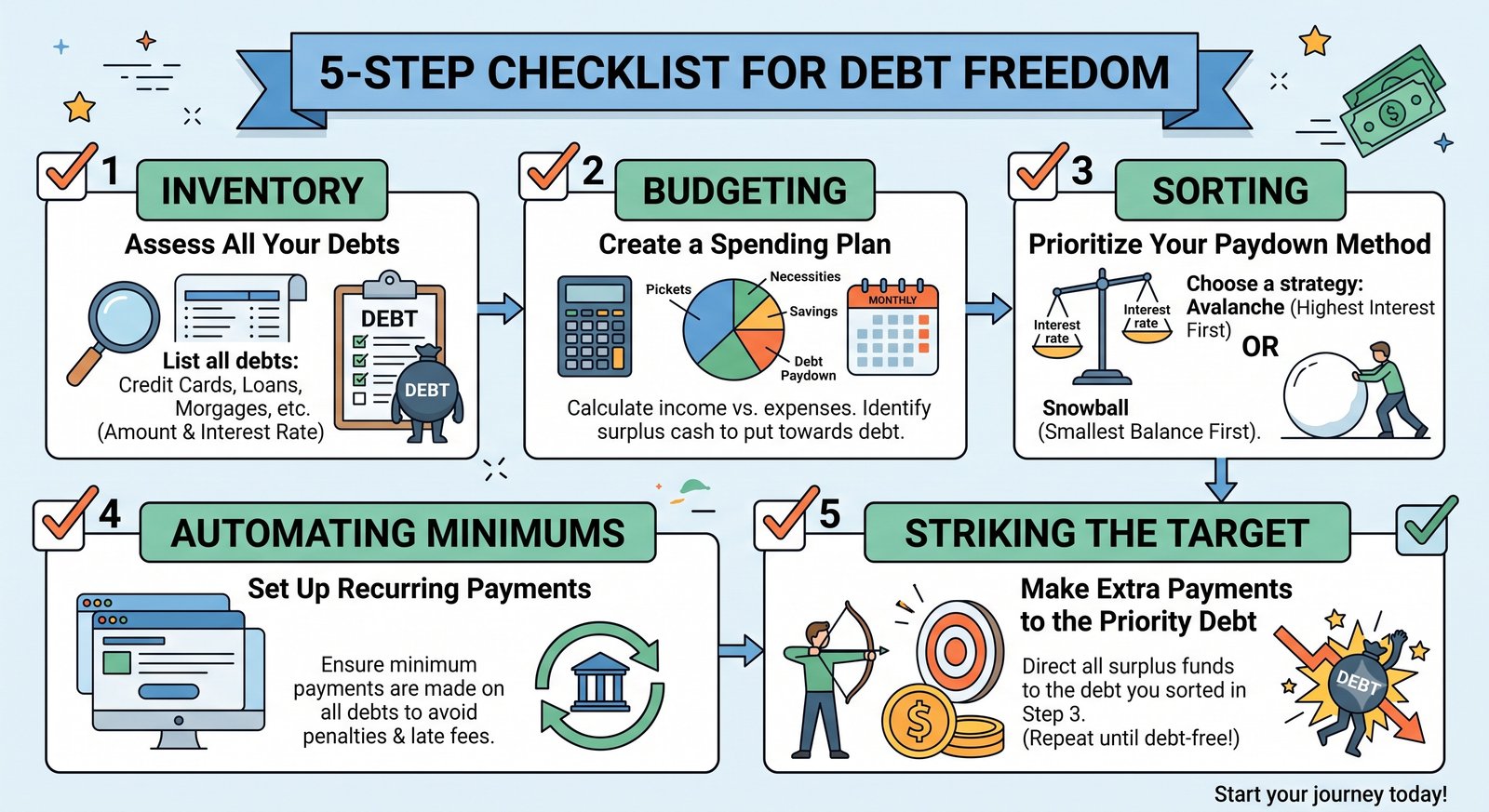
- Step 1: Perform a Comprehensive Debt Inventory. You cannot manage what you do not measure. Open a spreadsheet and catalog every single liability. For each account, record the Creditor Name, Total Outstanding Balance, Minimum Monthly Payment, and current Annual Percentage Rate (APR).
- Step 2: Calculate Your Absolute Surplus Cash. Audit your monthly budget. Deduct your absolute essential living expenses (housing, utilities, basic food, insurance) and your total minimum debt payments from your net income. The remaining amount is your "Surplus Combat Cash." Be realistic—if you strip your budget too bare, you will inevitably relapse into credit card usage for emergencies.
- Step 3: Choose Your Methodology & Sort. Based on your personality type (emotional vs. analytical), choose either Snowball or Avalanche. Sort your spreadsheet accordingly. If you choose Snowball and two balances are identical, rank the one with the higher APR first. If you choose Avalanche and two APRs are identical, rank the one with the smaller balance first.
- Step 4: Automate the Minimums. Set up automatic bank transfers for the minimum payments on all accounts *except* the primary target account. This guarantees you will never suffer a late fee or credit ding due to forgetfulness while your attention is focused elsewhere.
- Step 5: Manually Attack the Target. Every payday, take your precise Surplus Combat Cash and manually log in to pay the targeted account. The act of manually making this large payment reinforces the behavioral shift required to sustain the journey.
- Step 6: Deploy the Hybrid "Snow-alanche" (Optional). If you are mathematically inclined but psychologically fatigued, utilize a hybrid approach. If you have several tiny "nuisance" debts (e.g., three $100 balances), knock them out instantly using the Snowball method to clear your mental bandwidth. Once the clutter is gone, immediately pivot your entire remaining strategy strictly to the Avalanche method to optimize the remaining large balances.
Frequently Asked Questions (FAQs)
Q: What should I do if two of my debts have the exact same interest rate when using the Avalanche method?
If you are executing the Debt Avalanche and encounter a "tie" where two debts share the exact same highest APR, you should always break the tie using the Snowball methodology. Target the debt with the smaller principal balance first. Because the interest savings rate is identical on both, eliminating the smaller balance provides a psychological win and frees up cash flow faster without sacrificing any mathematical efficiency.
Q: Does accelerating my debt payoff hurt my credit score?
Generally, no. In fact, paying down credit card balances aggressively lowers your Credit Utilization Ratio (the amount of revolving credit you are using divided by your total available limits), which is a major factor in boosting your FICO score. However, if your strategy involves paying off and immediately closing installment loans (like an auto loan), you may see a temporary, minor dip in your score due to the alteration of your credit mix and the closure of an active, on-time trade line. Regardless, paying zero interest is always financially superior to paying interest simply to appease a credit scoring algorithm.
Q: How should I handle a promotional 0% APR balance transfer within these strategies?
A 0% promotional APR creates a strategic edge case. Under pure Avalanche theory, you would drop this debt to the absolute bottom of your priority list because the interest cost is zero. However, promotional rates expire. You must calculate the minimum payment required to completely eliminate the transferred balance strictly *before* the promotional window closes (e.g., dividing a $3,000 balance by 15 months = $200/month). Treat this calculated $200 as your hard "minimum payment" for this specific card, automate it, and then proceed to apply the remainder of your surplus cash to your standard Avalanche or Snowball targets.
Q: Should I halt my retirement contributions while executing the Debt Snowball or Avalanche?
This depends on the severity of your debt's interest rates and your employer's benefits. As a strict mathematical rule, if your employer offers a 401(k) or similar retirement match, you should absolutely contribute exactly up to the match limit—an employer match represents an immediate, risk-free 100% return on investment, which effortlessly outpaces even a 29% credit card APR. Beyond the match, if your debt carries high interest (e.g., above 8-10%), it is generally prudent to pause further investing and redirect that capital into your debt elimination strategy until the high-interest liabilities are neutralized.
See also
- Loading related topics...