Digital Banking Security
The Definitive Guide to Cryptography, Threat Vectors, and Financial Data Defense Architecture
The global macroeconomic transition from legacy, paper-based banking ledgers to instantaneous, hyper-connected digital financial networks has exponentially increased transactional efficiency, capital velocity, and global consumer access. Trillions of dollars in sovereign and retail capital now move autonomously across digital switchboards daily, facilitated by mobile applications, internet portals, and third-party payment gateways. However, this profound structural shift has simultaneously created a massively expanded attack surface for sophisticated cybercriminals, highly organized hacking syndicates, and hostile state-sponsored actors. As physical bank vaults of steel and concrete have been entirely superseded by digital server farms, kinetic bank robberies have been rendered obsolete by remote data breaches, brute-force credential attacks, and complex psychological social engineering schemes.
To mitigate these catastrophic systemic threats, the global financial sector deploys a rigorous, multi-layered cybersecurity architecture. Modern Digital Banking Security is not reliant upon a singular, vulnerable protective wall; rather, it is a complex, overlapping framework of advanced cryptography, dynamic authentication protocols, network tokenization, and strict regulatory oversight. This "defense-in-depth" strategy dictates that if one defensive layer is successfully compromised by a malicious actor, subsequent, isolated layers are mathematically designed to detect the anomaly, isolate the threat, and definitively prevent unauthorized capital extraction.
Understanding the mechanics of digital security is no longer the exclusive, esoteric domain of backend network engineers; it is an absolute necessity for modern consumer financial literacy. This encyclopedic analysis deeply dissects the fundamental mathematical technologies driving banking cybersecurity, the primary human and digital threat vectors actively utilized to siphon retail capital, the mechanics of tokenized payment gateways, and the vital behavioral safeguards that consumers must forcefully employ to protect their digital wealth.
1. Cryptographic Protocols and Data Encryption Mathematics
The absolute, non-negotiable foundation of all secure digital commerce is cryptography. When a retail consumer logs into their banking portal or initiates an outbound fund transfer, their sensitive data—including account numbers, routing codes, passwords, and transaction values—is never transmitted across the public internet infrastructure in raw, readable plain text. Instead, prior to leaving the user's device, the data is immediately subjected to massive mathematical algorithms that scramble the information into an incomprehensible, randomized string of characters known as ciphertext.
Modern financial institutions globally deploy 256-bit Advanced Encryption Standard (AES), a military-grade, symmetric-key cryptographic protocol. This protocol requires a highly specific, mathematically paired digital key to unlock, decrypt, and read the data at the receiving endpoint (the bank's servers). To comprehend the staggering security of this encryption, one must look at the mathematics: a 256-bit key boasts 2^256 possible unique combinations. It would take the world's most powerful current supercomputers millions of years of continuous, uninterrupted brute-force processing to crack a single AES-256 session key. This ensures that even if a cybercriminal successfully intercepts the data stream mid-transit across a compromised public Wi-Fi network (a classic "man-in-the-middle" attack), the intercepted data packet is completely mathematically useless to them without the decryption key.
This encryption tunnel is established and visually verified on the consumer end through the implementation of Transport Layer Security (TLS) protocols (the modern successor to Secure Sockets Layer / SSL). Consumers can easily verify this active protocol by observing the "HTTPS" prefix (Hypertext Transfer Protocol Secure) and the locked padlock icon in their browser's URL bar. This confirms a verified, encrypted, and authenticated tunnel has been successfully established directly between the user's local machine and the bank's central corporate servers.
2. Multi-Factor Authentication (MFA) and Biometric Security
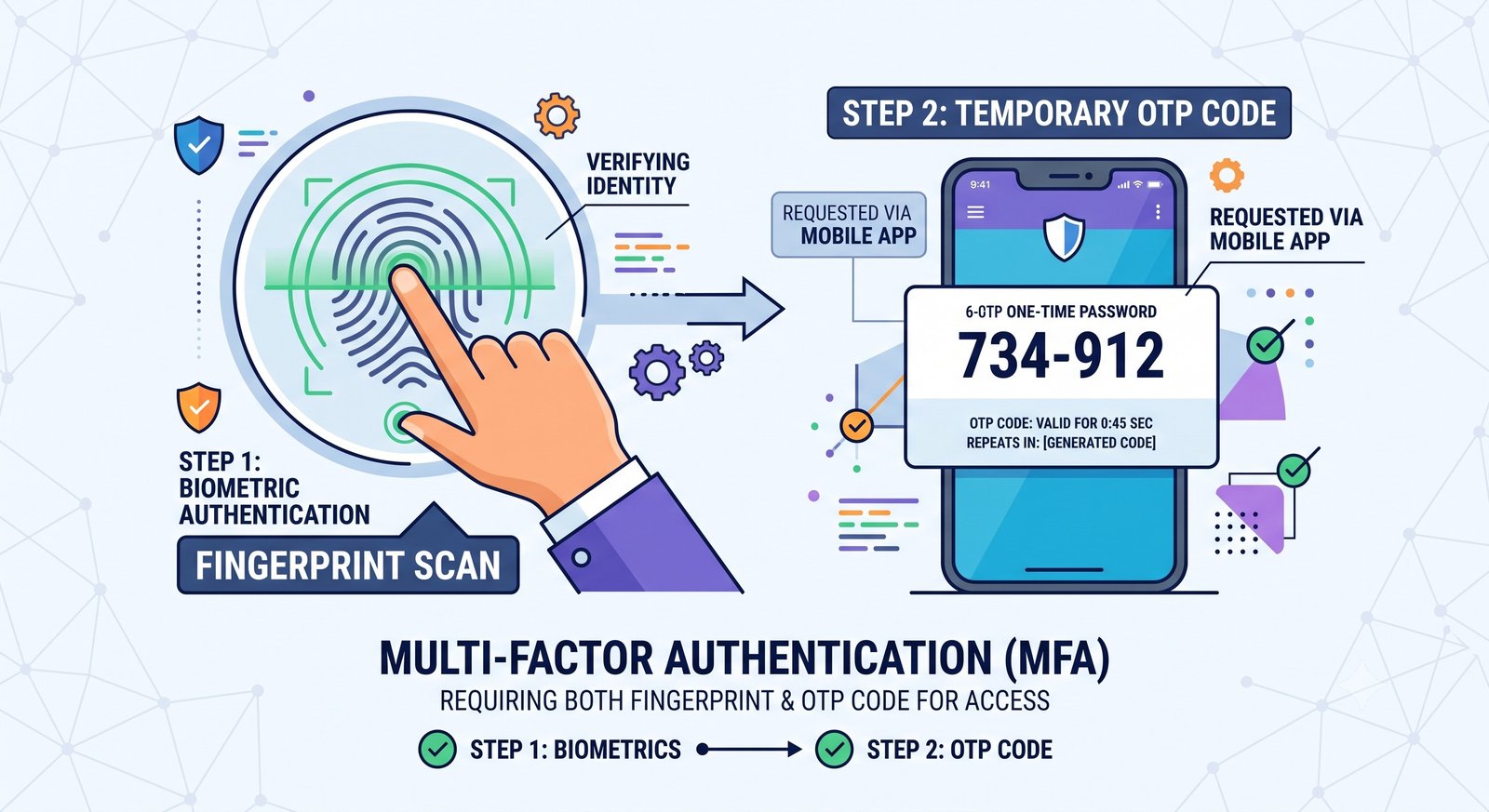
Historically, legacy banking security relied entirely on single-factor authentication: a static username combined with a memorized password. However, due to rampant corporate data breaches leaking billions of credentials, widespread consumer password reuse across multiple sites, and the deployment of advanced keylogging malware, static passwords are now considered fundamentally compromised by the cybersecurity industry. To combat global credential theft, financial institutions universally mandate Multi-Factor Authentication (MFA) for accessing financial ledgers or authorizing outbound capital transfers.
MFA operates on the strict principle that a user must provide two or more distinct, independent categorical proofs of identity. These authentication factors fall into three distinct categories:
- "Something You Know" (Knowledge Factor): A memorized PIN, a complex password, or the answers to specific security questions.
- "Something You Have" (Possession Factor): A registered physical smartphone receiving a time-sensitive One-Time Password (OTP) via SMS or an Authenticator App, or a physical hardware security key (like a YubiKey) plugged into the device.
- "Something You Are" (Inherence Factor): Unique physical biometrics, such as fingerprint topography, facial recognition geometry, or retinal scans processed directly on the secure enclave of the mobile device.
By enforcing MFA, the banking system structurally and aggressively neutralizes remote hackers. Even if a hostile actor located overseas successfully acquires a consumer's exact login credentials from a dark web database breach, they remain entirely locked out of the financial account. The attack fails because they do not physically possess the consumer's localized smartphone to generate or receive the required secondary OTP, completely breaking the authentication chain.
3. The Primary Threat Vectors: Phishing and Social Engineering
Despite the impenetrable mathematics of AES encryption and the structural robustness of MFA, the digital banking system contains one inherent, unpatchable vulnerability: human psychology. Cybercriminals frequently bypass heavy institutional network security entirely by directly manipulating the retail consumer through a psychological tactic known as Social Engineering. Instead of hacking the bank's mainframe, they "hack" the user's mind.
| Threat Vector | Delivery Mechanism | Psychological Tactic | Primary Defense Strategy |
|---|---|---|---|
| Phishing | Fraudulent Emails | Panic / False Urgency (e.g., "Account Suspended") | Never click embedded links; manually type the bank's URL. |
| Smishing | SMS Text Messages | Curiosity / Fear (e.g., "Confirm huge payment") | Ignore texts from unknown shortcodes; verify via official app. |
| Vishing | Voice Phone Calls (Spoofed Caller ID) | Authority / Trust (Impersonating Fraud Dept.) | Never read OTPs aloud. Hang up and dial the number on the back of your card. |
| Device Malware | Malicious App Downloads | Deception (Hidden in fake games or utilities) | Only install applications from official Apple/Google stores. |
In a classic Phishing attack, the attacker deploys mass fraudulent emails heavily disguised as urgent, official communications from legitimate banking institutions. These messages induce panic, claiming an account is frozen or unauthorized activity has occurred, compelling the victim to click a malicious link. The link directs the victim to a perfectly cloned, fake banking portal. When the victim enters their username and password, the attacker captures them. More devastatingly, if the fake site prompts for an OTP, and the user enters it, the attacker intercepts the OTP and uses it in real-time on the genuine banking site, bypassing the MFA protection entirely because the user willingly handed over the keys.
4. Tokenization and Secure Payment Gateways
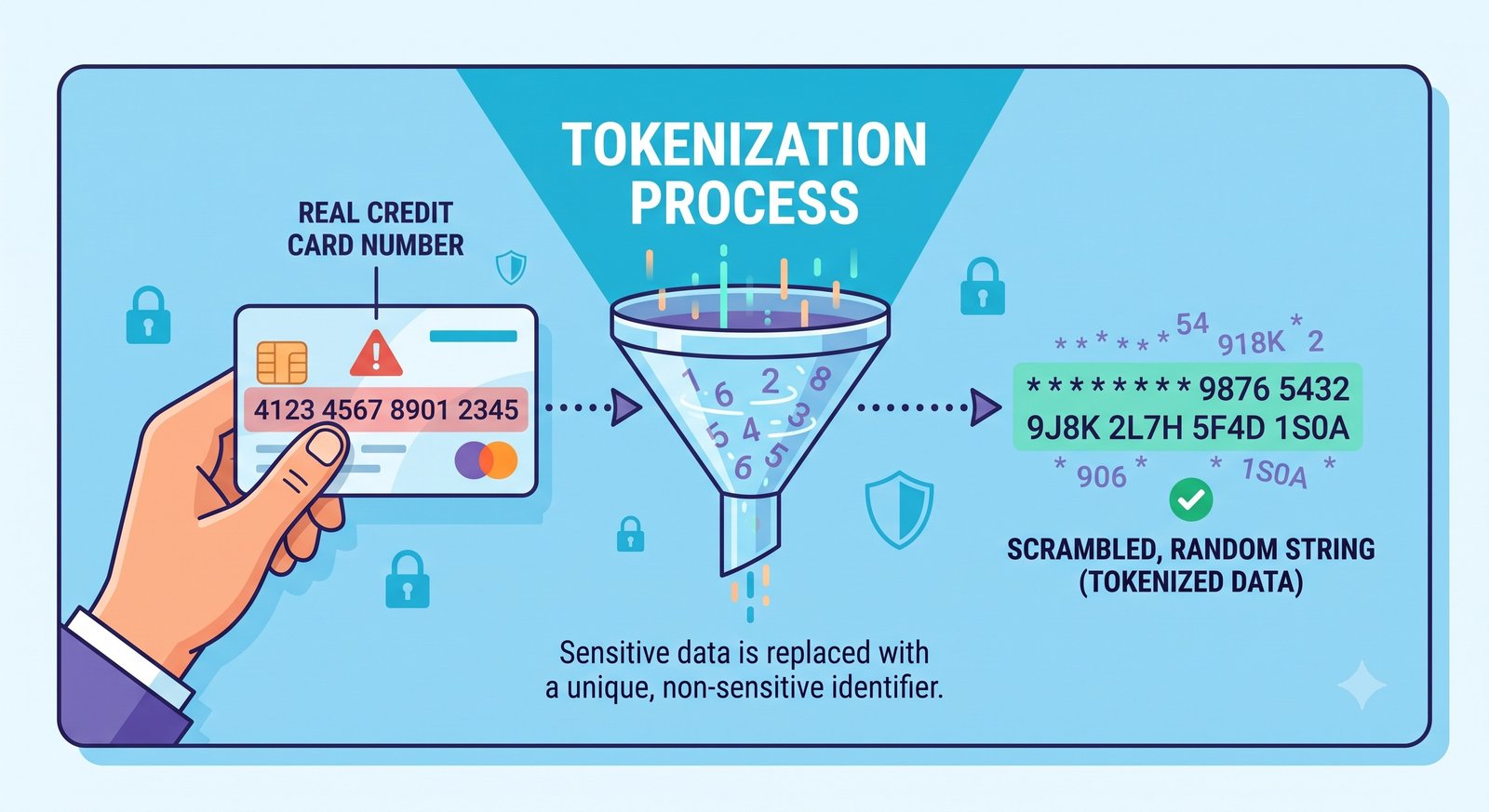
The proliferation of digital wallets (such as Apple Pay, Google Pay, and Samsung Pay) and third-party e-commerce gateways necessitated a revolutionary security architecture to prevent the mass exposure and theft of raw credit and debit card numbers. The financial industry solved this massive vulnerability via a process known as Network Tokenization.
Rather than transmitting or storing the consumer's actual 16-digit Primary Account Number (PAN) on external servers or merchant databases, the system generates a "token"—a mathematically random surrogate string of numbers that holds zero intrinsic value. When a consumer executes a digital transaction, the merchant's payment gateway only receives and processes this tokenized surrogate. The merchant never "sees", processes, or stores the actual card data on their own servers.
The token is transmitted back to the central card network (e.g., Visa, Mastercard), which securely de-tokenizes the string in their heavily guarded, centralized internal vault, matches it to the real account, and authorizes the transaction with the issuing bank. This creates a massive structural firewall: if a major e-commerce retailer is subsequently hacked, the cybercriminals only acquire databases full of useless, single-use or single-merchant tokens. They cannot use those tokens to extract funds elsewhere, completely protecting the consumer's underlying banking ledger from exposure.
5. Empirical Case Studies in Banking Security Failures
Case Study 1: The Vishing MFA Bypass (Human Vulnerability)
Scenario: David is targeted by a specialized vishing syndicate. The attackers have already acquired his banking username and password from a previous third-party data breach, but they cannot access his account because it is protected by SMS-based MFA. They call David, using Caller ID spoofing to make the call appear as if it is coming from "Chase Bank Fraud Prevention."
The Attack: The caller informs David that his account is currently under attack in a foreign country and they need to verify his identity to freeze the account. The attacker, while on the phone with David, attempts to log into David's real banking portal. The bank's system automatically generates a legitimate 6-digit OTP and texts it to David's phone. The attacker calmly asks David to "read the security code we just sent you to verify your identity." Panic-stricken, David reads the code aloud. The attacker types the code into the portal, successfully authenticating the session, and immediately wires $15,000 out of the account. Result: The bank's encryption and MFA worked flawlessly. The system failed solely because the human user was socially engineered into actively dismantling his own defenses.
Case Study 2: The E-Commerce Tokenization Save
Scenario: Sarah uses Apple Pay to purchase groceries at a large national supermarket chain. Apple Pay utilizes device-specific tokenization (Device Account Number). Six months later, the supermarket's central payment databases are severely breached by hackers.
The Defense: The hackers steal millions of transaction records. However, because Sarah used a tokenized digital wallet, the hackers only steal the surrogate Device Account Number and a dynamic security code specific to that single transaction. When the hackers attempt to clone Sarah's card to make fraudulent purchases online, the Visa network rejects the transactions because the stolen token cannot be used outside of the original authorized environment. Result: Sarah's actual 16-digit credit card number was never compromised, and she did not even need to be issued a replacement card by her bank.
6. Advanced Behavioral Analytics and AI Risk Engines
Modern financial institutions no longer rely exclusively on static, front-door barriers (passwords and OTPs); they deploy proactive, Artificial Intelligence (AI) driven risk engines that operate continuously and invisibly in the background. These complex machine-learning algorithms analyze massive real-time datasets, establishing a precise, highly granular baseline behavioral profile for every individual account holder.
The AI analyzes dozens of metadata variables simultaneously: the typical geographic IP location of logins, the specific MAC address or model of the smartphone used, the precise speed at which the user types their password, standard transaction volumes, historical spending categories, and regular routing endpoints (e.g., usually transferring money to local domestic accounts).
If a severe statistical anomaly is detected—such as a sudden, massive capital transfer initiated from an unrecognized IP address in Eastern Europe at 4:00 AM, using an Android device when the user has historically only used iOS—the AI risk engine instantly flags the transaction as critical risk. Depending on the severity of the deviation from the established baseline profile, the system will instantly and autonomously intercede. It may automatically freeze the transaction, trigger an emergency step-up authentication requirement (forcing biometric face-scan verification), or physically lock the entire banking profile pending direct verbal verification from the consumer. This proactive, algorithmic surveillance architecture acts as the ultimate failsafe against sophisticated credential breaches.
7. Actionable Strategy Guide: Consumer Digital Hygiene
Institutional security is meaningless if the retail endpoint (the consumer) hands over the keys. Implement this strict protocol to harden your personal financial architecture against exploitation:
- Step 1: Eliminate Password Reuse. Never use the same password for your banking portal that you use for social media or retail sites. If a retail site is breached, hackers use automated scripts ("credential stuffing") to test those stolen passwords against thousands of bank portals. Utilize a dedicated, complex passphrase stored in an encrypted Password Manager.
- Step 2: Upgrade MFA Mechanisms. Do not rely on SMS text messages for your OTPs if better options exist. SMS can be intercepted via "SIM swapping" attacks. Navigate to your bank's security settings and upgrade your MFA to an Authenticator App (like Google Authenticator or Authy) which generates codes locally on your device without relying on vulnerable cellular networks.
- Step 3: Implement The 'Hang Up' Rule. Establish a strict personal policy: you will never provide account details, passwords, or OTP codes to anyone who calls you, regardless of how official the Caller ID looks or how urgent the threat sounds. Hang up the phone immediately, turn over your physical debit card, and dial the official fraud department number printed on the back.
- Step 4: Audit Linked APIs and Apps. Periodically review the "Connected Apps" or "Open Banking" section within your bank's portal. Revoke access to any old budgeting tools, fintech apps, or payment aggregators that you no longer actively use to reduce your third-party attack surface.
8. Frequently Asked Questions (FAQ)
Q: Are digital wallets like Apple Pay and Google Pay safer than using a physical plastic debit card?
Yes, significantly safer. When you use a physical plastic card, you expose your actual 16-digit account number to the merchant's point-of-sale system, which could be compromised by malware or physical skimmers. Digital wallets use Network Tokenization, passing only a randomized, useless string of numbers to the merchant. Furthermore, digital wallets require biometric authentication (FaceID or Fingerprint) to execute the transaction, meaning a stolen phone is useless for payments, whereas a stolen physical card can be used immediately.
Q: Is it safe to check my bank balance on public Wi-Fi at a coffee shop or airport?
While modern banking apps utilize TLS/SSL encryption that protects your data even on unsecured networks, it is still a poor security practice. Sophisticated attackers can set up "Evil Twin" networks—fake Wi-Fi hotspots named identically to the coffee shop's network. If you connect, they can attempt to strip the encryption or redirect you to a phishing site. If you must check your balance in public, disable Wi-Fi and utilize your cellular data network (4G/5G), which is vastly more secure against localized interception.
Q: If a hacker drains my checking account, will the bank reimburse me?
It depends entirely on how the money was stolen. Under the Electronic Fund Transfer Act (Regulation E), if a hacker breaches the bank's security or steals your debit card details and you report it promptly (usually within 2 days), your liability is strictly limited, and the bank must reimburse the stolen funds. However, if you are the victim of a social engineering scam where you voluntarily authorized the transfer (e.g., you were tricked into sending a wire transfer to a scammer), the bank is generally not legally obligated to reimburse you, as the system functioned exactly as you commanded it to.
Q: Why does my banking app log me out automatically after a few minutes of inactivity?
This is a mandated regulatory security feature known as an automatic session timeout. It is designed to mitigate physical "session hijacking." If you log into your banking portal on a computer or phone and walk away or leave the device unlocked, the automatic timeout ensures that a malicious actor passing by cannot simply sit down and initiate transfers from your already authenticated session.
Q: Can a bank's biometric security (like facial recognition) be fooled by a photograph?
Early, rudimentary 2D facial recognition systems could occasionally be spoofed by high-resolution photographs. However, modern financial-grade biometric systems (like Apple's FaceID or advanced Android scanners) utilize highly advanced 3D depth-mapping technology. They project thousands of invisible infrared dots onto the user's face to measure precise topographical depth, completely neutralizing 2D photograph spoofing. Additionally, they often require "liveness detection" (e.g., eye movement or blinking) to ensure a physical, living human is present.
See also
- Loading related topics...