Employees Provident Fund (EPF)
The Definitive Guide to India's Institutional Retirement Architecture, Compounding Mechanics, and Taxation Statutes
The Employees' Provident Fund (EPF) is the undisputed bedrock of India's organized sector retirement planning. Governed by the Employees' Provident Funds and Miscellaneous Provisions Act of 1952, it is managed by the Employees' Provident Fund Organisation (EPFO), one of the world's largest social security organizations by client volume and volume of financial transactions. For decades, the EPF has functioned as a mandatory, forced-savings vehicle designed to cultivate financial discipline among salaried individuals, ensuring that the transition from a steady paycheck to retirement is insulated from old-age poverty.
However, characterizing the EPF merely as a "savings account" is a gross underestimation of its structural complexity. It is, in reality, a multi-tiered financial ecosystem comprising three distinct statutory schemes: The Employees' Provident Fund Scheme (EPFS, 1952), the Employees' Pension Scheme (EPS, 1995), and the Employees' Deposit Linked Insurance Scheme (EDLI, 1976). To fully harness the wealth-generating capacity of the EPF, one must rigorously understand its macroeconomic investment guidelines, the mathematical realities of its interest calculations, and the recent paradigm-shifting amendments in its taxation laws.
1. The Anatomy of EPF Contributions
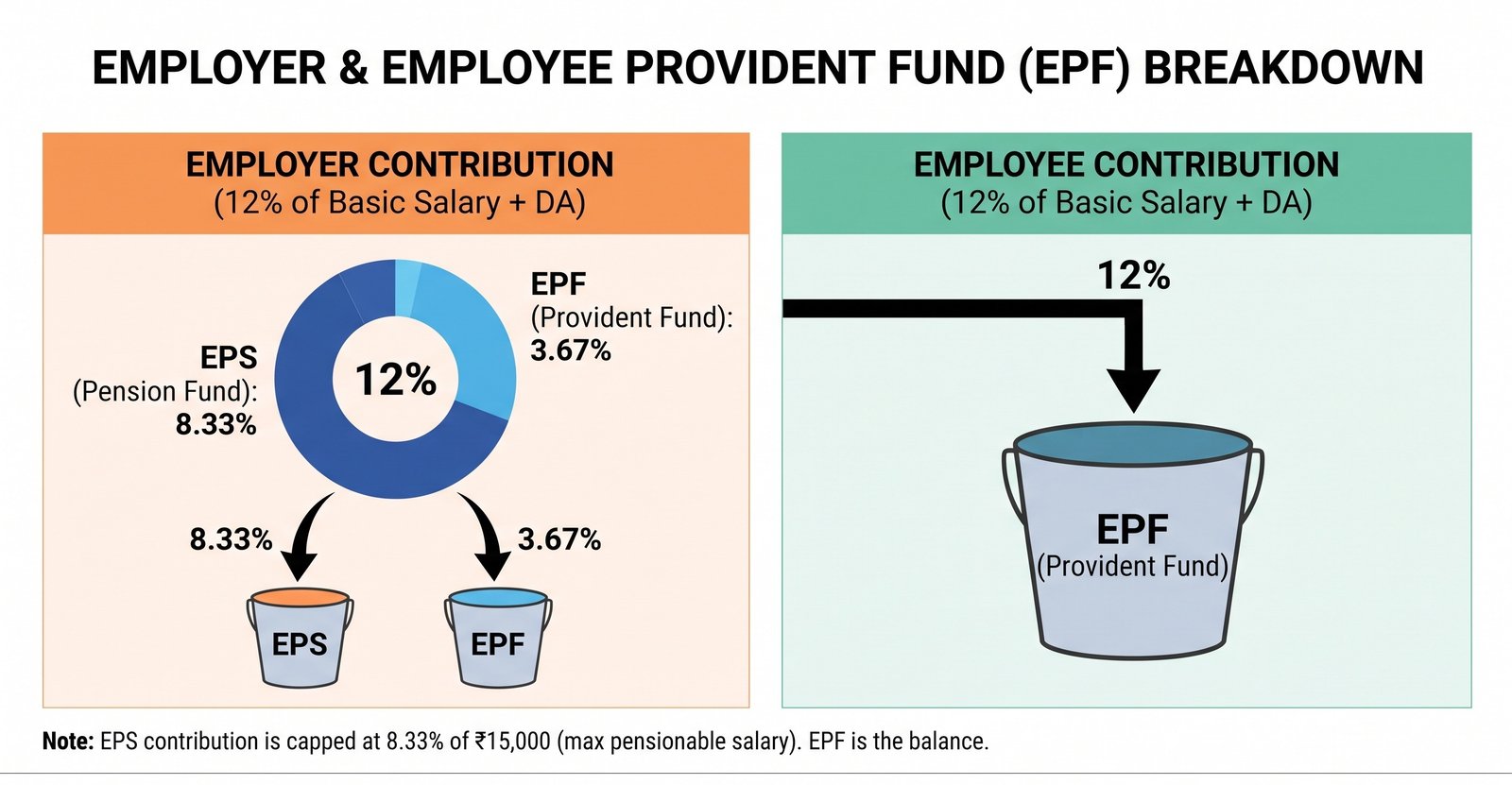
The EPF operates on a co-contribution model. By statutory mandate, both the employee and the employer must contribute 12% of the employee's "Basic Salary + Dearness Allowance (DA)" to the EPFO every month. While the employee's 12% is a straightforward deduction, the employer's 12% contribution is fragmented across different schemes to provide a holistic social security net.
- The Employee Contribution (12%): This entire amount goes directly into the individual's EPF account. It accrues interest annually and compounds until retirement or authorized withdrawal.
- The Employer Contribution (12%): This is bifurcated. 8.33% is routed into the Employees' Pension Scheme (EPS) to build an annuity fund that pays out a monthly pension after age 58. The remaining 3.67% is routed into the EPF account, joining the employee's contribution to earn compound interest.
- Additional Employer Liabilities: Over and above the 12%, the employer must bear the cost of the EDLI scheme (0.5% of Basic Pay, capped at ₹15,000) providing life insurance cover up to ₹7,00,000, and administrative charges (0.5%) for managing the EPF account. These do not add to the employee's investible corpus.
- The ₹15,000 Wage Ceiling Rule: By law, EPF compliance is mandatory only for employees earning a basic salary up to ₹15,000 per month. For such employees, the 8.33% EPS contribution is capped at ₹1,250 per month (8.33% of ₹15,000). Employees earning above this threshold can mutually agree with their employer to contribute 12% on their actual basic salary, but the EPS portion usually remains capped at ₹1,250, with the excess spilling over into the 3.67% EPF bucket.
2. Macroeconomic Mechanics and Interest Rate Declarations
Unlike mutual funds or unit-linked insurance plans, the EPF guarantees the safety of principal and interest. However, the interest rate is not fixed at the time of account creation. It is declared annually by the Central Board of Trustees (CBT), the apex decision-making body of the EPFO, in consultation with the Ministry of Finance.
The CBT determines the interest rate based on the earnings of the EPFO’s massive investment corpus. Historically, the EPFO was mandated to invest 100% of its funds into sovereign and AAA-rated corporate debt instruments. However, recognizing the need to outpace inflation, the mandate was amended in 2015 to allow the EPFO to invest between 5% and 15% of its incremental corpus into the equity markets, primarily through Exchange Traded Funds (ETFs) tracking the Nifty 50 and BSE Sensex. The blending of high-yield long-term debt and equity growth allows the EPF to consistently declare interest rates higher than prevailing bank Fixed Deposits, usually hovering between 8.1% and 8.5%.
3. Deep-Dive Explanations & Mathematical Formulas
To optimize EPF wealth, one must understand how the mathematics of compounding is applied administratively. A common misconception is that EPF interest compounds monthly. In reality, interest is calculated on the monthly running balance but is only credited to the account at the end of the financial year (March 31st). Consequently, the interest earned during a financial year does not earn interest upon itself during that same year.
The annual interest (Iannual) credited is calculated using the simple interest formula on the progressive monthly balances:
Iannual = ∑m=112 [ OBm + Cm - Wm ] × (r / 12)
Where:
- OBm: Opening balance at the start of month m.
- Cm: Total contribution (Employee + Employer 3.67%) deposited in month m.
- Wm: Any partial withdrawals made in month m.
- r: The annual EPF interest rate declared for that financial year (e.g., 0.0815 for 8.15%).
The EPS (Pension) Formula: The 8.33% routed to the EPS does not earn interest. It pools into a defined-benefit pension system. Upon reaching age 58 (provided you have completed a minimum of 10 years of eligible service), your monthly pension is calculated mathematically as follows:
Monthly Pension = (Pensionable Salary × Pensionable Service) / 70
(Note: "Pensionable Salary" is typically the average basic salary of the last 60 months, capped strictly at ₹15,000 for most employees, meaning the maximum statutory pension is inherently limited unless modified by supreme court rulings on actual salary contributions.)
4. The Taxation Paradigm: EEE Status and Recent Amendments
Historically, the EPF enjoyed a pure "EEE" (Exempt-Exempt-Exempt) tax status. Contributions up to ₹1.5 Lakhs were exempt under Section 80C, the annual interest accrual was exempt, and the final maturity corpus was completely tax-free. However, to curb high-net-worth individuals (HNIs) from using the EPF as a tax-free haven for massive wealth, the government introduced two critical macroeconomic amendments.
- The ₹2.5 Lakh Threshold (Employee Side): Effective April 1, 2021, if an employee's total contribution (Basic EPF + VPF) exceeds ₹2.5 Lakhs in a single financial year, the interest earned on the excess amount becomes fully taxable at the individual's marginal income tax slab rate. The EPFO now mathematically splits accounts into a "Taxable" and "Non-Taxable" sub-ledger to track this.
- The ₹7.5 Lakh Threshold (Employer Side): As per Section 17(2)(vii) of the Income Tax Act, if the aggregate contribution by the employer to the EPF, National Pension System (NPS), and Superannuation fund exceeds ₹7.5 Lakhs in a financial year, the excess amount, plus the interest accrued on that excess, is treated as a taxable perquisite in the hands of the employee.
- Premature Withdrawal Taxation: If an employee withdraws their EPF corpus before completing 5 years of continuous service, the entire amount loses its tax-exempt status. The principal becomes taxable (past 80C deductions are reversed), and the interest is taxed as "Income from Other Sources." TDS at 10% is deducted if the withdrawal amount exceeds ₹50,000.
5. Realistic Case Studies
Translating tax codes and formulas into real-world mechanics is essential for optimal portfolio structuring. Let us examine two specific edge cases.
Case Study 1: Vikram and the ₹2.5 Lakh VPF Tax Trap
Vikram, a senior software engineer, has a basic salary of ₹1,50,000 per month (₹18,00,000 annually). His mandatory 12% employee contribution to EPF is ₹2,16,000 per year. Knowing EPF yields 8.1%, he decides to allocate an additional ₹2,00,000 annually via the Voluntary Provident Fund (VPF) to build a massive debt portfolio.
- Total Contribution: ₹2,16,000 (Mandatory) + ₹2,00,000 (VPF) = ₹4,16,000.
- Tax Impact: Vikram has breached the ₹2.5 Lakh limit by ₹1,66,000.
- The Math: The interest generated on the first ₹2.5 Lakhs remains strictly tax-free. However, the 8.1% interest generated on the excess ₹1,66,000 (which is ₹13,446) is added to Vikram's taxable income. Since Vikram is in the 30% tax bracket, he will pay approximately ₹4,033 in taxes on this interest. His effective post-tax yield on the excess VPF contribution drops from 8.1% to roughly 5.67%. At this yield, Vikram might be mathematically better off investing the excess ₹2,00,000 into a debt mutual fund or PPF (if limit available) instead of VPF.
Case Study 2: Neha's Job Switch and Continuous Service Rule
Neha works at Company A for 3 years. She quits and joins Company B. Unaware of the mechanics, she decides to withdraw her EPF corpus of ₹3,00,000 to buy a car, rather than transferring it to Company B using her Universal Account Number (UAN).
- The Error: Because she withdrew before completing 5 years of continuous service, her EPF withdrawal becomes entirely taxable.
- The Optimal Strategy: If Neha had utilized the EPFO portal to initiate an online transfer of her EPF from Company A to Company B, the tenure at Company A would have been added to Company B. After 2 more years at Company B, she would hit the 5-year continuous service mark. Any withdrawal after that point would be 100% tax-free, regardless of how many times she switched jobs, provided the accounts were sequentially merged.
6. Structured Comparison Tables: Retirement Vehicles
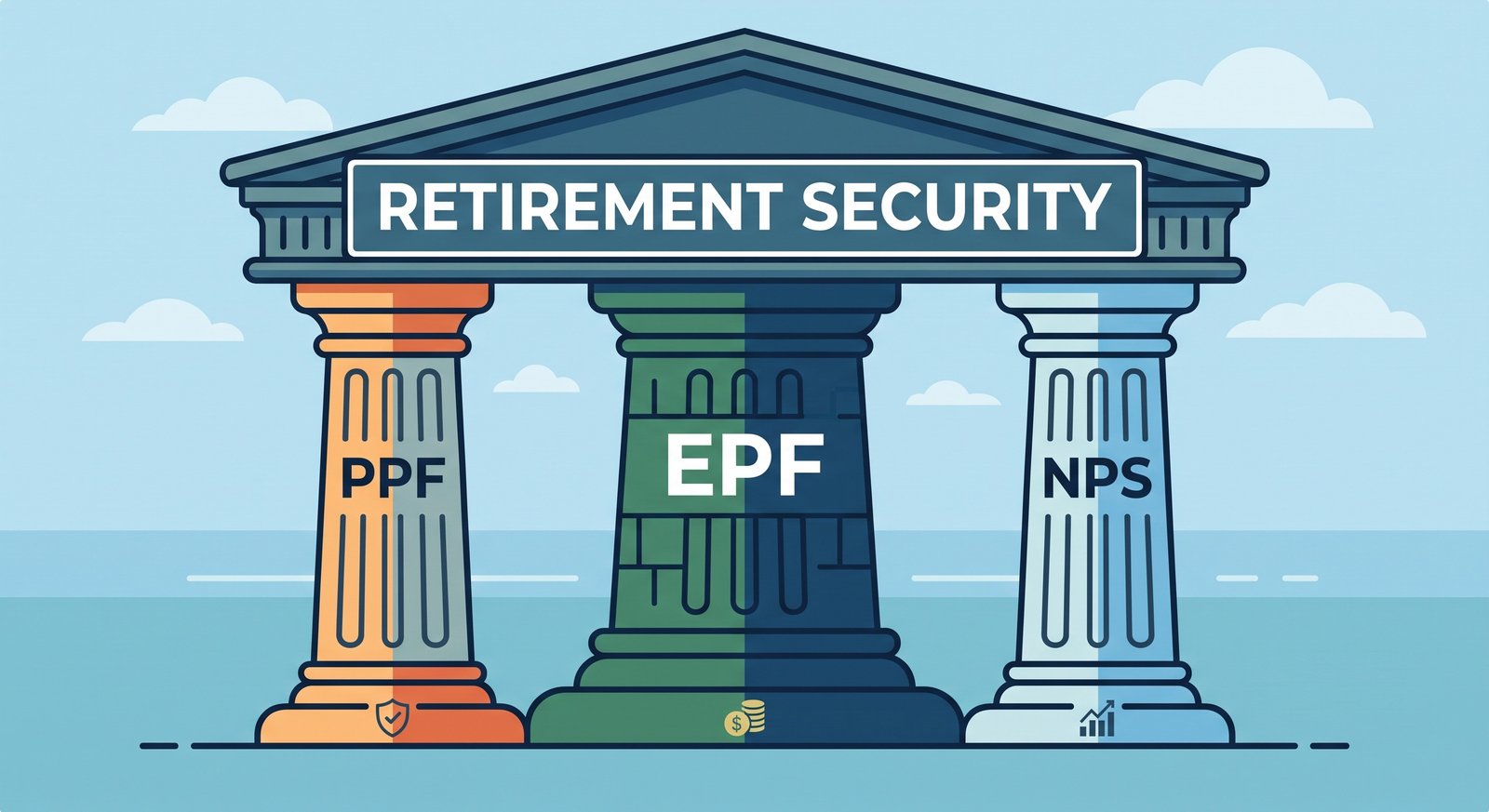
To contextualize the EPF, investors must compare it against the other two primary long-term government-backed retirement schemes: The Public Provident Fund (PPF) and the National Pension System (NPS).
| Feature / Metric | Employees' Provident Fund (EPF) | National Pension System (NPS) |
|---|---|---|
| Eligibility | Salaried employees in registered organizations. | All Indian citizens (Salaried or Self-Employed). |
| Investment Risk & Returns | Fixed, sovereign-backed return (typically 8.1% - 8.5%). Zero capital risk. | Market-linked. Navigates Equities, Corporate Bonds, and G-Secs. Returns are variable. |
| Liquidity & Lock-in | Locked until retirement (58 years). Partial advances allowed for specific life events (housing, medical). | Locked until age 60. Extremely stringent partial withdrawal rules (max 25% of own contribution). |
| Maturity Mechanics | Lump-sum withdrawal is fully tax-free (if 5 years service completed). | 60% lump-sum tax-free. Mandatory to purchase an annuity with the remaining 40% (annuity payouts are taxable). |
7. Advanced Strategies: Withdrawals, Transfers, and UAN
The introduction of the Universal Account Number (UAN) revolutionized EPF administration. Previously, every job change resulted in a new EPF Member ID, leading to fragmented, untraceable accounts. The UAN is a static 12-digit umbrella number that aggregates all your disparate Member IDs across different employers.
Navigating EPFO Forms:
- Form 13 (Transfer): Used to transfer the EPF balance from a previous employer's Member ID to the current employer's Member ID under the same UAN. This preserves the "continuous service" mandate for taxation.
- Form 31 (Partial Advances): Allows non-refundable withdrawals during active employment. Specific rules govern the quantum. For example, for a medical emergency, you can withdraw up to 6 times your basic salary or your entire employee share, whichever is lower. For buying a house (after 5 years of service), you can withdraw up to 36 months of basic wages.
- Form 19 (Final Settlement): Used to withdraw the entire EPF corpus. This can only be filed upon retirement, or if you have been unemployed for more than 2 consecutive months (60 days).
- Form 10C (EPS Withdrawal): If you quit before completing 10 years of service, you are not eligible for a pension. Form 10C allows you to withdraw the accumulated EPS (8.33%) amount along with your EPF (Form 19). If you cross 10 years of service, you must file Form 10D at age 58 to begin receiving your monthly pension.
8. Actionable Strategy Guide: Optimizing Your EPF Portfolio
To maximize the debt portion of your asset allocation using the EPF, execute the following operational steps.
- Step 1: Unify Your Portfolio via UAN KYC. Immediately log into the EPFO Unified Member Portal. Ensure your Aadhaar, PAN, and Bank Account are digitally verified (KYC compliant) and seeded to your UAN. Without Aadhaar linking, employers cannot deposit contributions, and you cannot file online claims.
- Step 2: Merge Legacy Accounts. If you worked before the UAN era (pre-2014), you likely have disconnected EPF accounts. File a "One Member - One EPF Account" online transfer request using Form 13. Merging maximizes the power of a single compounding base.
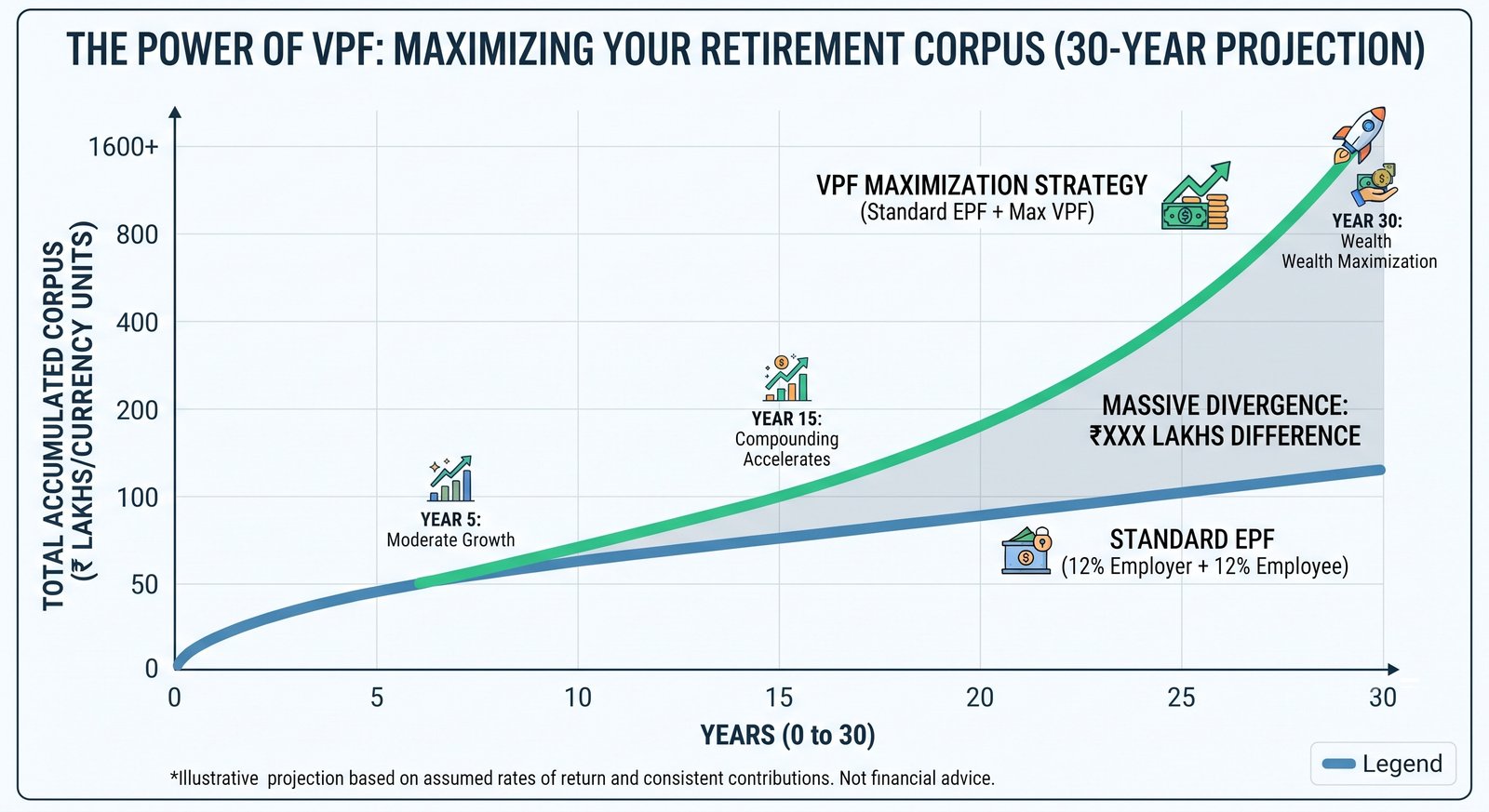
- Step 3: Calculate the VPF Sweet Spot. Use the Voluntary Provident Fund to boost your debt allocation, but actively monitor the ₹2.5 Lakh employee contribution limit. If your mandatory 12% contribution is ₹1.5 Lakhs, you can safely allocate ₹1 Lakh to VPF to earn tax-free, sovereign-backed 8%+ interest. If you exceed the ₹2.5 Lakh limit, perform a post-tax yield analysis against debt mutual funds to see if VPF still makes mathematical sense for your tax bracket.
- Step 4: Never Withdraw on Job Transition. Resist the urge to withdraw EPF funds when switching jobs or taking a sabbatical. Withdrawing resets your "continuous service" clock to zero, risking taxation on future withdrawals, and permanently destroying the exponential curve of your compounding interest.
- Step 5: Utilize e-Nomination. Ensure your e-Nomination is filed digitally with an e-Sign. In the event of an untimely demise, a digitized nomination allows dependents to instantly claim the EPF corpus, the EPS widow/orphan pension, and the EDLI insurance payout (up to ₹7 Lakhs) without enduring bureaucratic probate processes.
9. Frequently Asked Questions (FAQs)
Q: Does an inactive EPF account (where I am no longer contributing) continue to earn interest?
Yes. Previously, accounts inactive for 36 months stopped earning interest. However, an amendment ensures that even if you leave employment and do not contribute, your EPF balance will continue to accrue interest until you reach the retirement age of 58. However, any interest earned on an inactive account after you have left employment becomes taxable in the year it is credited.
Q: Can I opt out of the EPF scheme entirely to increase my take-home salary?
If you are starting your first job and your starting Basic Salary + DA is strictly above ₹15,000 per month, you have the legal right to opt out of the EPF scheme at the very beginning by filling out Form 11, declaring yourself an "excluded employee." However, if you have ever been an EPF member in the past and possess a UAN, you cannot opt out in any subsequent employment, regardless of how high your salary is.
Q: How does the new Supreme Court ruling on higher EPS pensions affect me?
Historically, the 8.33% EPS contribution was capped at a salary of ₹15,000 (meaning a max contribution of ₹1,250/month), which artificially depressed final pensions. A recent ruling allows eligible employees (who were members prior to Sept 2014) to opt to contribute 8.33% on their actual higher salary. Exercising this option transfers a massive chunk of funds retroactively from your EPF corpus to the EPS corpus. While this drastically increases your monthly pension post-retirement, it permanently destroys your lump-sum EPF corpus. This is a complex actuarial decision that depends on your life expectancy and need for liquidity versus guaranteed annuity income.
Q: What is the exact difference between EPF and PPF?
EPF (Employees' Provident Fund) is strictly for salaried individuals, driven by payroll deductions with employer matching, and typically offers a higher interest rate (e.g., 8.1%+). PPF (Public Provident Fund) is open to any Indian citizen (salaried, self-employed, or non-working), requires manual deposits, has a strict cap of ₹1.5 Lakhs per year, and generally offers a slightly lower interest rate (e.g., 7.1%), but its interest remains universally tax-free without the ₹2.5L limit applied to EPF.
Q: What are International Workers (IWs) and how do EPF rules differ for them?
An International Worker is either a foreign national working in India or an Indian working in a country with which India holds a Social Security Agreement (SSA). For IWs working in India, EPF compliance is mandatory on their entire global salary (the ₹15,000 cap does not apply). Furthermore, withdrawal rules are immensely strict; an IW from a non-SSA country can only withdraw their EPF corpus upon reaching the Indian retirement age of 58, even if they permanently leave India years prior.
See also
- Loading related topics...