Financial Goal Setting
The Definitive Guide to Strategic Capital Allocation, Behavioral Economics, and Wealth Engineering
Within the broader framework of personal finance, institutional wealth management, and macro-economic planning, financial goal setting is the highly systematic process of identifying, mathematically quantifying, and establishing definitive execution timelines for specific capital accumulation or debt reduction objectives. Unlike simple budgeting—which is primarily a tactical, short-term mechanism used to manage monthly cash flows and operational expenditures—goal setting serves as the strategic, overarching architecture of a financial life. It dictates precisely how surplus capital is captured and deployed over extended temporal horizons. By translating abstract, subjective desires—such as "retiring comfortably," "achieving financial independence," or "purchasing real estate"—into concrete, actionable mathematical targets, individuals can reverse-engineer a verifiable, systemic path to long-term solvency.
The absence of formalized financial goals almost universally leads to a severe economic phenomenon known as lifestyle creep (or Parkinson’s Law of Triviality applied to personal finance). This occurs when periodic, organic increases in top-line income are proportionally and invisibly consumed by simultaneous increases in discretionary lifestyle spending, rather than being captured to expand net worth. Consequently, financial economists, fiduciary wealth managers, and certified financial planners universally mandate that rigorous goal setting must be the required precursor to all other financial mechanics. The goals established in this phase directly inform the required portfolio asset allocation, dictate mathematically acceptable risk tolerances, and establish the strict savings rates necessary to insulate an economic unit against unforeseen macroeconomic shocks.

1. The Psychological and Behavioral Imperative
Behavioral economics provides profound, empirical, and data-driven insights into why explicit goal setting is mathematically and psychologically mandatory for consistent financial success. The human brain is not biologically optimized for multi-decade financial planning; instead, human beings inherently suffer from "present bias" or "hyperbolic discounting." This is a cognitive, neurological predisposition where immediate, tangible rewards (e.g., purchasing a luxury vehicle today) are overwhelmingly preferred over future, objectively larger and more rational rewards (e.g., compound interest yielding a secure retirement in 30 years). Hyperbolic discounting makes it extraordinarily difficult to voluntarily sacrifice current consumption for future security without a robust, compelling structural counter-narrative. Setting explicit financial goals interrupts this default psychological mechanism.
By establishing highly defined financial goals, individuals engage in a beneficial psychological process known as "future self-continuity." This process bridges the cognitive gap between the present self (who desires to consume capital immediately) and the future self (who requires the accumulated capital for survival, healthcare, or comfort). When a goal is articulated clearly and vividly, the brain ceases to view saving as a generic, painful deprivation of resources. Instead, it re-categorizes the act of saving as the active, positive purchasing of a specific future outcome, thereby significantly increasing behavioral compliance rates with established saving protocols and neutralizing impulsive spending behaviors.
Furthermore, goal setting actively utilizes the concept of "mental accounting," a behavioral trait identified by Nobel Laureate Richard Thaler. By assigning specific names, visual markers, and purposes to different pools of money, individuals are statistically far less likely to raid those accounts for unrelated discretionary purchases. The cognitive friction required to withdraw funds explicitly designated for a "Child's University Education Fund" to purchase luxury apparel is significantly higher than withdrawing from a generic, unnamed "Savings Account."
2. The Mathematical Architecture of Goal Formulation: The SMART Framework
In institutional wealth management and highly structured personal financial planning, goals are never left as ambiguous, open-ended statements. The universally accepted, mathematically sound methodology for structuring these financial objectives is the SMART criteria framework. A functional financial goal must comprehensively satisfy all five parameters of this framework to be considered viable for mathematical execution and modeling.
- Specific: The objective must be exact and unambiguous. Stating "I want to buy a house" is functionally insufficient and cannot be modeled. Conversely, stating "I need to accumulate a 20% down payment for a $400,000 primary residence in a suburban school district" provides the necessary specificity required for a financial planner to begin reverse-engineering the math.
- Measurable: The goal must have a strict, quantifiable monetary value to allow for precise variance tracking, compound interest modeling, and progress monitoring. Using the prior housing example, the precise mathematical capital target is firmly set at $80,000.
- Achievable: The target must logically reconcile with the individual's projected income trajectory, existing debt obligations, and baseline survival living expenses (BSBR). Attempting to save $80,000 in two years on a $60,000 annual net salary is mathematically improbable; setting unrealistic goals leads rapidly to behavioral fatigue, compounding frustration, and the ultimate abandonment of the entire financial plan.
- Relevant: The objective must strictly align with the individual's broader macroeconomic life plan, risk tolerance, and deeply held personal values. This ensures that the required short-term financial sacrifice (reduced consumption) is genuinely justified by the eventual long-term utility of the achieved goal.
- Time-Bound: The goal must possess a strict, non-negotiable deadline (e.g., "by December 31, 2029"). An exact temporal timeline dictates the required monthly contribution rate and heavily influences the class of asset allocation chosen to house the capital during the multi-year accumulation phase.
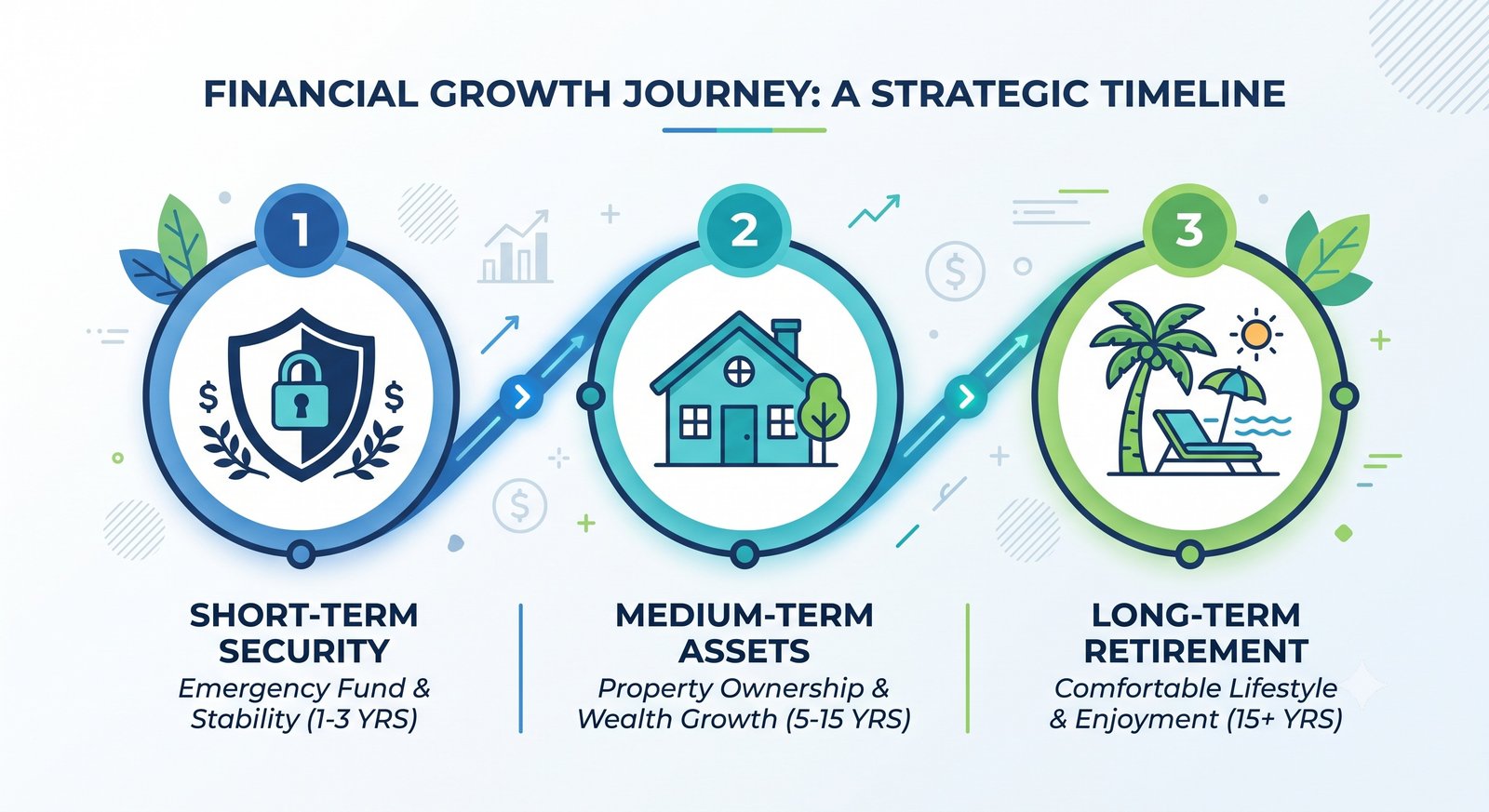
3. Temporal Classification and Asset Matching Strategies
Financial objectives must be strictly segregated by their intended execution dates. This temporal classification is the absolute determinant of how the designated capital is housed and invested. Mismatching the timeline of the goal with the volatility of the investment vehicle exposes the financial planner to severe sequence-of-returns risk (selling assets at a loss during a market crash because the deadline arrived), liquidity constraints, or long-term purchasing power erosion due to inflation.
Short-Term Goals (0 to 12 Months): These immediate objectives demand uncompromising capital preservation and absolute liquidity. Common examples include funding a baseline emergency reserve, covering an impending tax liability, or saving for an annual property insurance premium. Because the capital will be deployed rapidly, it cannot be exposed to the volatility of equity markets. Funds designated for short-term goals must remain in zero-risk environments, such as High-Yield Savings Accounts (HYSAs), fixed-term liquid deposits, or highly liquid money market funds, regardless of their lower nominal yields.
Medium-Term Goals (1 to 5 Years): Objectives falling into this category generally represent significant capital expenditures. Examples include saving for a real estate down payment, financing a major life event like a wedding, or accumulating tuition for imminent higher education. While the timeline provides a slight temporal buffer, the capital still requires robust protection from severe equity market downturns, as a sudden recession could indefinitely delay the purchase. Planners typically house this capital in fixed-income instruments like Certificates of Deposit (CDs), government Treasury Bills (T-Bills), or short-duration corporate bond funds, thereby balancing the need for mild inflation protection with a high degree of capital safety.
Long-Term Goals (5 to 30+ Years): Long-term objectives, most notably retirement funding, pension structuring, or generational wealth transfer, are characterized by horizons spanning several decades. Over such extensive durations, the primary threat to the portfolio is not short-term market volatility (which smooths out over time), but the silent, compounding erosion of inflation. Consequently, funds allocated for long-term goals must be deployed into growth-oriented, aggressive asset classes—predominantly diversified equities, broad-market index funds, and real estate. This strategic exposure to risk allows the mechanics of compound interest to maximize the final output over the lifecycle of the investment.
| Temporal Horizon | Primary Objective | Tolerable Volatility Risk | Optimal Asset Classes |
|---|---|---|---|
| Short-Term (0-1 Year) | Capital Preservation & Liquidity | Zero Risk | High-Yield Savings (HYSA), Money Market Funds, Cash |
| Medium-Term (1-5 Years) | Inflation Pacing & Security | Low Risk | Treasury Bills, Fixed Deposits, Short-Duration Bond Funds |
| Long-Term (5-30+ Years) | Aggressive Capital Growth | High Risk (Volatility Accepted) | Equities, Broad-Market Index ETFs, Real Estate, REITs |
4. The Mathematics of Prioritization and Opportunity Cost
Because an individual's available free capital is mathematically finite, they will inevitably face competing financial goals. The process of deciding which objectives receive primary funding requires an acute, objective understanding of opportunity cost—the potential financial benefit completely lost by choosing one economic alternative over another. When deploying capital to reach a goal, you must calculate the Expected Return of the capital deployed versus the Cost of Capital of any outstanding liabilities.
A classic, pervasive scenario involves the conflict between accelerating debt repayment and investing capital for retirement. If an individual holds unsecured consumer credit card debt carrying a 22% annual percentage rate (APR), allocating surplus capital toward a stock market index fund yielding a historical average of 8% represents a massive net mathematical loss of 14% per year. Therefore, rational mathematical prioritization dictates that high-interest debt elimination must absolutely supersede general investment accumulation. The only universally accepted exception to this rule in personal finance is capturing an employer match in a 401(k) or equivalent retirement account, which effectively represents a guaranteed 50% to 100% immediate return on invested capital.
Financial Goal Prioritization Hierarchy (The Institutional Standard):
1. Micro-Emergency Buffer (1 Month Survival Capital)
2. Capture Maximum Employer Retirement Match (Guaranteed ROI)
3. Eradicate Toxic Debt (Credit Cards, Personal Loans > 8% APR)
4. Fully Fund Tiered Emergency Reserve (3-6 Months)
5. Long-Term Wealth Accumulation (Equities, Maximize Tax-Advantaged Accounts)
6. Medium-Term Sinking Funds (Real Estate, Vehicles, Low-Interest Debt Payoff)
However, prioritization is not entirely devoid of behavioral and emotional considerations. Financial planners often sanction the "Debt Snowball" method (paying off the smallest debt balances first, regardless of the interest rate) over the mathematically superior "Debt Avalanche" method (paying off the highest interest rate first). The rationale is firmly rooted in psychology: capturing early, tangible victories provides a massive dopamine response, which reinforces the behavioral discipline necessary to stay engaged and achieve larger, subsequent financial goals over multi-year horizons.

5. Empirical Case Studies: Goal Setting in Practice
To fully comprehend how abstract financial goals are translated into rigorous mathematical execution, examine the following detailed, real-world case simulations.
Case Study 1: The Medium-Term Property Acquisition (Reverse Engineering the Math)
Scenario: Elena (32, Corporate Engineer) has established a goal to purchase a primary residence. Her initial statement is: "I want to buy a house in the suburbs soon." As a financial objective, this fails entirely because it is neither specific, measurable, nor time-bound.
SMART Transformation: "I will accumulate a $120,000 capital reserve (representing a 20% down payment on a $500,000 property plus $20,000 for closing costs and immediate repairs) over the next 48 months."
Execution Calculus: Elena must accumulate $120,000 in exactly 48 months. Because the horizon is only 4 years (Medium-Term), she cannot risk this capital in the S&P 500. She opens a high-yield savings account generating a stable 4.0% Annual Percentage Yield (APY), compounding monthly. Utilizing the Future Value of an Annuity formula, Elena's required monthly contribution (PMT) is calculated.
PMT = FV / [ ((1 + r)^n - 1) / r ]
PMT = 120,000 / [ ((1 + 0.00333)^48 - 1) / 0.00333 ]
PMT = ~$2,305 per month.
Result: Elena sets up an automated clearing house (ACH) transfer to deduct $2,305 from her checking account the day her paycheck clears. By mathematically defining the goal and isolating the capital in a risk-appropriate vehicle, her success is systemically guaranteed barring severe income disruption.
Case Study 2: The Indebted Graduate Combating Compounding Interest
Scenario: Marcus (26) recently entered the workforce. He holds $45,000 in federal student loans (averaging 6.5% APR) and $12,000 in high-interest credit card debt (22.5% APR). He has zero savings and wants to "start investing in the stock market" because he fears missing out on compound growth.
Execution (Prioritization Hierarchy): A fiduciary planner immediately vetoes Marcus's goal to invest in equities. The opportunity cost mathematics are clear: generating an 8% return in the stock market while bleeding 22.5% in credit card interest results in rapid net-worth destruction. Marcus's goals are re-structured via the Institutional Hierarchy:
- Goal 1: Accumulate a $2,000 micro-emergency buffer (Duration: 2 months). This stops him from using the credit card if his car breaks down.
- Goal 2: Capture the 4% employer 401(k) match (Guaranteed 100% ROI).
- Goal 3: Execute the Debt Avalanche. Direct every remaining surplus dollar toward the 22.5% credit card debt until the $12,000 is eradicated (Duration: 14 months).
Result: By delaying his desire to "invest" and instead targeting the mathematically toxic liability, Marcus prevents thousands of dollars in interest bleed, freeing up massive monthly cash flow to eventually tackle his student loans and actual retirement goals.
6. Actionable Strategy Guide: Implementing Systemic Goal Automation
Even the most perfectly structured SMART goals fail entirely without a robust, frictionless execution methodology. Relying solely on raw human willpower to manually log into a banking portal and transfer funds at the end of each month is a statistically flawed strategy. It is highly susceptible to decision fatigue, ego depletion, and the emergence of unforeseen lifestyle expenses. To achieve guaranteed compliance, execute the following implementation blueprint:
- Step 1: The Zero-Based Assignment. List every current financial objective. Limit your active goals to no more than three at any given time (e.g., Emergency Fund, Debt Payoff, Retirement). Attempting to fund 10 disparate goals simultaneously diffuses capital velocity and kills momentum.
- Step 2: Calculate the Monthly Capital Requirement. Use future-value calculators to determine the exact monthly deposit required to hit the target by the deadline (as demonstrated in Case Study 1).
- Step 3: Establish Digital Segregation (Sinking Funds). Do not group all your savings into a single, generic bank account. Open distinct, explicitly named sub-accounts (e.g., "Property Tax Fund," "Vehicle Replacement Fund"). This structural compartmentalization protects capital designated for critical obligations from being inadvertently utilized for discretionary desires.
- Step 4: Execute "Pay Yourself First" Automation. Configure automated banking transfers scheduled for the exact date your payroll income clears. The capital must be removed from your primary operating checking account before you have the opportunity to conceptually view or consume it. By making the transfer invisible and automatic, progress toward the overarching goal becomes a systemic default rather than a conscious struggle.
- Step 5: Windfall Routing. Establish a strict pre-commitment rule regarding unexpected capital (tax refunds, corporate bonuses, inheritance). Mandate that 80% of all windfalls immediately route toward your highest-priority financial goal, allowing 20% for immediate guilt-free consumption to satisfy behavioral reward systems.
7. Variance Analysis and Dynamic Goal Recalibration
Financial goal setting is not a rigid, static event; it requires dynamic, ongoing maintenance. A comprehensive financial plan is constantly assaulted by external macroeconomic variables over which the individual has zero control. These include surging core inflation rates, changing central bank interest environments, severe stock market corrections, or shifting governmental taxation policies. Furthermore, personal microeconomic factors—including rapid career advancement, job loss, marriage, or the birth of a child—fundamentally alter an individual's available cash flow and long-term risk profile overnight.
To actively counter these variables, individuals must routinely engage in periodic variance analysis. This practice involves reviewing established goals on a strict quarterly or annual basis to directly compare projected milestones against actual mathematical outcomes. If an individual is demonstrably falling behind on a specific timeline due to inflation eroding their surplus capital, they must actively intervene. The mathematical reality dictates they have only three choices: 1) increase the monthly contribution rate by reducing discretionary consumption, 2) decrease the final monetary target to a more realistic figure, or 3) extend the deadline entirely.
Ultimately, the primary objective of rigorous financial goal setting is not blind, dogmatic adherence to an initial, potentially outdated plan. Rather, it is the establishment of a robust strategic direction that can intelligently adapt to economic turbulence. By continuously aligning their capital allocation with their evolving life priorities and market realities, individuals successfully replace generalized financial anxiety with mathematical certainty.
8. Frequently Asked Questions (FAQ)
Q: How many financial goals should I focus on at one time?
Financial planners strongly recommend limiting active, intense financial goals to no more than two or three at any given time. This is known as "capital concentration." If you attempt to fund an emergency reserve, pay off a student loan, save for a wedding, and invest in a new vehicle simultaneously, your surplus capital is diffused so thinly that progress on any single goal feels imperceptible. This leads to behavioral fatigue. Focus your capital with laser precision on the highest-priority goal (e.g., eradicating toxic debt), crush it quickly, and then roll that massive freed-up cash flow into the next goal on the list.
Q: Should I adjust my long-term retirement goals if the stock market crashes?
No. Long-term goals (10+ years out) are mathematically designed to absorb multiple severe market cycles, including recessions and bear markets. If your goal is decades away, a market crash is actually a highly beneficial accumulation event; your automated monthly contributions are now purchasing equity shares at significantly discounted valuations. Altering a 30-year goal based on a 6-month macroeconomic panic is a classic behavioral error that permanently destroys compound interest potential.
Q: What is the difference between a goal and a 'Sinking Fund'?
A financial goal usually represents a significant milestone or wealth accumulation target (e.g., buying a home, retiring at 55). A sinking fund is an operational tool used to achieve smaller, highly predictable, but irregular liabilities. For example, if you know you owe a $1,200 property insurance bill every December, you create a sinking fund and contribute $100 to it every month. While setting up a sinking fund is a type of goal, it functions more as a defensive mechanism to protect your cash flow from predictable annual shocks.
Q: If inflation is high, should I stop saving cash for my medium-term goals and invest it instead?
This is a dangerous trap. While high inflation rapidly erodes the purchasing power of fiat cash, investing funds you need within the next 1 to 4 years into the stock market exposes you to sequence-of-returns risk. If you invest your house down payment in the S&P 500 to "beat inflation," and the market drops 25% the year you plan to buy the house, your goal is completely derailed. To combat inflation on medium-term goals without risking principal, deploy the capital into short-duration Treasury Bills (T-Bills) or fixed Certificates of Deposit (CDs) which lock in a guaranteed, risk-free yield.
Q: Does buying a primary residence count as a wealth-building financial goal?
From a strict accounting perspective, a primary residence is a heavily leveraged, highly illiquid asset that operates as a forced savings mechanism, but it does not generate cash flow. In fact, it generates continuous liabilities (property taxes, maintenance, interest). While buying a home provides housing stability and protects against rent inflation, it should be categorized as a "Lifestyle Goal" rather than a pure "Wealth Accumulation Goal" (like purchasing index funds or income-producing rental properties). Your holistic financial plan must balance both.
See also
- Loading related topics...