High-Yield Fixed Deposits
The Definitive Guide to Term Premiums, Institutional Liquidity, and Risk-Adjusted Capital Preservation
A Fixed Deposit (FD)—frequently classified in various global banking jurisdictions as a Term Deposit or a Certificate of Deposit (CD)—is a specialized, time-bound financial instrument offered by commercial banks, credit unions, and Non-Banking Financial Companies (NBFCs). The fundamental macroeconomic premise of a fixed deposit involves a retail or institutional investor providing a specific, lump-sum infusion of capital to a financial institution for a strictly defined temporal duration (the "tenor"). In exchange for relinquishing immediate liquidity and legally locking away this capital, the institution guarantees a predetermined, fixed rate of interest that is mathematically insulated from subsequent market fluctuations.
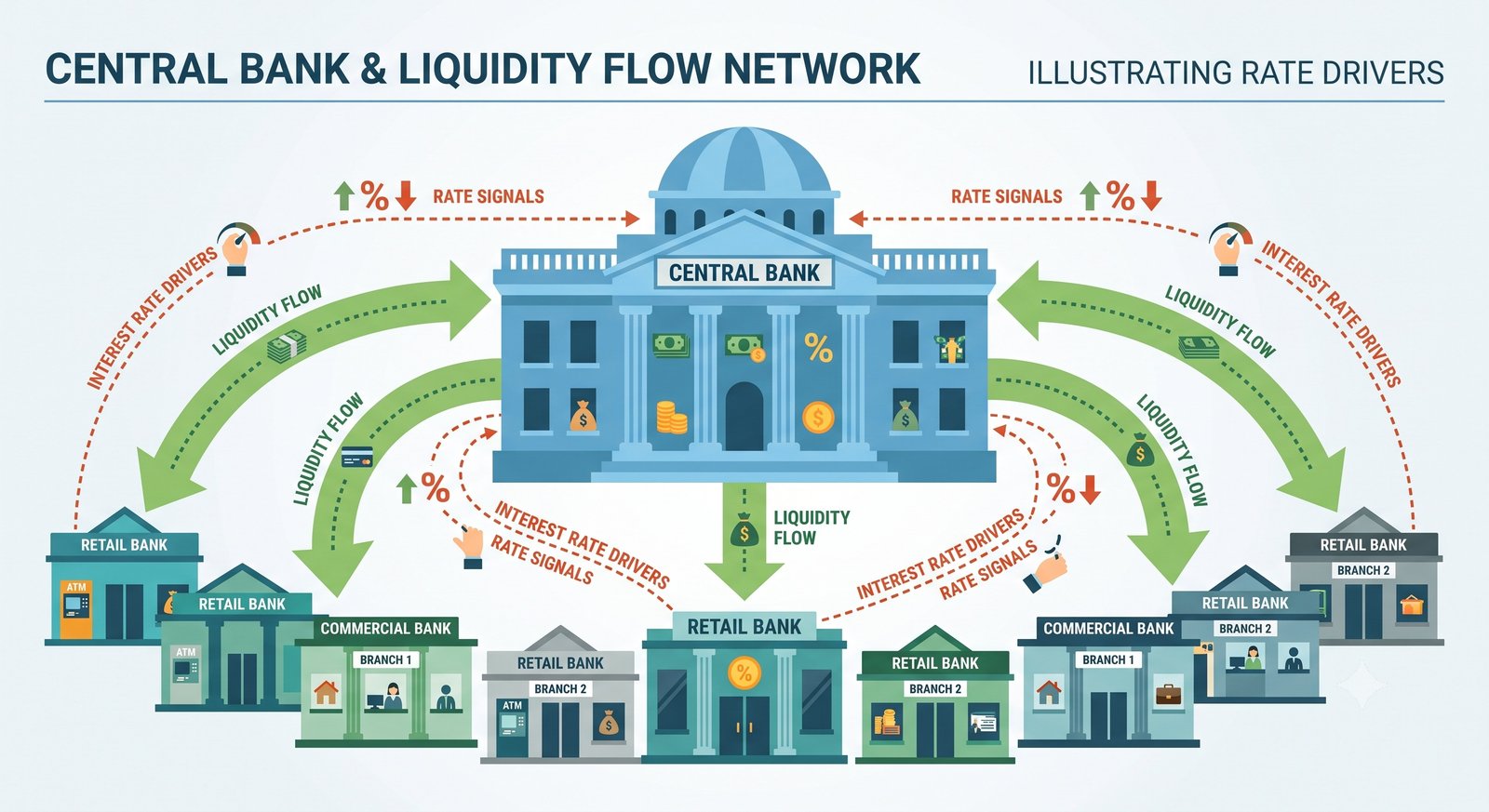
Within this broader fixed-income asset class, a High-Yield Fixed Deposit distinguishes itself by offering interest rates that significantly exceed the standard macroeconomic baseline established by systemically important, tier-one retail banks. These premium yields are structurally engineered to attract substantial and immediate capital inflows. They serve as a critical liquidity generation mechanism for the issuing institution, allowing them to confidently fund long-term, high-margin lending operations such as commercial real estate mortgages, auto financing, or corporate credit facilities without the constant threat of a bank run.

Simultaneously, for the sophisticated depositor, high-yield fixed deposits function as a highly predictable, mathematically certain income-generating asset. They form the defensive, unyielding bedrock of a well-diversified portfolio, purposefully insulated from the daily mark-to-market volatility that characterizes public equity, cryptocurrency, and commodity exchanges. However, the elevated interest rates associated with high-yield fixed deposits do not manifest in an economic vacuum. The premium yield—often referred to as the illiquidity premium or credit risk premium—is the mathematical manifestation of specific economic tradeoffs. It is directly correlated with underlying central bank monetary policy, intense institutional liquidity demands, and, most critically, a slightly elevated credit risk profile compared to standard sovereign debt. Understanding these underlying mechanics, the precise risk-to-reward ratios, and the advanced strategies for deployment is essential for fiduciary-level fixed-income portfolio management.
1. Operational Mechanics and Contractual Architecture
The operational framework of a high-yield fixed deposit is governed by a rigid, bilateral contractual agreement between the depositor (acting as the unsecured creditor) and the financial institution (acting as the debtor). Unlike a standard demand deposit (checking account) or a High-Yield Savings Account (HYSA)—both of which offer immediate transactional liquidity—a fixed deposit is intrinsically time-bound. The core terms of this contract define the profitability, compound velocity, and constraints of the asset.
- Principal Amount (The Corpus): The initial lump sum of capital deposited into the account. Because high-yield instruments are costly for financial institutions to maintain and service, they frequently require higher minimum principal thresholds (e.g., $10,000 or ₹1,00,000) compared to standard retail savings products to justify the administrative overhead.
- Tenor (Maturity Duration): The specific timeline for which the capital is legally locked. Tenors can range from ultra-short durations of 7 to 14 days to extended, multi-year periods of up to ten years. The length of the tenor heavily dictates the position on the Yield Curve; generally, longer tenors command higher interest rates to compensate for extended illiquidity and inflation risk.
- Annual Percentage Yield (APY): The effective annual rate of return, taking into account the powerful mathematical effect of compounding interest. The APY represents the true, precise growth rate of the deposit over a one-year horizon, as opposed to the nominal interest rate which ignores compounding frequency.
- Interest Rate Invariability (The Lock-In Effect): The "fixed" nomenclature indicates that the interest rate established at the exact inception of the contract remains completely immutable throughout the entire life of the asset. It is impervious to subsequent fluctuations in the broader macroeconomic environment.
This invariability is a double-edged sword known as Interest Rate Risk. If central banking authorities unexpectedly enact dovish monetary policy (cutting rates to stimulate the economy), the fixed deposit holder continues to enjoy their locked-in, elevated yield, generating massive alpha over the declining broader market. Conversely, if hawkish monetary policy drives baseline interest rates upward to combat surging inflation, the depositor is contractually trapped in a suboptimal yield environment, suffering a severe opportunity cost until the instrument finally reaches its maturity date.
2. Deep-Dive Explanations & Formulas: The Mathematics of Yield
To accurately evaluate a high-yield fixed deposit, an investor must move beyond the advertised marketing rate and calculate the exact mathematical yield. Financial institutions differentiate between the Nominal Interest Rate (the stated rate) and the compound yield. High-yield instruments generate wealth by reinvesting the interest at specific intervals—typically daily, monthly, or quarterly. The formula to calculate the Future Value (Maturity Value) of a cumulative fixed deposit is derived from the standard compound interest equation:
Maturity Value (A) = P × (1 + r/n)^(n×t)
Where:
P = Principal investment amount
r = Annual nominal interest rate (expressed as a decimal)
n = Number of times that interest is compounded per year (e.g., 4 for quarterly, 12 for monthly)
t = Time the money is invested for, in years
For example, if an investor places $50,000 into a 3-year high-yield fixed deposit offering an 8% nominal rate compounded quarterly, the math is: A = 50,000 × (1 + 0.08/4)^(4×3). The equation resolves to 50,000 × (1.02)^12, resulting in a maturity value of $63,412.09. Because the interest was continually reinvested, the Effective Annual Yield exceeds the flat 8% stated rate.
High-yield instruments are generally categorized into two distinct architectural payout formats:
- Cumulative Fixed Deposits: As calculated above, the interest generated is never distributed to the investor during the active tenor of the asset. Instead, it is continually and automatically reinvested into the principal balance. The investor receives the original principal plus all compounded interest as a single, consolidated lump-sum payout at maturity. This structure is universally optimal for long-term wealth creation.
- Non-Cumulative Fixed Deposits: This structure actively extracts the generated interest and distributes it directly to the investor's linked savings or checking account at regular, predetermined intervals (monthly, quarterly, or annually). While this prevents the capital from achieving exponential compounding growth, it provides the investor with a highly predictable, recurring income stream. Non-cumulative FDs are exceptionally popular among retirees seeking to subsidize their living expenses through passive fixed-income yields.
3. Institutional Typology: Why Do High Yields Exist?
The aggressive rates associated with high-yield fixed deposits are not an anomaly of the market; they are carefully calibrated mechanisms reflecting specific institutional positioning. Not all FDs are created equal. The market is segmented into distinct tiers based on the issuing institution, each carrying a different risk premium.
- Tier 1 Retail Banks (Low Yield, Zero Risk): Massive, systemically important multinational banks (e.g., JPMorgan Chase, State Bank of India) possess trillions in existing consumer demand deposits. They do not desperately need your capital to fund their loan books. Therefore, they offer extremely low, sub-inflationary interest rates on their CDs/FDs.
- Challenger Neobanks & Credit Unions (High Yield, Zero Risk): Digital-only "neobanks" and regional credit unions lack massive, historically entrenched retail deposit bases. To aggressively fund their loan portfolios, these challenger banks must acquire capital swiftly. By offering high-yield premiums, they effectively pay a higher customer acquisition cost to siphon deposits away from tier-one competitors. Because online institutions operate without the exorbitant overhead costs associated with physical branch networks, they can comfortably pass these operational savings to the consumer in the form of higher APYs, while still retaining full government deposit insurance.
- Corporate Fixed Deposits / NBFCs (Highest Yield, Elevated Risk): A substantial segment of the high-yield market consists of Corporate Fixed Deposits issued by Non-Banking Financial Companies (NBFCs), real estate developers, or massive manufacturing conglomerates. Because these corporate entities do not possess commercial banking licenses, they cannot access cheap central bank liquidity windows. To raise operational capital, they turn directly to the retail investor market. To compensate the retail investor for bypassing traditional, heavily insured banking intermediaries and accepting direct corporate counterparty risk, these corporate FDs must offer yields that significantly surpass standard bank rates.
4. Structural Comparison: Fixed-Income Yield Vehicles
To determine the optimal placement for capital, investors must weigh the structural trade-offs of High-Yield FDs against competing fixed-income assets in the macroeconomic landscape.
| Instrument Type | Liquidity Profile | Interest Rate Volatility | Credit Default Risk |
|---|---|---|---|
| High-Yield Savings Account (HYSA) | Very High (T+1 Settlement) | High (Floating rate changes at any time) | Zero (Backed by Sovereign Deposit Insurance) |
| Bank Fixed Deposit (FD / CD) | Low (Locked; penalizes premature withdrawal) | Zero (Locked at contract inception) | Zero (Backed by Sovereign Deposit Insurance) |
| Corporate Fixed Deposit (NBFC) | Very Low (Often prohibits premature exit) | Zero (Locked at contract inception) | Moderate to High (Subject to corporate bankruptcy; Uninsured) |
| Treasury Bills (T-Bills) | High (Can be sold on secondary market) | Zero if held to maturity | Zero (Backed by Federal Government) |
5. Structural Vulnerabilities: Liquidity Traps and Inflationary Drag
Fixed deposits are universally marketed as zero-risk assets due to their guaranteed nominal returns and strict principal protection. However, this categorization is fundamentally incomplete. High-yield fixed deposits carry highly specific, insidious structural risks that can severely degrade the investor's actual purchasing power over time.
The most immediate structural threat is Liquidity Risk. High-yield FDs strictly mandate capital immobility. If an investor experiences a severe financial emergency and requires access to their locked capital prior to the maturity date, the issuing institution will enforce a premature withdrawal penalty. This typically involves calculating the interest not at the high contracted rate, but at the lower, baseline rate applicable for the shorter duration the money was actually held, and then subtracting an additional 1% to 2% penalty. This effectively destroys the high-yield advantage the investor initially sought.
The second, more pervasive threat is Macroeconomic Inflation and Tax Drag. The true economic success of a fixed-income investment is measured exclusively by the "Real Rate of Return." The real rate calculates the actual growth in purchasing power by adjusting the nominal yield against inflation, utilizing the Fisher Equation: Real Rate = [(1 + Nominal Rate) / (1 + Inflation Rate)] - 1.
This reality is exacerbated by taxation. In almost all global jurisdictions, the interest generated by fixed deposits is treated as ordinary income and taxed at the investor's marginal tax rate. If an investor in a 30% tax bracket holds an FD yielding 8%, the Tax-Equivalent Yield formula dictates their actual take-home yield is only 5.6% (Yield × (1 - Tax Rate) = 8% × 0.70). If the inflation rate is concurrently running at 6.0%, the investor's Real Rate of Return is profoundly negative. The capital is growing numerically, but the investor is mathematically losing wealth and purchasing power over time.
6. Empirical Case Studies in Yield Optimization
Case Study 1: The Interest Rate Trap (Duration Mismatch)
Scenario: In 2020, central bank interest rates hit rock bottom due to global economic stimulus. A highly conservative investor, Arthur, secures a $100,000 High-Yield Fixed Deposit at a regional bank. The bank offers a "premium" 3.5% APY, but requires a 5-year lock-in period. Arthur accepts, desiring guaranteed income.
The Mechanics of Failure: By 2022, rampant inflation forces the central bank to aggressively hike interest rates. Standard 1-year FDs and risk-free Treasury Bills are suddenly yielding 5.5%. Arthur is trapped. If he breaks his 5-year FD to reinvest at the new, higher 5.5% rate, the bank will charge him a 2% penalty on his accrued interest, negating the benefit. He is forced to hold the 3.5% asset during an era of 7% inflation, resulting in massive wealth destruction. Arthur suffered from a severe Duration Mismatch, locking capital for too long during a low-rate macroeconomic trough.
Case Study 2: The Corporate Arbitrageur (Credit Default Risk)
Scenario: Maya wants to maximize yield on her $50,000 emergency fund. A commercial bank offers a 6.0% insured FD, but a prominent real estate NBFC offers a "Corporate Platinum Fixed Deposit" yielding 9.5%. Tempted by the massive 3.5% premium (the credit risk premium), Maya places her entire emergency fund into the 3-year Corporate FD.
The Mechanics of Failure: In Year 2, the real estate market contracts sharply. The NBFC faces a severe liquidity crisis, defaults on its commercial paper, and enters bankruptcy proceedings. Because the Corporate FD was an unsecured loan without government deposit insurance, Maya is legally classified as an unsecured creditor. After years of litigation, she recovers only 40 cents on the dollar ($20,000) of her principal. Maya misunderstood the risk-profile; she attempted to use a risk-bearing corporate instrument to house capital that required absolute preservation.
7. Actionable Strategy Guide: Executing the Fixed Deposit Ladder
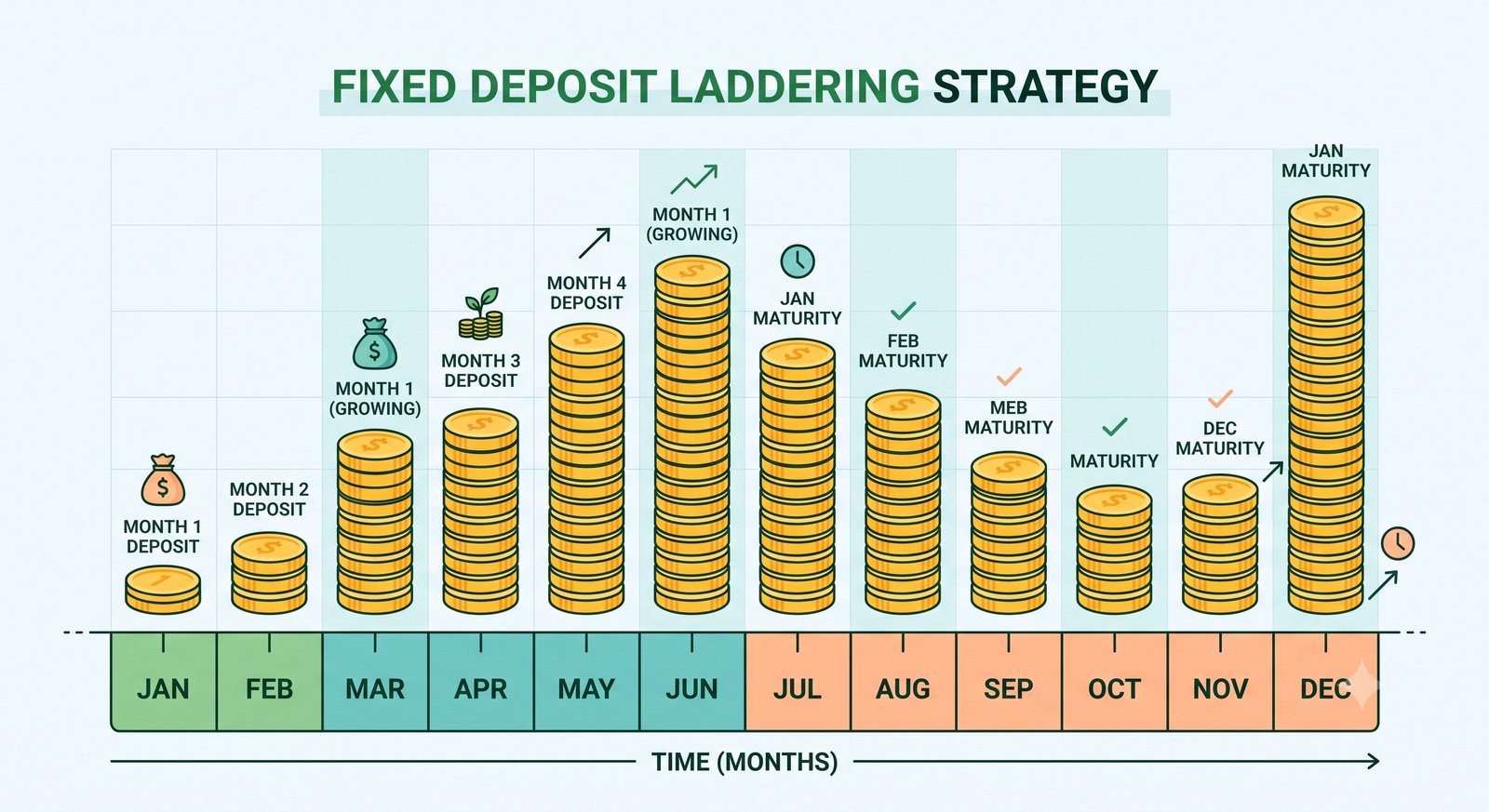
To systematically mitigate the inherent Reinvestment Risk (being forced to reinvest when rates drop) and severe liquidity constraints associated with locking up capital, sophisticated retail and institutional investors employ an advanced portfolio management technique known as Fixed Deposit Laddering. This strategy involves deliberately fractionating a large lump sum of capital into multiple, smaller fixed deposits, each engineered with a sequentially different maturity date.
- Step 1: Determine the Capital Allocation. Identify the total sum of risk-averse capital you wish to deploy. For this example, assume $100,000.
- Step 2: Fractionate the Corpus. Divide the $100,000 into five equal $20,000 tranches (the "rungs" of the ladder).
- Step 3: Execute Staggered Originations. Simultaneously invest the five tranches into separate high-yield FDs with staggered maturities: 1-Year ($20k), 2-Year ($20k), 3-Year ($20k), 4-Year ($20k), and 5-Year ($20k). Because longer tenors typically yield more, the 5-year tranche will secure the highest interest rate.
- Step 4: The Reinvestment Loop. After exactly 12 months, the initial 1-Year FD matures, making $20,000 (plus interest) perfectly liquid. If you do not need the cash, you immediately reinvest this matured capital into a brand new 5-Year FD at the back of the ladder.
- Step 5: Maintain the Perpetual Machine. By repeating Step 4 annually, you create a perpetual financial engine. After the first 4 years, every single "rung" on your ladder is earning the premium 5-Year interest rate, yet you have one FD maturing and becoming 100% liquid every 12 months.
The logistical advantages of the laddering strategy are profound. Primarily, it mathematically guarantees that a designated portion of the investor's portfolio becomes perfectly liquid annually, neutralizing the threat of premature withdrawal penalties. Furthermore, it completely eliminates the psychological stress and mathematical difficulty of attempting to perfectly time the macroeconomic interest rate cycle. Because the investor is constantly reinvesting maturing tranches into new long-term deposits, they naturally capture and average out prevailing market rates over a multi-year horizon.
8. Frequently Asked Questions (FAQ)
Q: Is it possible to lose my original principal amount in a Fixed Deposit?
If the Fixed Deposit is held at a licensed, federally insured commercial bank or credit union, the loss of principal is functionally impossible up to the statutory insurance limits (e.g., $250,000 under the FDIC). Even if the bank collapses, the government will restore your funds. However, if you place your money in a Corporate Fixed Deposit issued by an NBFC or private company, there is zero government backing. If that corporation goes bankrupt, you become an unsecured creditor and can lose 100% of your principal. Always verify the insurance status of the issuing institution.
Q: How do banks calculate the penalty if I break my Fixed Deposit early?
Premature withdrawal penalties are punitive by design. Banks generally recalculate your interest retroactively. They look at how long the money was actually held (e.g., you broke a 5-year FD after only 2 years). They then apply the interest rate they would have offered you for a 2-year FD, which is lower than the 5-year rate. Finally, they subtract a strict penalty fee (usually 1% to 2%) from that revised rate. In severe cases, breaking an FD very early can result in receiving back slightly less than your original principal due to the math of the penalty exceeding the accrued interest.
Q: Are Fixed Deposits better than bond mutual funds for generating income?
They serve different structural purposes. An FD guarantees your principal; if you put in $10,000, you are guaranteed to get $10,000 back plus exactly the agreed interest. Bond mutual funds and ETFs consist of hundreds of underlying bonds trading on the open market. Therefore, the principal value of a bond fund fluctuates daily based on interest rate movements. If interest rates rise rapidly, the principal value of your bond fund will crash, meaning you could lose money if you sell. FDs provide absolute principal security, while bond funds provide liquidity and the potential for capital appreciation.
Q: Can I negotiate the interest rate on a High-Yield Fixed Deposit?
For standard retail deposits (under $100,000), interest rates are algorithmic, publicly advertised, and strictly non-negotiable. However, for High Net Worth Individuals (HNWIs) or corporate treasuries placing "jumbo" or bulk deposits (often exceeding $1,000,000), relationship managers and private bankers have discretionary authority to negotiate custom yields. These negotiated rates are based on the bank's immediate liquidity requirements and the investor's broader relationship with the institution (e.g., moving commercial loan portfolios or wealth management accounts to the bank).
See also
- Loading related topics...