Index Funds Explained
1. The Philosophy and History of Passive Investing
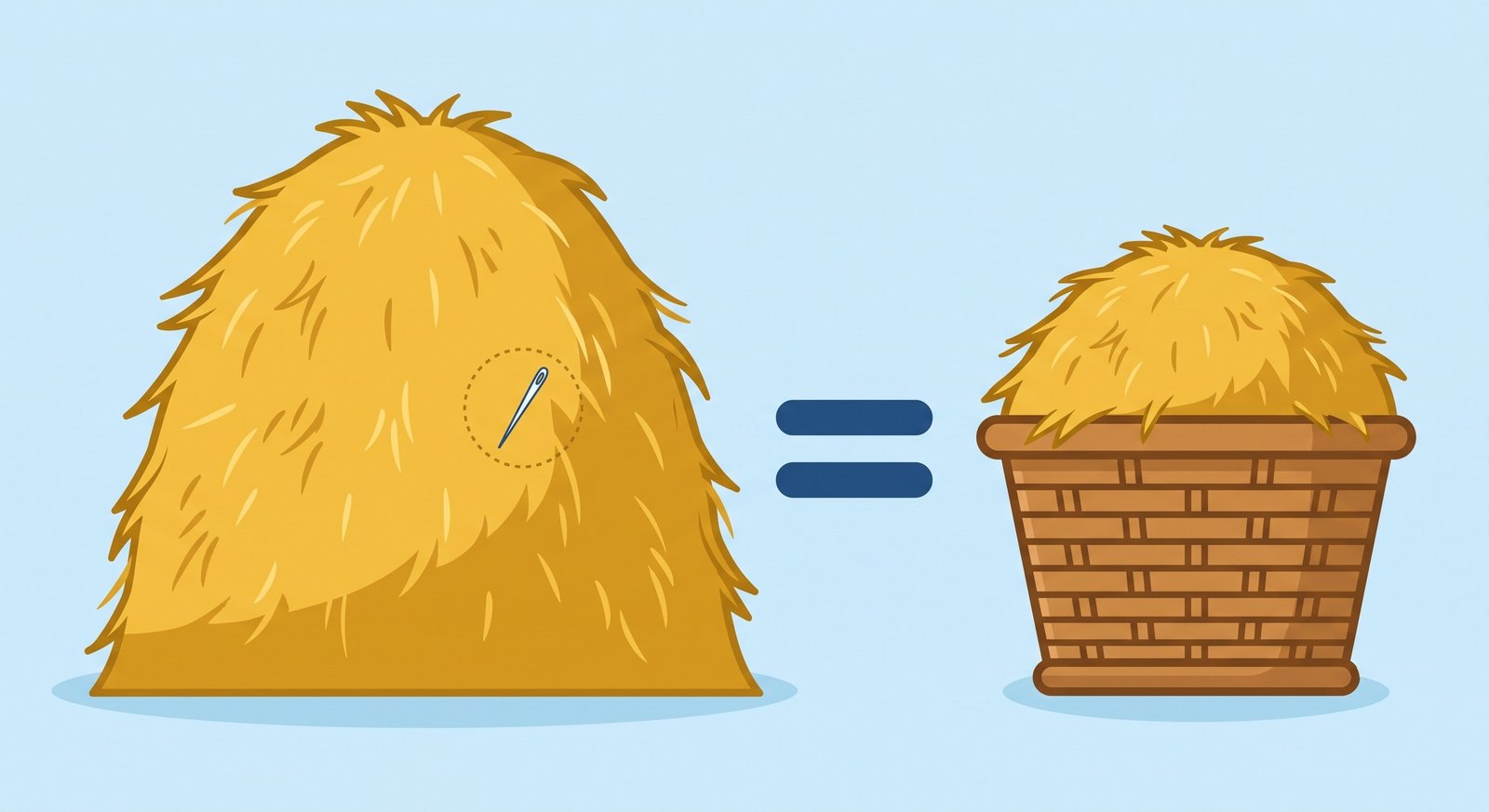
An index fund is a type of mutual fund or exchange-traded fund (ETF) that features a portfolio constructed to match or track the components of a financial market index, such as the Standard & Poor's 500 Index (S&P 500) or the Nifty 50. Instead of relying on a highly paid portfolio manager to actively buy and sell stocks in an attempt to "beat the market," an index fund passively buys all (or a representative sample) of the securities in a specific index. This foundational shift in investing mechanics replaces human forecasting with algorithmic, rules-based replication.
The history of the index fund is inextricably linked to John C. Bogle, who founded The Vanguard Group and launched the First Index Investment Trust in 1976. At the time, the concept was derided by Wall Street as "Bogle's Folly" and deemed "un-American" because it settled for average market returns rather than striving for exceptionalism. However, Bogle recognized a profound mathematical certainty: before costs, the return of all investors in the market is precisely equal to the market's return. After costs (management fees, trading commissions, taxes), the return of active investors must, by definition, fall short of the market. Over decades, this frictionless, low-cost approach has proven mathematically superior to active management in long-term performance.
Macroeconomically, index funds serve as democratizing vehicles. They allow retail investors to capture the overall growth of human productivity, corporate earnings, and inflation seamlessly. Because an index like the S&P 500 is naturally self-cleansing—dropping bankrupt or shrinking companies and adding thriving, innovative ones—an index fund investor inherently owns a dynamic, surviving slice of the global economy without lifting a finger.
2. Deep-Dive Explanations & Formulas: The Mechanics of Indexing
Understanding index funds requires exploring the underlying quantitative mechanics that govern their operation. Index funds do not simply hold an equal amount of every stock; they must adhere to the weighting methodology of the index they track. The most common methodology is Free-Float Market Capitalization Weighting.
- Market Capitalization Formula: The weight of any single company (i) in an index is calculated as: Weight(i) = (Price of Stock(i) * Free-Float Shares Outstanding(i)) / Total Market Capitalization of all Index Companies. If a company's stock price rises, its market capitalization increases, and the index fund automatically allocates a larger percentage of its capital to that company. This creates a momentum effect where winners run and losers shrink.
- Tracking Error: This is the most vital metric for evaluating an index fund's efficiency. Tracking error measures the annualized standard deviation of the difference in daily returns between the index fund and its benchmark. Formula: TE = Standard Deviation of (Return of Fund - Return of Index). A high tracking error means the fund manager is failing to replicate the index properly, often due to cash drag, transaction costs, or sampling inefficiencies.
- Expense Ratio Impact: The total expense ratio (TER) is deducted continuously. The formula for the final return is approximately: Net Return = Gross Market Return - TER - Tracking Difference. Because passive funds require minimal research and low turnover, their TER can be as low as 0.03%, compared to 1.5% for active funds.
3. Case Study 1: The Accumulation Phase and the Tyranny of Compounding Fees
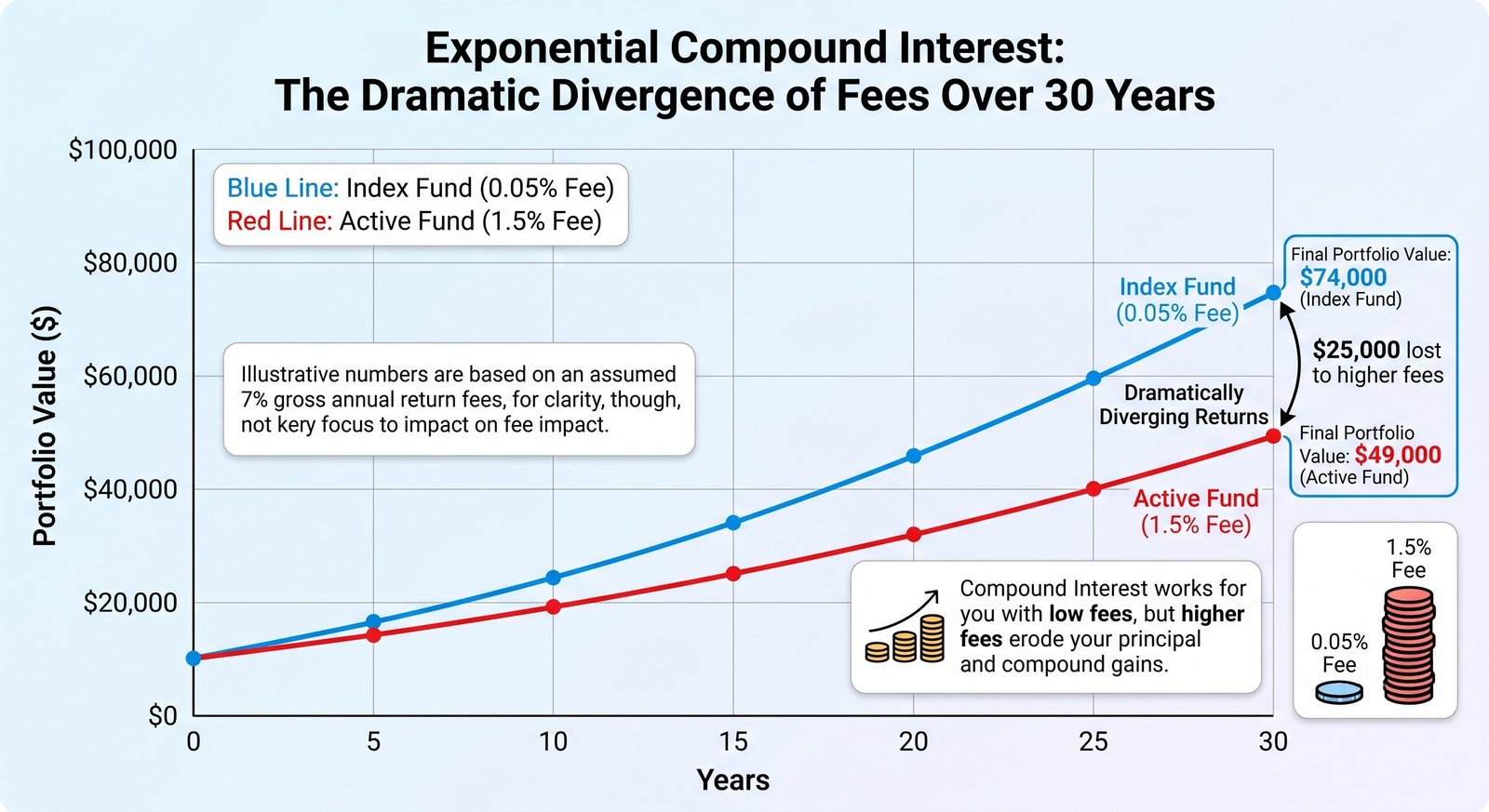
To grasp the true power of index funds, one must witness the mathematical devastation of fees over a long time horizon. Let us examine a realistic scenario comparing passive indexing against active management.
Scenario: Consider two investors, Emma and Liam, both 25 years old. They each invest $10,000 initially and contribute $1,000 every month to their retirement accounts for 35 years until age 60. The broader stock market returns a gross annualized rate of 8% over this duration.
Emma chooses a Total Stock Market Index Fund with an expense ratio of 0.05%. Liam, swayed by a bank advisor, chooses a "Five-Star" Active Growth Mutual Fund that charges a 1.50% expense ratio. Because active managers rarely beat the market consistently over three decades, we will assume Liam's fund matches the market's gross 8% return before fees. Therefore, Emma's net annualized return is 7.95%, while Liam's net return is 6.50%.
The Outcome: After 35 years, Emma's index fund portfolio grows to approximately $2,253,000. Liam's actively managed portfolio, however, grows to only $1,556,000. Despite both experiencing the same underlying market growth and contributing the exact same amount of principal, Liam surrendered nearly $700,000—almost one-third of his potential wealth—to Wall Street in the form of management fees. This case study highlights that in investing, you get exactly what you don't pay for.
4. Structured Comparison: Index Funds vs. Active Funds
The financial industry offers several vehicles for wealth creation. Understanding the fundamental differences in their structure, tax efficiency, and management style is critical for portfolio allocation.
| Metric / Feature | Passive Index Funds | Actively Managed Funds |
|---|---|---|
| Management Strategy | Rules-based algorithmic replication of a market benchmark. | Human-led stock picking, forecasting, and market timing. |
| Expense Ratio (TER) | Extremely Low (0.01% - 0.20%) | High (0.75% - 2.00%+) |
| Tax Efficiency | Highly efficient; low turnover results in fewer taxable capital gains. | Inefficient; high turnover generates frequent, unavoidable capital gains taxes. |
| Predictability | Will virtually guarantee matching market returns minus tiny fees. | High variance; manager risk can lead to severe underperformance. |
5. Case Study 2: Sequence of Returns Risk and Diversified Indexing
Index funds are not limited to equities. Total Bond Market index funds play a crucial role in wealth preservation during the retirement distribution phase, acting as a shock absorber against sequence of returns risk.
Scenario: Robert, age 65, retires with $1,000,000. He requires a $40,000 annual withdrawal (4% rule). If Robert held 100% of his wealth in an Equity Index Fund, and a major recession caused a 40% market crash in Year 1 of his retirement, his portfolio would plummet to $600,000. Withdrawing his necessary $40,000 forces him to sell an outsized number of shares at rock-bottom prices, permanently destroying his capital base and risking portfolio depletion before he dies.
The Solution: Robert implements a balanced index portfolio: 60% Total Stock Market Index Fund and 40% Total Bond Market Index Fund. When the equity market crashes by 40% in Year 1, his stock portion drops to $360,000. However, central banks typically lower interest rates during recessions, causing his high-quality Bond Index Fund to rise slightly, bringing its value to $420,000. Instead of selling depleted stocks, Robert withdraws his $40,000 entirely from the Bond Index Fund. This provides his equity index fund the critical time (2-3 years) needed to recover back to baseline levels, successfully preserving his wealth through asset class diversification.
6. Advanced Mechanics and Edge Cases
While indexing is robust, sophisticated investors must understand its edge cases. One such anomaly is Index Front-Running. When a committee (like S&P Dow Jones Indices) announces that a new stock will be added to the index, active hedge funds immediately buy the stock. They know that passive index funds are mathematically forced to buy millions of shares on the official inclusion date, driving the price up. By buying early and selling to the index funds, active traders siphon a small premium. To combat this, massive index providers have begun using sophisticated staggered buying algorithms to hide their footprints.
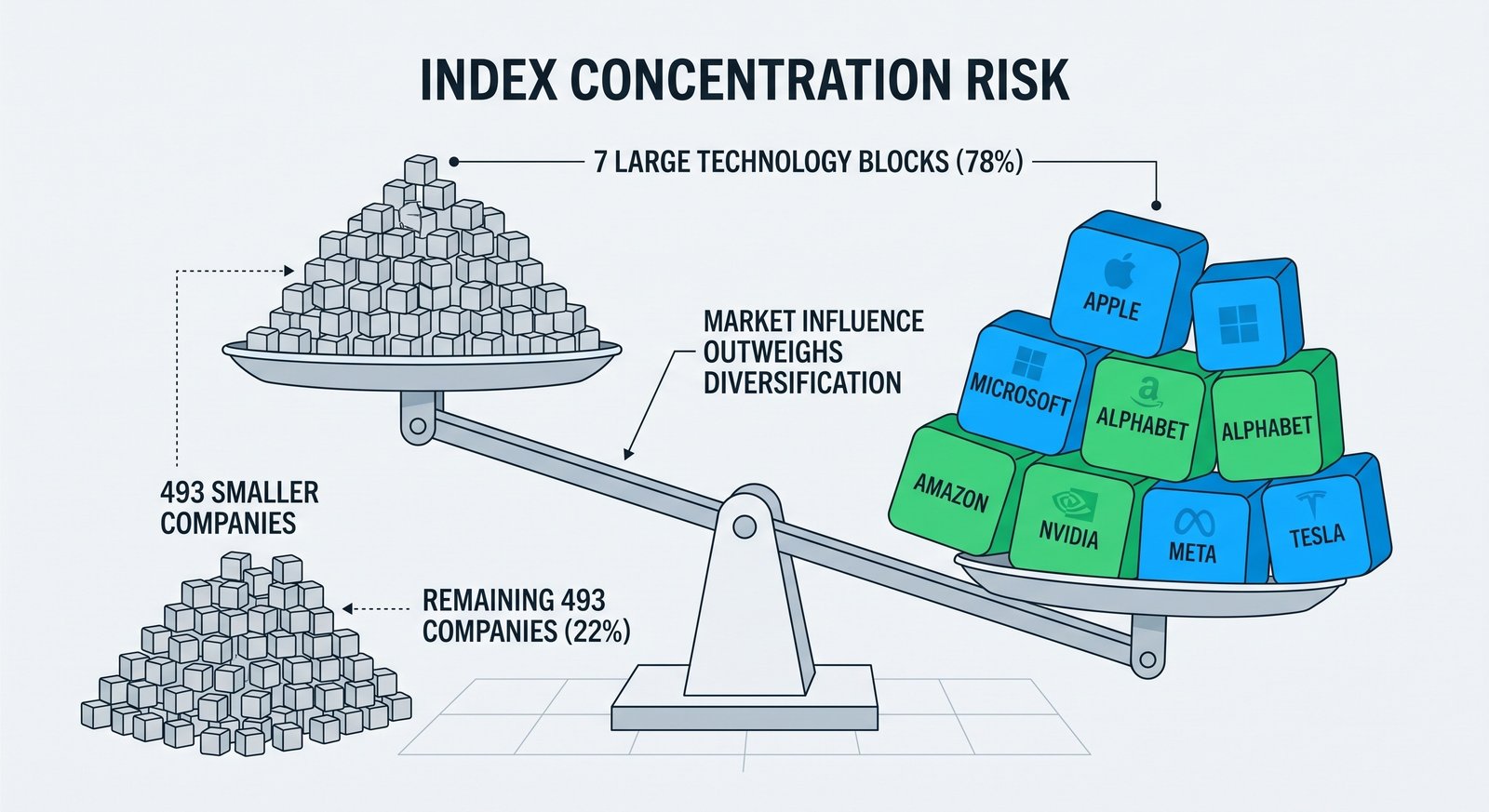
Another edge case is Top-Heavy Concentration Risk. Because indices are market-cap weighted, a prolonged bull market in a specific sector can heavily skew the index. For instance, in the 2020s, a handful of mega-cap tech companies (often dubbed the "Magnificent Seven") grew to represent nearly 30% of the entire S&P 500's weight. Investors buying a broad index fund during this period were inadvertently making a massive, concentrated bet on the technology sector. If those specific stocks suffer a severe regulatory or macroeconomic shock, the "diversified" index will plummet almost as severely as the individual stocks.
7. Actionable Strategy Guide: Implementing a Boglehead Portfolio
Knowledge without execution is futile. To apply the principles of indexing, one can construct the renowned "Three-Fund Portfolio," a strategy popularized by the Bogleheads community that offers maximum global diversification with minimal complexity.
- Step 1: Select a Domestic Equity Index Fund: Allocate the core of your portfolio to a Total Domestic Stock Market Index Fund. This captures the thousands of publicly traded companies in your home country, providing the primary engine for long-term growth. Ensure the TER is below 0.10%.
- Step 2: Add an International Equity Index Fund: To protect against domestic economic stagnation, allocate 20% to 40% of your equity portion to an International/Global Index Fund. This diversifies your geographic and currency risk across developed and emerging markets worldwide.
- Step 3: Integrate a Total Bond Market Index Fund: Based on your age and risk tolerance (e.g., your age minus 10 in percentage terms), purchase a broad bond index fund. This provides downside protection, regular interest income, and dry powder to rebalance during stock market crashes.
- Step 4: Automate and Ignore: Set up automated monthly contributions across these three funds. Do not check the balances during market panics. Rebalance the portfolio strictly once a year to bring the target percentages back in line, forcing you to buy low and sell high automatically.
8. Frequently Asked Questions (FAQ)
Q: Can an index fund's value ever drop to exactly zero?
Theoretically, it is virtually impossible for a broad market index fund to reach absolute zero. For an index like the S&P 500 to hit zero, all 500 of the largest corporations in the United States would have to go entirely bankrupt on the exact same day. Because the index continuously replaces failing companies with rising ones, the structure protects against total systemic collapse.
Q: How do index funds handle corporate dividends?
When the underlying companies within the index pay out dividends, the index fund manager collects this cash. Depending on the fund structure (Growth/Accumulation vs. Distribution/Income), the manager will either automatically reinvest those dividends to buy more shares of the index (increasing the Net Asset Value), or distribute the pooled dividends as cash to the fund's shareholders on a quarterly or annual basis.
Q: Are ETFs and Index Funds the exact same thing?
No, though the terms are often used interchangeably. "Indexing" is an investment strategy, while a Mutual Fund and an Exchange-Traded Fund (ETF) are simply the legal wrappers that hold the investments. You can buy an S&P 500 Index Mutual Fund (priced once daily) or an S&P 500 Index ETF (traded continuously throughout the day). Conversely, there are many actively managed ETFs that do not track indices at all.
Q: Why do two different index funds tracking the same benchmark have slightly different returns?
This variance is caused by Tracking Error and Expense Ratios. One fund might charge 0.03% while another charges 0.15%. Additionally, some massive funds can perfectly buy all the underlying stocks, while smaller funds might use "representative sampling," buying only a selection of stocks to mimic the index, which introduces slight statistical deviations in daily performance.
Q: Do I need to pay capital gains tax just by holding an index fund?
Generally, index funds are extremely tax-efficient because they rarely sell stocks, which avoids triggering capital gains distributions. However, if a company is removed from the index (e.g., due to falling market cap or being acquired), the fund is forced to sell those shares. If sold at a profit, the fund must pass those capital gains distributions onto the shareholders, who may owe taxes on them depending on their local jurisdiction and account type.
See also
- Loading related topics...