National Pension System (NPS)
The Definitive Guide to India's Sovereign Market-Linked Retirement Architecture
The National Pension System (NPS) represents one of the most profound structural reforms in the history of Indian macroeconomic policy. Introduced to systematically address the looming pension liabilities of the state and subsequently opened to all Indian citizens, the NPS constitutes a paradigm shift from a Defined Benefit (DB) pension architecture to a Defined Contribution (DC) framework. Managed under the regulatory purview of the Pension Fund Regulatory and Development Authority (PFRDA), the NPS is arguably the most cost-efficient, mathematically rigorous, and tax-advantaged long-term retirement vehicle available globally.
Prior to 2004, the Indian government operated under a Defined Benefit system where civil servants were guaranteed a pension based on their last drawn salary, regardless of their lifetime contributions. As life expectancies increased and the workforce expanded, the government recognized this liability was mathematically unsustainable, prompting the commissioning of the OASIS (Old Age Social and Income Security) report in 1999. The result was the NPS—launched initially for government employees joining on or after January 1, 2004, and subsequently democratized for the general public (the "All Citizen Model") in 2009. Unlike the Employees' Provident Fund (EPF) or Public Provident Fund (PPF), which offer guaranteed, politically-determined interest rates, the NPS is fundamentally a market-linked instrument. It forces investors to actively or passively participate in the capital markets across Equities, Corporate Bonds, and Government Securities to organically outpace inflation.
1. Structural Anatomy: PRAN, Tier I, and Tier II Accounts
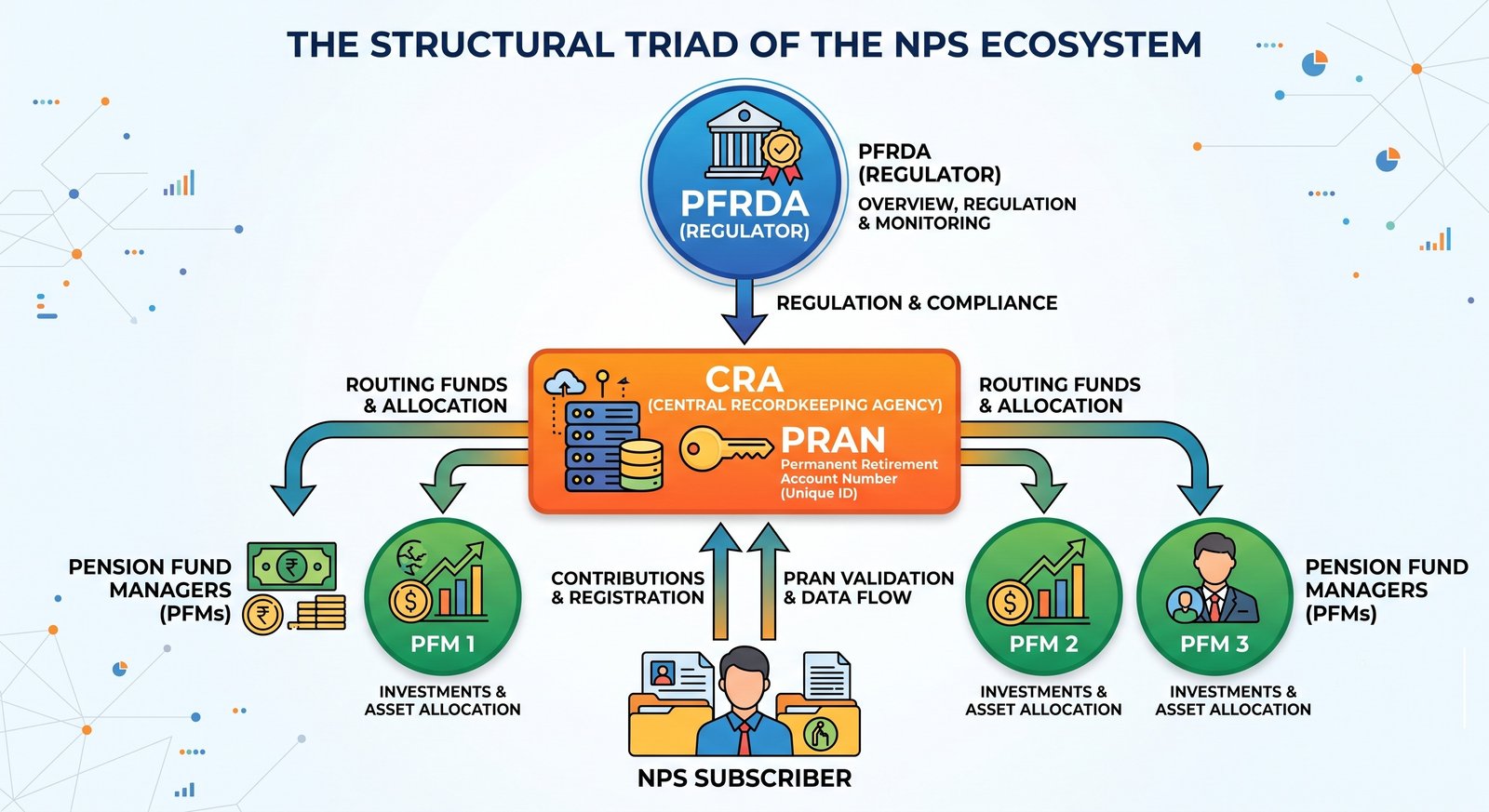
The operational foundation of the NPS rests on a unique, highly portable identifier known as the Permanent Retirement Account Number (PRAN). Unlike traditional provident funds that were historically plagued by job-switching friction and fragmented accounts, the PRAN remains static throughout an individual's lifetime, moving seamlessly across employers, geographies, and employment statuses (from salaried to self-employed).
Under a single PRAN, a subscriber can operate two distinct sub-accounts, each with drastically different liquidity parameters and taxation rules:
- Tier I Account (The Mandatory Core): This is the primary retirement account. It is subject to extreme lock-in rules (restricted until age 60 or superannuation). Withdrawals are severely penalized or entirely prohibited before maturity, enforcing strict financial discipline. Contributions to this tier qualify for exclusive tax deductions. Opening a Tier I account is mandatory to participate in the NPS.
- Tier II Account (The Voluntary Overlay): This functions essentially as an ultra-low-cost mutual fund. It requires an active Tier I account to exist but has absolutely no lock-in period. A subscriber can deposit or withdraw capital at any time without exit loads. However, because of its extreme liquidity, Tier II contributions (for the general public) do not qualify for any Section 80C or 80CCD tax benefits, and the capital gains are fully taxable as per the investor's marginal income tax slab.
The management of these funds is not handled directly by the government. The NPS relies on a robust "unbundled" architecture. When you invest, your transaction is processed by a Point of Presence (PoP) (usually your bank). The data and accounting are managed by the Central Recordkeeping Agency (CRA) (like NSDL or KFintech). The actual money is routed to a Pension Fund Manager (PFM) (like HDFC, SBI, or ICICI Pension Funds) of your choosing. The assets themselves are held safely by a Trustee Bank and Custodian. This separation of powers ensures that even if your chosen PFM collapses, your underlying assets remain secure and accounted for.
2. Asset Allocation: The Risk-Return Spectrum and Lifecycle Matrices
The primary mechanism by which the NPS combats inflation and generates retirement wealth is through diversified capital market exposure. Subscribers do not select individual stocks or bonds. Instead, they allocate their capital as percentages across four distinct macroeconomic Asset Classes:
- Asset Class E (Equity): Funds are invested in shares of large-cap and mid-cap companies listed on the BSE and NSE. This is the high-risk, high-return engine of the portfolio, historically providing the highest alpha over long horizons.
- Asset Class C (Corporate Debt): Funds are invested in high-rated fixed-income instruments issued by public and private sector corporations, infrastructure bonds, and PSU bonds. It offers moderate yields with medium credit risk.
- Asset Class G (Government Securities): Capital is deployed into sovereign bonds (State and Central Government Securities). This carries zero default risk but is highly sensitive to interest rate fluctuations (duration risk).
- Asset Class A (Alternative Assets): A minor allocation (capped at 5%) into Real Estate Investment Trusts (REITs), Infrastructure Investment Trusts (InvITs), Commercial Mortgage-Backed Securities, and Alternative Investment Funds (AIFs).
Investment Choices (Active vs. Auto): The PFRDA allows subscribers to choose exactly how their money is divided among these classes, acknowledging that a 25-year-old and a 55-year-old require fundamentally different risk profiles.
Under Active Choice, the subscriber manually dictates the percentage allocation. For instance, an aggressive investor might choose 75% in 'E', 15% in 'C', and 10% in 'G'. However, to prevent older individuals from suffering catastrophic sequence-of-returns risk right before retirement, the PFRDA caps Equity exposure at 75% up to age 50. After age 50, the maximum allowable Equity exposure automatically tapers down by 2.5% each year, mandating a shift into safer debt assets.
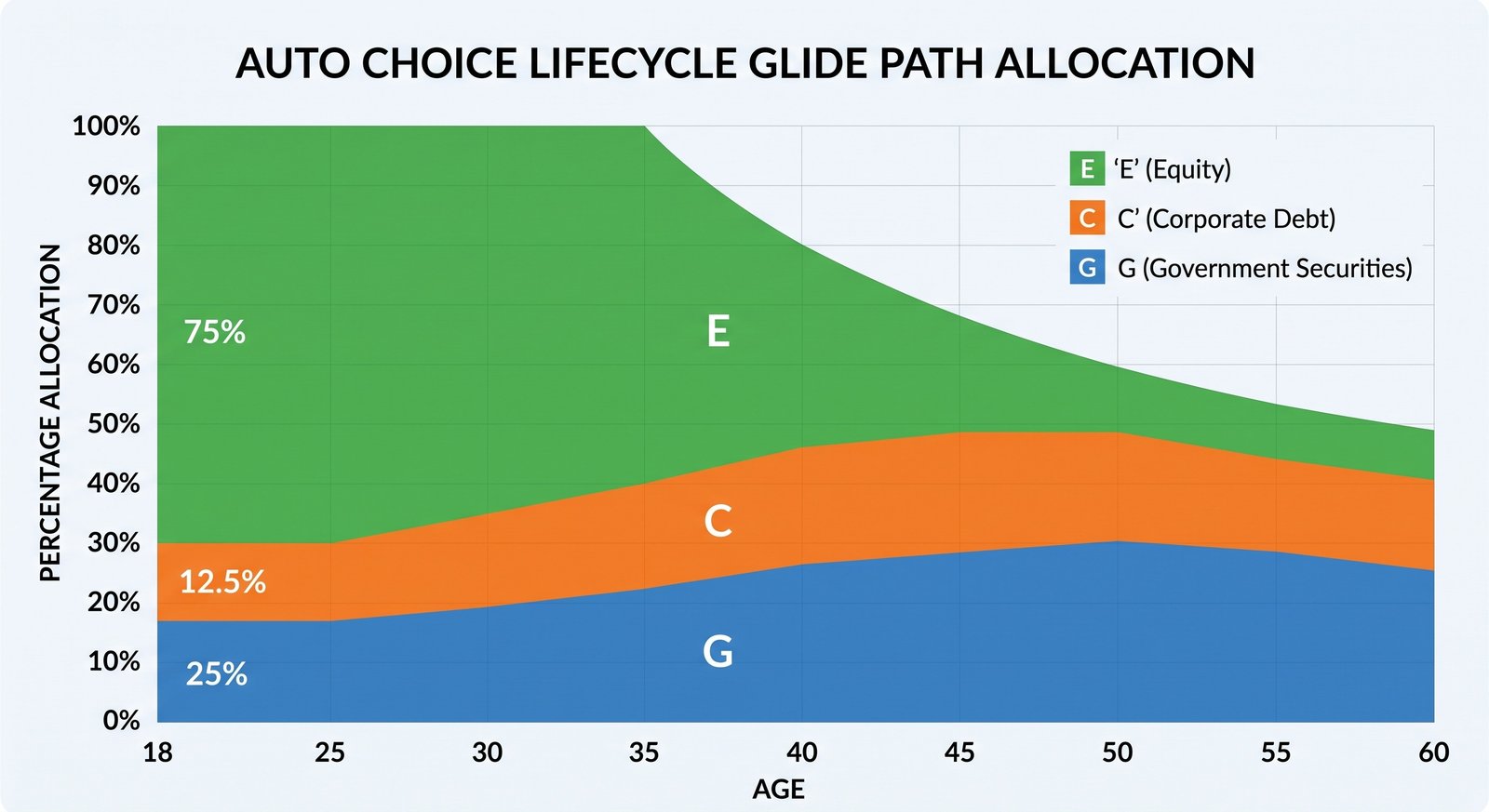
For investors who lack the financial acumen to actively manage their portfolios, the NPS offers Auto Choice (Lifecycle Funds). This operates on a predefined "glide path." The subscriber selects a risk profile—Aggressive (LC75), Moderate (LC50), or Conservative (LC25). If LC75 is chosen, the system locks Equity at 75% until the subscriber reaches age 35. Starting from their 36th birthday, the system algorithmically and automatically sells a fraction of their Equity holdings every year and reallocates it to Corporate and Government bonds. By age 55, the Equity allocation is mathematically reduced to just 15%, ensuring capital preservation as the retirement date approaches.
3. Deep-Dive Explanations & Mathematical Valuations
To truly appreciate the wealth-building capacity of the NPS, one must deconstruct the mathematics of compounding and annuity yields. Unlike traditional Fixed Deposits that accrue simple or quarterly compounded interest, NPS operates purely on a Net Asset Value (NAV) basis, identical to mutual funds. Every contribution buys "units" of the chosen Pension Fund.
The daily NAV of a specific asset class fund is calculated as:
NAV = (Market_Value_of_Assets + Accrued_Income - Total_Liabilities) / Total_Outstanding_Units
To project the future maturity corpus of a monthly NPS SIP (Systematic Investment Plan), financial planners rely on the Future Value of an Annuity formula (assuming end-of-period contributions):
FV = P × [ ((1+r)n - 1) / r ]
Where:
- FV: Expected Future Value (Maturity Corpus at age 60)
- P: Fixed monthly contribution amount
- r: Expected monthly rate of return (Annual Expected Return / 12)
- n: Total number of monthly contributions (Years to retirement × 12)
The Annuity Mathematics: The most contentious and misunderstood aspect of the NPS is its exit mandate. Upon reaching age 60, a subscriber can withdraw a maximum of 60% of the FV as a tax-free lump sum. The remaining 40% (at minimum) must be legally surrendered to a PFRDA-empanelled Life Insurance Company to purchase an Annuity (a pension). The monthly pension received is a function of the prevailing annuity yield rate at the exact time of retirement.
Monthly_Pension = (Annuity_Corpus × Annuity_Rate) / 12
If a subscriber reaches age 60 with a total corpus of ₹1 Crore, they may withdraw ₹60 Lakhs tax-free. They must buy an annuity with the remaining ₹40 Lakhs. If the prevailing annuity rate is 6% per annum, their guaranteed monthly pension will be ₹20,000 before taxes ((4,000,000 × 0.06) / 12). It is crucial to note that while the 60% lump sum is tax-exempt, the annuity payouts are treated as regular income and taxed according to the retiree's marginal tax slab in their senior years.
4. The Taxation Paradigm: The 80CCD Tax Arbitrage
The primary catalyst for the explosion in NPS adoption among the Indian salaried class is its unparalleled tax architecture under the Income Tax Act, 1961. The NPS operates under an "EET-ish" structure (Exempt-Exempt-Taxable, though highly modified), making it a formidable tool for minimizing current tax outgoes.
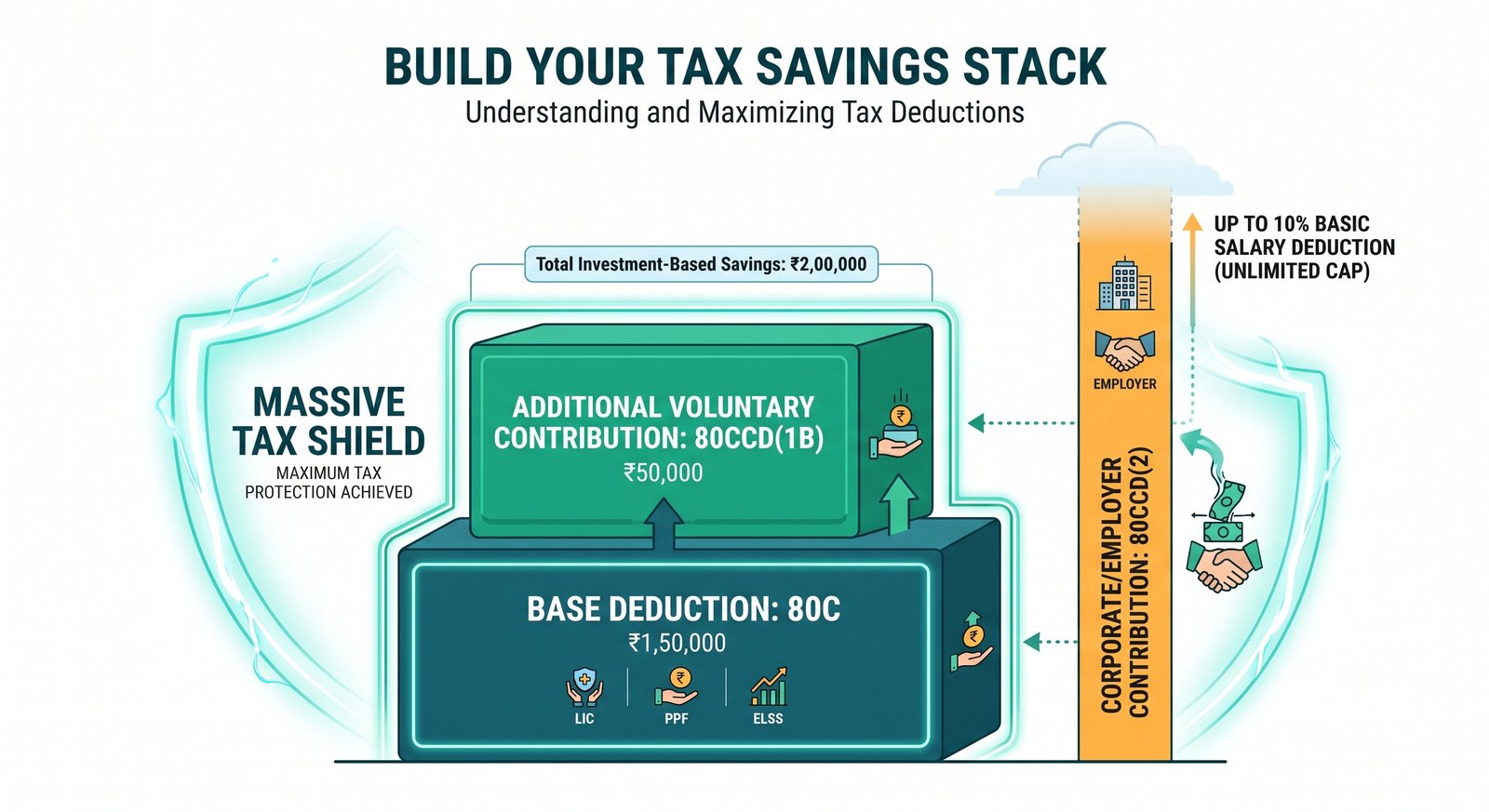
- Section 80CCD(1): Contributions made by the employee are eligible for a tax deduction up to 10% of their salary (Basic + DA), capped under the overarching Section 80CCE limit of ₹1,50,000. (This competes directly with EPF, PPF, and ELSS).
- Section 80CCD(1B): The Exclusive Shield. This is the golden goose of NPS. It provides an additional and exclusive tax deduction of up to ₹50,000 specifically for NPS Tier I contributions. This is over and above the ₹1.5 Lakh 80C limit. For an individual in the 30% tax bracket, investing ₹50,000 here yields an immediate, guaranteed ₹15,600 reduction in their annual tax liability.
- Section 80CCD(2): The Corporate Model. This is a macro-tax strategy for high-net-worth salaried individuals. If an employer routes up to 10% of the employee's Basic Salary directly into the employee's NPS account as an employer contribution, this entire amount is deductible from the employee's taxable income without any upper monetary cap (provided the aggregate contribution to EPF, NPS, and Superannuation does not exceed ₹7.5 Lakhs annually). This restructuring of CTC (Cost to Company) effectively renders 10% of one's basic salary completely tax-free during the accumulation phase.
5. Realistic Case Studies: Stress Testing the NPS Architecture
Theoretical mechanics are best understood when subjected to long-term projections and real-world tax constraints. Consider the following exhaustive edge cases.
Case Study 1: The Multi-Decade Compounding Effect (The Young Professional)
Arjun, aged 25, enters the workforce and immediately realizes the power of the exclusive 80CCD(1B) benefit. He decides to invest exactly ₹50,000 per year (approx. ₹4,166 per month) into NPS Tier I until he turns 60. He chooses the "Active Choice" and allocates 75% to Equity (E) and 25% to Corporate Bonds (C). Historically, large-cap Indian equities have returned 12%, and corporate bonds 8%. This creates a blended expected portfolio return of 11% (0.75 × 12 + 0.25 × 8).
- Total Capital Invested: ₹50,000 × 35 Years = ₹17,50,000.
- Maturity Corpus (at 11% CAGR): Through the sheer violence of geometric compounding over 35 years, his ₹17.5 Lakhs mutates into a staggering ₹1,71,00,000 (₹1.71 Crores).
- The Exit Mathematics: At age 60, Arjun claims his 60% tax-free lump sum, pocketing ₹1.02 Crores straight to his bank account. The remaining ₹68.4 Lakhs is surrendered for an annuity. Assuming a conservative 5.5% annuity rate three decades from now, he secures a lifelong monthly pension of ₹31,350. All of this was achieved merely by maximizing the ₹50k tax-saving window.
Case Study 2: Corporate NPS as a Macro Tax Shield (The Mid-Career Executive)
Priya, aged 40, is a VP at an IT firm with a Basic Salary of ₹2 Lakhs per month (₹24 Lakhs annually). She is in the highest 30%+ tax bracket. She has already exhausted her ₹1.5 Lakh 80C limit (via EPF) and her ₹50k 80CCD(1B) limit. She pays crushing income tax. She approaches HR to restructure her salary to utilize the Corporate NPS model under Section 80CCD(2).
- The Restructuring: Her employer deducts 10% of her Basic Salary (₹20,000 per month / ₹2.4 Lakhs per year) from her "Special Allowance" component and directly routes it to her PRAN as an employer contribution.
- The Tax Arbitrage: This ₹2.4 Lakhs is completely erased from her taxable income. By avoiding the 31.2% tax hit on this amount, she saves roughly ₹74,880 in pure taxes every single year. Furthermore, the money is now growing in an Equity/Debt blended market fund (NPS) rather than sitting as a highly taxed cash component in her salary slip.
6. Structured Comparison Table: NPS vs. EPF vs. Mutual Funds
To optimize asset allocation, investors must view the NPS not in isolation, but relative to traditional fixed income and modern equity alternatives.
| Feature / Metric | National Pension System (NPS) | Employees' Provident Fund (EPF) | ELSS Mutual Funds |
|---|---|---|---|
| Asset Class & Returns | Market-linked (Equity/Debt blend). Variable expected returns (9%-12%). | Fixed Income. Sovereign guarantee (historic ~8.15%). | Pure Equity. Market-linked. Highest volatility, highest potential alpha. |
| Tax Savings Status | Up to ₹1.5L (80C) + ₹50K (80CCD1B) + 10% Basic (80CCD2). | Up to ₹1.5L under standard Section 80C only. | Up to ₹1.5L under standard Section 80C only. |
| Expense Ratio (Fees) | Exceptionally low (Max 0.09% for PFMs). World's cheapest pension product. | No direct fee to employee, employer pays admin charges. | Relatively high (0.50% to 1.50% depending on active/direct plans). |
| Exit & Maturity Rules | Locked to age 60. 60% lump sum (tax-free). 40% mandatory taxable annuity. | Lump sum withdrawal at retirement is 100% tax-free. | 3-year lock-in. Entirely liquid thereafter. LTCG taxed at 12.5% above ₹1.25L. |
7. Actionable Strategy Guide: Optimizing Your NPS Account
A passive approach to NPS yields average results. To maximize the institutional advantages of the system, execute this step-by-step optimization framework.
- Step 1: Exploit the Corporate Model. If you are salaried, immediately engage your HR department to restructure your compensation to include the employer NPS contribution under Section 80CCD(2). It is the most powerful legal tax loophole available to the salaried class.
- Step 2: Reject Auto Choice if Under 45. The Auto Choice (Lifecycle) funds force you out of equity far too early. If you are decades away from retirement, the volatility of equity is your greatest ally against inflation. Select "Active Choice" and manually lock in the maximum 75% Equity allocation. Only begin tapering into debt manually when you are 5 to 7 years away from your target retirement date.
- Step 3: PFM Diversification Strategy. The PFRDA allows you to select different Pension Fund Managers for different asset classes. For example, you can select HDFC Pension for your Equity (E) class if they have strong index tracking, and ICICI Prudential for your Government Debt (G) class if they have superior duration management. Review your PFM's tracking error and returns annually and port your funds if they chronically underperform (allowed once per financial year without tax consequences).
- Step 4: The Tier II Mutual Fund Alternative. Do not ignore the Tier II account. Because NPS PFMs charge an expense ratio capped at 0.09% (compared to mutual funds charging 1.0%), Tier II operates as an ultra-cheap, highly liquid index fund. If you want pure debt exposure without mutual fund exit loads or lock-ins, routing capital into Tier II (Asset Class G or C) is mathematically superior over a 10-year horizon purely due to fee reduction.
8. Liquidity Architecture: Premature Exits and Partial Withdrawals
The primary psychological barrier to NPS adoption is the perception of illiquidity. While the system is designed to lock capital until age 60, the PFRDA has engineered specific release valves for genuine distress.
Partial Withdrawals: After completing 3 years in the NPS, a subscriber can withdraw up to 25% of their own contributions (excluding employer contributions and accumulated interest). This is strictly permitted only for specified reasons: higher education of children, marriage of children, purchase/construction of a primary residence, or treatment of critical illnesses. A maximum of 3 such partial withdrawals are allowed throughout the entire tenure, spaced at least 5 years apart.
Premature Exit (Before 60): If a subscriber wishes to close the account entirely before age 60, the rules are punitive. In a premature exit, the individual is allowed to withdraw a maximum of only 20% of the corpus as a lump sum. An overwhelming 80% of the corpus must be used to purchase a mandatory annuity. (Note: If the total accumulated corpus is less than ₹2.5 Lakhs, the entire 100% can be withdrawn as a lump sum without purchasing an annuity).
9. Frequently Asked Questions (FAQs)
Q: What happens to the NPS corpus if the subscriber passes away before maturity?
In the unfortunate event of the subscriber's death during the accumulation phase, the entire 100% of the accumulated Tier I and Tier II corpus is paid out as a lump sum to the registered nominee or legal heir. The nominee is not forced to purchase an annuity. Furthermore, this death benefit payout is completely exempt from income tax.
Q: Can I delay withdrawing my NPS corpus after I reach age 60?
Yes. The PFRDA allows subscribers to defer their exit. You can choose to delay the withdrawal of your lump sum and the purchase of the annuity until you reach the age of 75. Moreover, you can continue to actively contribute to the NPS and claim tax deductions during this extended period (between age 60 and 75), allowing your corpus to compound further if you have alternative income streams to support early retirement.
Q: Does the "Equity" portion of NPS invest in direct stocks or index funds?
The Pension Fund Managers (PFMs) manage Asset Class E passively. They are mandated by the PFRDA to replicate the portfolio of either the BSE Sensex or the NSE Nifty 50 indices. They do not engage in aggressive, active stock picking or sector rotation. This passive indexing strategy minimizes tracking error, reduces risk, and justifies the extraordinarily low fund management fees charged to the subscriber.
Q: Is the annuity payout guaranteed to keep up with inflation?
No. This is the primary structural weakness of the NPS exit phase. When you purchase an annuity at age 60, the insurance company locks in a fixed interest rate based on prevailing macro conditions. If they lock you in at 6%, you will receive exactly that fixed nominal amount until you die. It does not increase annually. Over 20 years, inflation will severely erode the purchasing power of this fixed pension. This is why aggressive growth during the accumulation phase is mathematically critical.
Q: Can Non-Resident Indians (NRIs) invest in the NPS?
Yes, NRIs can open an NPS Tier I account, provided they maintain a valid Indian passport and have a PAN card and an NRE/NRO bank account. However, NRIs are strictly prohibited from opening an NPS Tier II account due to Foreign Exchange Management Act (FEMA) restrictions regarding the high liquidity and repatriation complexities of the Tier II structure.
See also
- Loading related topics...