Public Provident Fund (PPF)
The Definitive Guide to India's Sovereign-Backed Tax-Free Wealth Creation Vehicle
The Public Provident Fund (PPF) stands as one of the most powerful, historically significant, and mathematically sound wealth-generation tools in the Indian personal finance ecosystem. Introduced in 1968 by the National Savings Institute under the Ministry of Finance, the PPF was originally designed to mobilize small savings from the unorganized sector, providing self-employed individuals and workers without pension safety nets a reliable avenue for retirement planning. Today, it has evolved into a cornerstone of asset allocation for nearly every class of Indian investor, prized for its unmatched trifecta of sovereign guarantee, tax-free compounding, and long-term forced discipline.
At its core, the PPF is a 15-year statutory scheme backed completely by the Government of India. This means it carries virtually zero credit risk. However, the true brilliance of the PPF lies in its "EEE" (Exempt-Exempt-Exempt) tax status under the Income Tax Act, 1961. This rare classification means that the capital invested is exempt from tax (up to specific limits), the interest accrued every year is exempt from tax, and the final maturity corpus is entirely tax-free. To master the PPF, one must move beyond basic deposit rules and understand the intricate mechanics of interest calculation, maturity extension strategies, and macroeconomic interest rate cycles.

1. Macroeconomic Mechanics: How PPF Rates Are Determined
A common misconception among retail investors is that the PPF interest rate is arbitrarily decided by the government. In reality, it is deeply tethered to macroeconomic indicators, specifically the yields on Government Securities (G-Secs). Prior to 2011, the PPF rate was relatively static. However, following the recommendations of the Shyamala Gopinath Committee, the Ministry of Finance fundamentally restructured the pricing mechanism of small savings schemes to make them market-linked.
Today, the PPF interest rate is reviewed and announced on a quarterly basis. The formula is pegged to the average secondary market yield of Government of India bonds with a comparable maturity (typically 10-year G-Secs) during the preceding three months, plus a mandated spread of 25 basis points (0.25%).
- Rising Rate Environments: When the central bank (RBI) hikes the repo rate to combat inflation, bond yields typically rise. Consequently, the PPF interest rate is usually revised upwards in subsequent quarters to maintain its 25 bps premium over G-Secs.
- Falling Rate Environments: During economic easing, when bond yields compress, PPF rates face downward pressure. However, because it is a politically sensitive retail instrument, the government sometimes delays rate cuts, creating a temporary artificial premium over market rates.
- The Compounding Dynamic: The interest rate applicable for a specific quarter applies only to that quarter. However, the interest is not paid out; it is credited to the account at the end of the financial year (March 31st), compounding annually thereafter.
2. Deep-Dive Explanations & Mathematical Formulas
The most critical mechanical flaw that plagues uneducated PPF investors is the timing of their deposits. To optimize a PPF account, one must understand the precise algorithm used by banks and post offices to calculate monthly interest.
The 5th-Day Rule: The PPF statute dictates that interest is calculated on the lowest balance in the account between the close of the 5th day and the end of the last day of every month. If you deposit funds on the 6th of a month, that deposit earns absolutely zero interest for that specific month, because the lowest balance between the 5th and the end of the month will be the balance before your deposit.
The mathematical formula for the annual interest (Iannual) credited at the end of the financial year is the sum of the monthly interests:
Iannual = ∑m=112 [ Bm × (rm / 12) ]
Where:
- Bm: The lowest balance in the account between the close of the 5th day and the end of month m.
- rm: The prevailing annualized PPF interest rate for that specific quarter, expressed as a decimal (e.g., 0.071 for 7.1%).
- 12: Denominator to convert the annualized rate into a monthly yield.
Because the interest is credited only on March 31st, the total maturity corpus (A) over n years (assuming a constant rate for simplicity) follows the standard compound interest formula for annual compounding with continuous periodic additions, mathematically represented as the future value of an annuity series if deposits are regular.
3. Realistic Case Studies
To translate macroeconomic theory and mathematical algorithms into actionable intelligence, let us examine two edge-case scenarios demonstrating the severe long-term impact of seemingly minor administrative decisions.
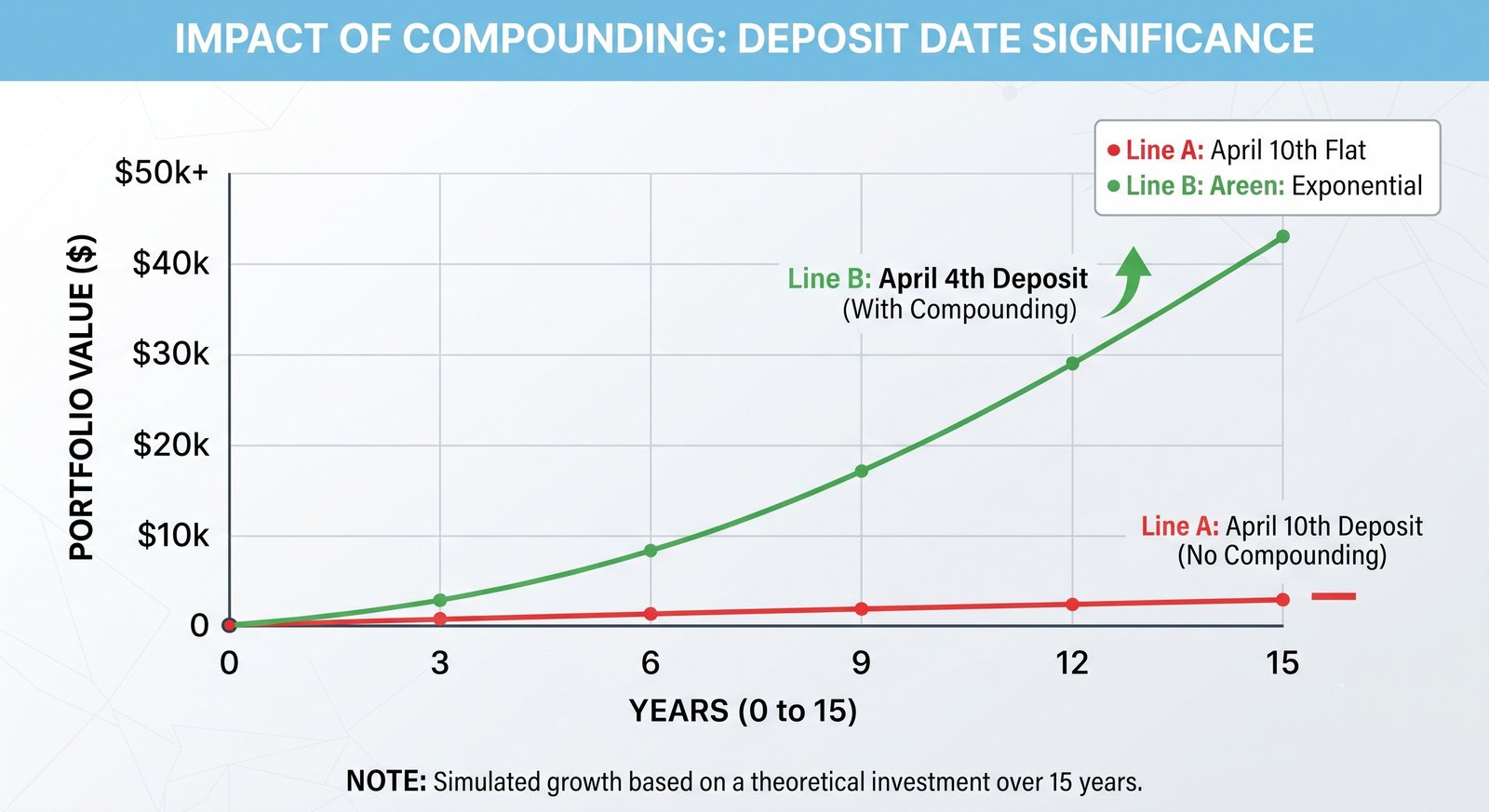
Case Study 1: The Multi-Lakh Cost of "April 6th" (Deposit Timing)
Arjun and Priya both invest the maximum allowable limit of ₹1,50,000 every year into their respective PPF accounts. The interest rate remains flat at 7.1% for the entire 15-year block.
- Arjun's Strategy: He deposits ₹1,50,000 every year on April 25th, after he receives his annual bonus.
- Priya's Strategy: She is meticulous and ensures her ₹1,50,000 deposit clears into her PPF account on April 4th of every financial year.
- The Mathematical Result: Because Priya deposits before the 5th, her ₹1.5 Lakh earns interest for the entire month of April (and thus, all 12 months of the year). Arjun’s deposit misses the 5th-day cutoff; therefore, his ₹1.5 Lakh earns zero interest for April and begins accruing interest only from May (11 months). Over 15 years, Priya’s corpus will mature at ₹40,68,209. Arjun’s corpus will mature at approximately ₹39,44,599. The simple act of depositing 21 days earlier yields Priya an extra ₹1,23,610 in pure, tax-free profit due to the mechanics of compounding.
Case Study 2: The Extension Dilemma (Retirement Hedging)
Vikram's PPF account reaches its 15-year maturity on March 31, 2024. He has a corpus of ₹45,00,000. He doesn't need the money immediately as he is 5 years away from retirement. He ignores the account, assuming it will continue to grow. He then decides in August 2025 that he wants to deposit another ₹1,50,000 to save on taxes under Section 80C.
- The Edge Case Rule: By law, if a subscriber does not explicitly submit Form 4 (Extension with Contribution) within 1 year of maturity, the account is automatically extended in a block of 5 years as an Extension without Contribution.
- The Consequence: Because Vikram let the 1-year window pass (ending March 31, 2025), his account defaulted to "without contribution." When he tries to deposit ₹1,50,000 in August 2025, the bank rejects it. Furthermore, once an account defaults to "without contribution," it cannot be reversed. Vikram’s ₹45L corpus will continue to earn tax-free interest for the next 5 years, but he has permanently lost the ability to use this specific PPF account for fresh 80C tax deductions. He must now open a different instrument for tax savings.
4. Structured Comparison Tables: PPF vs. Alternatives
To optimize asset allocation, one must view the PPF not in isolation, but relative to other Section 80C tax-saving instruments. The table below delineates the structural differences across key metrics.
| Feature / Metric | Public Provident Fund (PPF) | Equity Linked Savings Scheme (ELSS) |
|---|---|---|
| Asset Class & Risk | Fixed Income. Sovereign Guarantee. Zero market risk. | Equity (Mutual Funds). High market risk. No guaranteed returns. |
| Lock-in Period | 15 Years (Partial withdrawals allowed under strict conditions after year 6). | 3 Years (The shortest lock-in among all 80C instruments). |
| Taxation at Maturity | Exempt. The entire corpus, regardless of size, is 100% tax-free. | Taxable. Long Term Capital Gains (LTCG) above ₹1 Lakh are taxed at 12.5% (as per latest budgets). |
| Contribution Limits | Minimum ₹500, Maximum ₹1,50,000 per financial year. | Minimum usually ₹500. No upper maximum limit (but 80C tax deduction is capped at ₹1,50,000). |
5. Advanced Utilities: Loans and Partial Withdrawals
The 15-year lock-in of the PPF often deters investors concerned about liquidity. However, the scheme possesses built-in relief mechanisms that transform it into a robust emergency asset.
The Loan Facility: You can pledge your PPF balance to take a short-term loan. This facility is strictly available between the 3rd and 6th financial year of opening the account. The maximum loan amount is capped at 25% of the balance that stood to your credit at the end of the second year immediately preceding the year in which the loan is applied for. The interest rate on this loan is an incredibly competitive 1% above the prevailing PPF rate (e.g., if PPF earns 7.1%, the loan costs 8.1%). The principal must be repaid within 36 months.
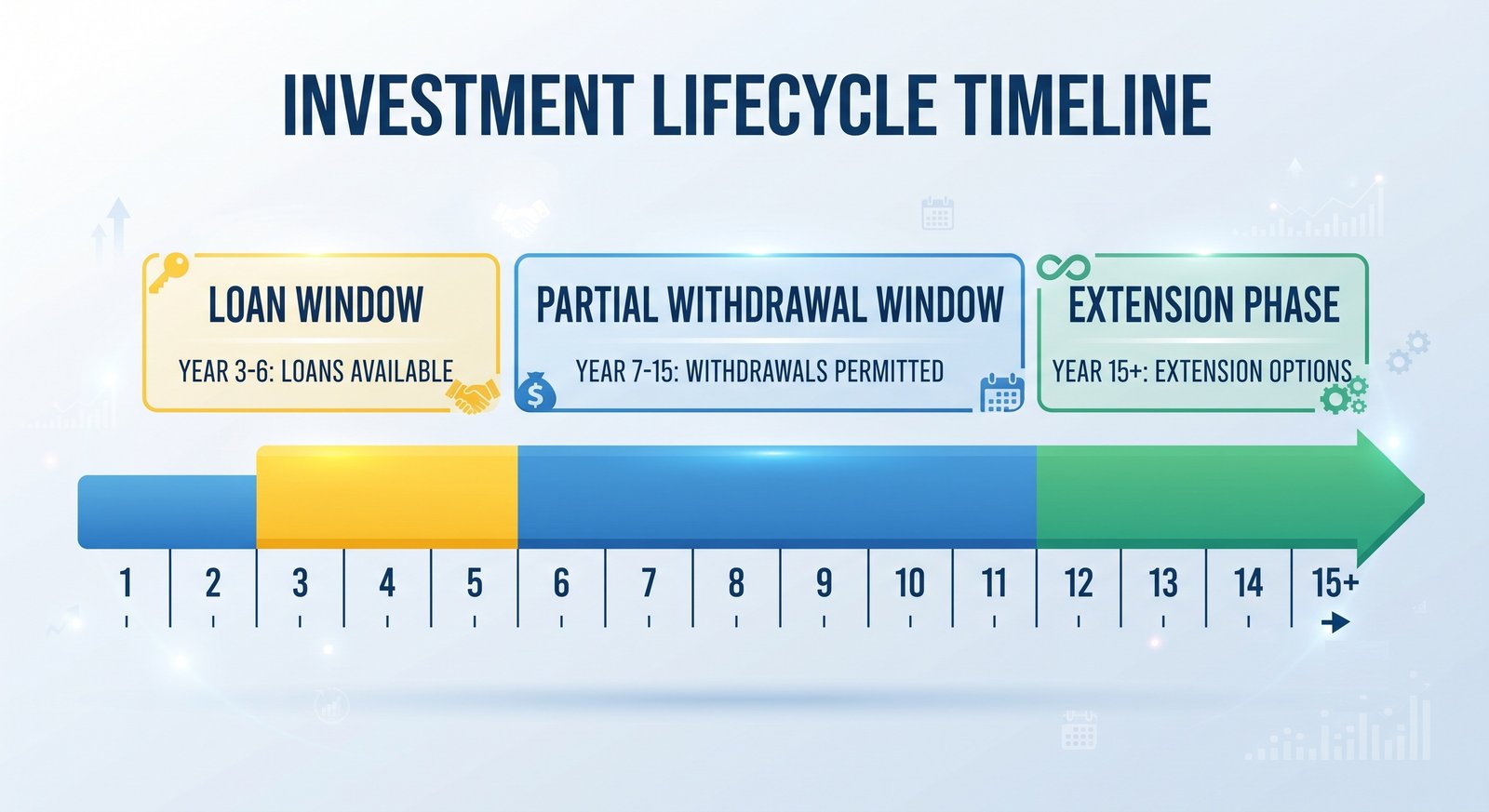
Partial Withdrawals: Once the loan window closes, the partial withdrawal window opens. From the 7th financial year onwards, a subscriber can make one tax-free partial withdrawal per financial year. The maximum withdrawal amount is limited to the lower of two figures: 50% of the account balance at the end of the financial year immediately preceding the year of withdrawal, or 50% of the balance at the end of the 4th preceding year.
6. Actionable Strategy Guide: Optimizing the PPF Lifecycle
To harness the full power of sovereign compounding, implement the following operational framework.
- Step 1: Front-Load Your Contributions. Do not set up a monthly SIP (Systematic Investment Plan) for your PPF if you have bulk cash available. Transfer the maximum allowable ₹1,50,000 as a lump sum between April 1st and April 4th. This ensures maximum capital is exposed to the compounding engine for the full 12 months.
- Step 2: Avoid Child Account Deductions. You can open a PPF account in the name of a minor child, acting as the guardian. However, the ₹1,50,000 maximum deposit limit applies to the combined total of your account and the minor's account. You cannot deposit ₹1.5L in yours and ₹1.5L in theirs to claim a ₹3L deduction. Therefore, focus on maximizing your own account first.
- Step 3: Execute the "Extension with Contribution" Blueprint. At the end of 15 years, do not withdraw the corpus unless necessary. Submit Form 4 within one year of maturity to extend the account with contributions for a 5-year block. The profound advantage here is that during the extension phase, you are allowed to withdraw up to 60% of the balance that existed at the start of the extension period. This transforms the rigid PPF into a highly liquid, tax-free emergency fund while maintaining EEE compounding on the massive accumulated base.
- Step 4: Hedge against Premature Closure Penalties. Premature closure (complete liquidation) is only allowed after 5 completed financial years, and strictly for life-threatening medical emergencies or higher education expenses. If executed, a penal deduction of 1% is applied to the interest rate for the entire tenure of the account. Avoid this by utilizing the loan or partial withdrawal features instead of a full closure.
7. Frequently Asked Questions (FAQs)
Q: Can Non-Resident Indians (NRIs) open a PPF account?
Under the current regulations, a Non-Resident Indian (NRI) cannot open a new PPF account. However, if a resident Indian opens a PPF account and subsequently becomes an NRI during the 15-year tenure, they are permitted to continue the account until its maturity on a non-repatriation basis. They cannot, however, extend the account for a 5-year block upon maturity.
Q: What happens if I fail to make the minimum ₹500 deposit in a financial year?
If you fail to deposit the minimum mandated ₹500 in any financial year, your PPF account will be classified as "Inactive" or "Discontinued." While the existing balance will continue to earn interest, you cannot make partial withdrawals or take loans against an inactive account. To revive it, you must pay a penalty of ₹50 for every year of default, along with the arrears of the minimum ₹500 deposit for each missed year.
Q: Is it true that a PPF account cannot be attached by a court order?
Yes, this is one of the most powerful legal protections of the scheme. Under Section 9 of the Public Provident Fund Act, the balance in a PPF account cannot be attached by any court decree or order in respect of any debt or liability incurred by the subscriber. It offers absolute bankruptcy protection against civil creditors, though the Income Tax authorities can still attach it to recover tax dues.
Q: Can I open a joint PPF account with my spouse?
No, a PPF account cannot be opened in joint names. It is strictly an individual account. You can, however, designate your spouse (or anyone else) as a nominee. If you wish to invest more family capital into PPF, your spouse must open a separate, independent PPF account under their own Permanent Account Number (PAN).
Q: Are PPF interest rates locked in for the 15-year tenure?
No. Unlike a Fixed Deposit (FD) where the interest rate at the time of booking is locked in for the entire tenure, the PPF interest rate is floating. It is declared quarterly by the Ministry of Finance. Your accumulated balance will earn interest at the newly declared rate for that specific quarter. Therefore, over a 15-year period, your corpus will be subjected to dozens of different interest rate environments.
See also
- Loading related topics...