Recurring Deposit Strategies
The Definitive Guide to Systematic Accumulation, Micro-Compounding, and Fixed-Income Sinking Funds
A Recurring Deposit (RD) is a highly specialized, structured term-deposit financial instrument offered extensively by commercial banks, sovereign post offices, and regulated credit unions. The instrument is engineered to facilitate systematic, disciplined, and periodic capital accumulation. Unlike a standard Fixed Deposit (FD) or Certificate of Deposit (CD)—which requires a substantial, single lump-sum injection of capital at the absolute inception of the account—a recurring deposit allows retail depositors to contribute mathematically smaller, fixed nominal amounts of capital at regular, recurring intervals (typically monthly) over a strictly predetermined temporal duration (the "tenor").
This distinct structural framework democratizes access to secure, fixed-income wealth generation. It actively enables individuals who lack immediate, massive capital reserves to systematically build a sizable financial corpus while simultaneously capturing guaranteed, elevated interest rates that closely mirror the premium yields normally reserved for lump-sum institutional fixed deposits. In the broader scope of macroeconomic wealth planning, the RD functions not as a tool for aggressive capital appreciation, but as a behavioral shock absorber and a high-yield "sinking fund."
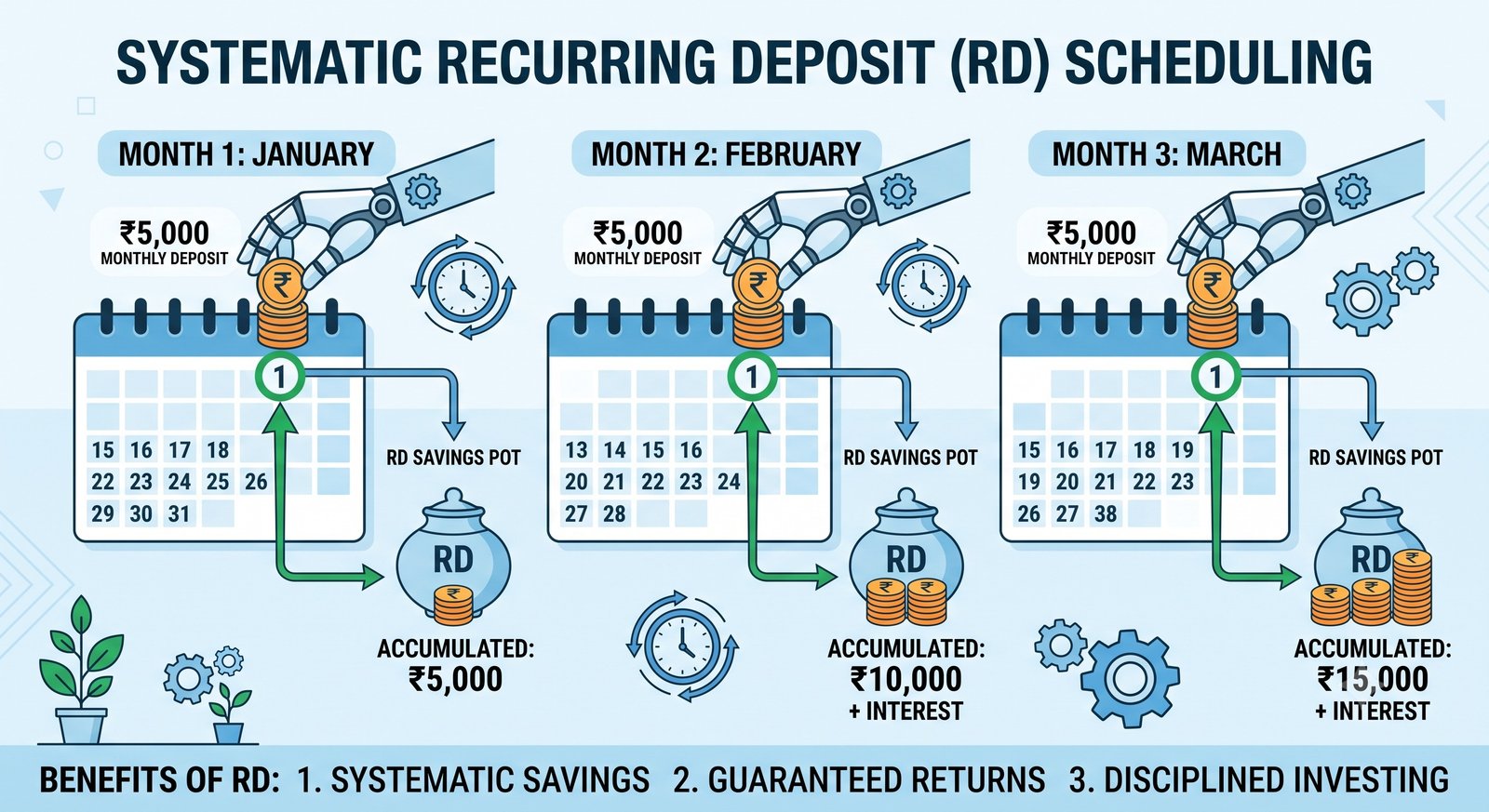
The primary economic and psychological objective of a recurring deposit is to enforce uncompromising financial discipline while completely eliminating the temporal friction and psychological anxiety associated with accumulating a massive lump sum. By automating the transfer of funds from a high-liquidity, zero-yield operational environment (a checking account) into a legally locked, yield-generating environment (the RD), the mechanism effectively isolates capital from discretionary, impulsive consumer spending. At the conclusion of the agreed-upon contractual maturity period, the depositor receives the aggregate total of all principal monthly installments alongside the compounded interest generated over the asset's specific lifecycle. Crucially, because the underlying interest rate is contractually locked at the inception of the RD, it shields the investor from subsequent dovish monetary policy shifts and declining macroeconomic benchmark interest rates.
1. Operational Framework and Institutional Mechanics
The operational mechanics of a recurring deposit are established through a rigid bilateral contract between the retail depositor (the unsecured creditor) and the licensed banking institution (the debtor). At the exact moment of account inception, the depositor commits to two immutable variables: the exact nominal monetary value of the monthly installment (the "Premium") and the specific duration (Tenor) of the deposit contract. Tenors typically range from an absolute minimum of six months to a maximum of ten years, providing high functional flexibility for aligning the asset with specific future capital requirements.
Once the contract is formally executed, the institution guarantees a specific Annual Percentage Yield (APY) that remains static throughout the entire multi-year tenor. It is critical for financial planners to recognize that a Recurring Deposit is functionally a sequential series of individual micro-deposits, not a single expanding block. Because each subsequent monthly installment remains in the account for a progressively shorter duration before the ultimate universal maturity date, each installment accrues interest for a vastly different length of time. For example, in a standard 12-month RD, the first installment generates compound interest for a full 12 months, whereas the final, 12th installment only generates interest for a single month.
- Automated Clearing (The Behavioral Lock): Modern banking infrastructure typically mandates the establishment of an automated Standing Instruction (SI) or an Automated Clearing House (ACH) mandate. This technological link ensures that the stipulated installment is autonomously deducted from the depositor's primary checking account on a specific date (usually 24 hours post-payroll), mathematically eliminating the behavioral risk of missed contributions or "decision fatigue."
- Penalty Structures (Liquidity Default): Failure to maintain adequate liquidity in the primary checking account to successfully fund the automated RD installment results in institutional penalties. The bank will often charge a flat "bounce fee." Repeatedly defaulting on consecutive monthly installments (usually three to five, depending on institutional policy) can lead to the administrative termination of the RD contract by the bank, forcing premature liquidation and a highly punitive reduction in the applied interest rate.
- Premature Withdrawal Constraints: Like all legitimate term deposits, RDs mandate capital illiquidity in exchange for premium yield. While capital can technically be accessed by the depositor prior to the contractual maturity date, doing so "breaks" the bilateral contract. This results in a severe penalty—usually 1% to 2% subtracted from the base rate applicable for the period the deposit actually ran—severely degrading the final yield and destroying the accumulation strategy.
2. Deep-Dive Explanations & Formulas: The Mathematics of RD Compounding
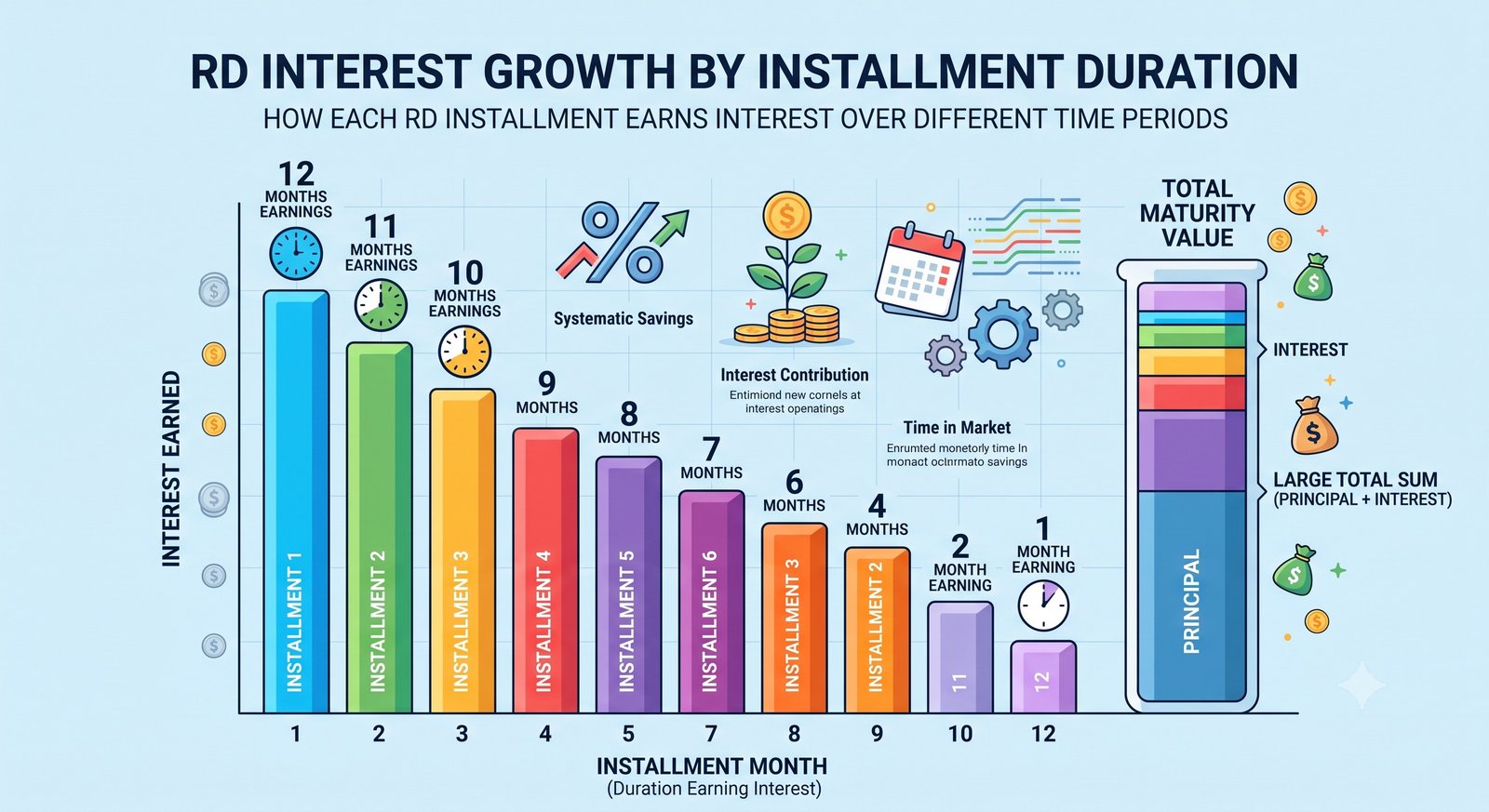
The mathematical calculation of a recurring deposit’s terminal maturity value is inherently more complex than calculating a standard lump-sum fixed deposit. Because the principal balance increases incrementally each month via the new deposits, the standard compound interest formula must be adapted to account for the fractional temporal duration of each specific installment. Furthermore, most commercial banking institutions compound RD interest on a quarterly basis, although the physical deposits themselves are made monthly.
The standard formula utilized by financial actuaries to calculate the exact maturity value (M) of a recurring deposit is:
M = R × [ (1+i)^n - 1 ] / [ 1 - (1+i)^(-1/3) ]
Where:
M = Maturity Value (Total Principal + Total Accumulated Interest)
R = Fixed Monthly Installment Amount
n = Total Number of Quarters (Total months / 3)
i = Quarterly Interest Rate (Annual Rate / 4, expressed as a decimal)
This complex formula accurately aggregates the future value of the entire series of cash flows, factoring in the exact temporal exposure of each individual micro-deposit. To understand the practical implications of this formula, we must analyze the "Yield Illusion" that frequently traps retail investors.
The Yield Illusion: RD vs. FD
A common retail banking misconception is that an RD and an FD offering identical interest rates will yield the exact same absolute total return on mathematically identical principal amounts. This is false. If an investor places a $12,000 lump sum into a standard FD at 8% for one year, the entire $12,000 earns interest for 12 full months, resulting in roughly $12,996 at maturity (assuming quarterly compounding). If the exact same investor places $1,000 per month into an RD at 8% for one year (totaling $12,000 in principal), the final maturity value is only roughly $12,526. The absolute monetary yield of the RD will always be substantially lower because the vast majority of the capital (the later installments) lacked the "time in the market" to compound. RD APYs are highly competitive, but they apply to a staggered principal base.
3. Structural Comparison: Fixed-Income Accumulation Strategies
To determine the optimal placement for systematic savings, investors must weigh the structural trade-offs of Recurring Deposits against competing accumulation methods in the macroeconomic landscape.
| Strategy / Instrument | Contribution Mechanism | Interest Rate / Yield Profile | Primary Disadvantage |
|---|---|---|---|
| Recurring Deposit (RD) | Strict, locked monthly installments. Penalizes defaults. | Fixed rate locked at inception. Shields against rate cuts. | Zero contribution flexibility; highly illiquid until maturity. |
| Automated Transfers to HYSA | Flexible. Can be paused or altered at any time without penalty. | Floating rate. Drops immediately if central banks cut rates. | Too liquid; easy for the investor to raid the account for impulse buys. |
| Mutual Fund SIP (Systematic Inv. Plan) | Automated monthly installments into equity markets. | Highly volatile. Can generate 12%+ or suffer massive losses. | Capital is not guaranteed; subject to severe market sequence-of-returns risk. |
| Flexi/Step-Up RD | Hybrid. Allows base installments + variable "top-ups" in surplus months. | Fixed base rate, but often yields slightly lower than standard rigid RDs. | Complex to track; lower base APY limits overall compounding efficiency. |
4. Empirical Case Studies: Goal-Based Accumulation in Practice
Despite yielding lower absolute returns than bulk lump-sum deposits, recurring deposits remain an exceptionally powerful tool for strict, goal-based financial planning. They act as "sinking funds," allowing individuals to systematically accumulate capital for precise, foreseeable future liabilities without exposing that critical capital to the volatility of the equity markets.
Case Study 1: The Predictable Liability Sinking Fund (Property Taxes)
Scenario: David (45) owns a home outright. He owes an annual property tax bill of $6,000 every December. Historically, David scrambles every November, draining his checking account and occasionally using high-interest credit cards to cover the massive lump-sum tax bill, generating severe financial anxiety.
Execution: In January, David establishes a 12-month Recurring Deposit specifically designated for property taxes. The bank offers a 6.0% APY. He sets up an automated monthly deduction of $488. By December, the RD matures. His total out-of-pocket contribution was $5,856, but due to accrued interest, the maturity value successfully crosses the $6,000 threshold. Result: David successfully amortized a massive, stressful annual liability into a completely automated, painless monthly expense. The RD enforced the discipline he lacked, and the bank effectively subsidized a portion of his tax bill through interest payments.
Case Study 2: The High-Risk Down Payment (Capital Protection)
Scenario: Sarah (31) plans to purchase her first home in exactly 36 months. She calculates she needs $45,000 for the down payment. She can afford to save $1,250 per month. A friend advises her to invest the monthly savings into an S&P 500 SIP to "grow it faster."
Execution: Recognizing that a 36-month horizon is far too short to risk capital in the equity markets (which could drop 20% in the year she needs to buy the house), Sarah rejects the advice. Instead, she opens a 36-month Recurring Deposit at 7.0% APY, depositing $1,150 per month. The mathematical maturity value of this RD ensures she surpasses her $45,000 target exactly on the date required. Result: Sarah traded the potential of high stock market gains for absolute certainty. When a moderate recession hit in month 32, dropping the stock market by 15%, Sarah was completely unaffected. Her down payment was mathematically guaranteed, allowing her to purchase her home without delay.
5. Inflationary Drag, Taxation, and Real Rate of Return
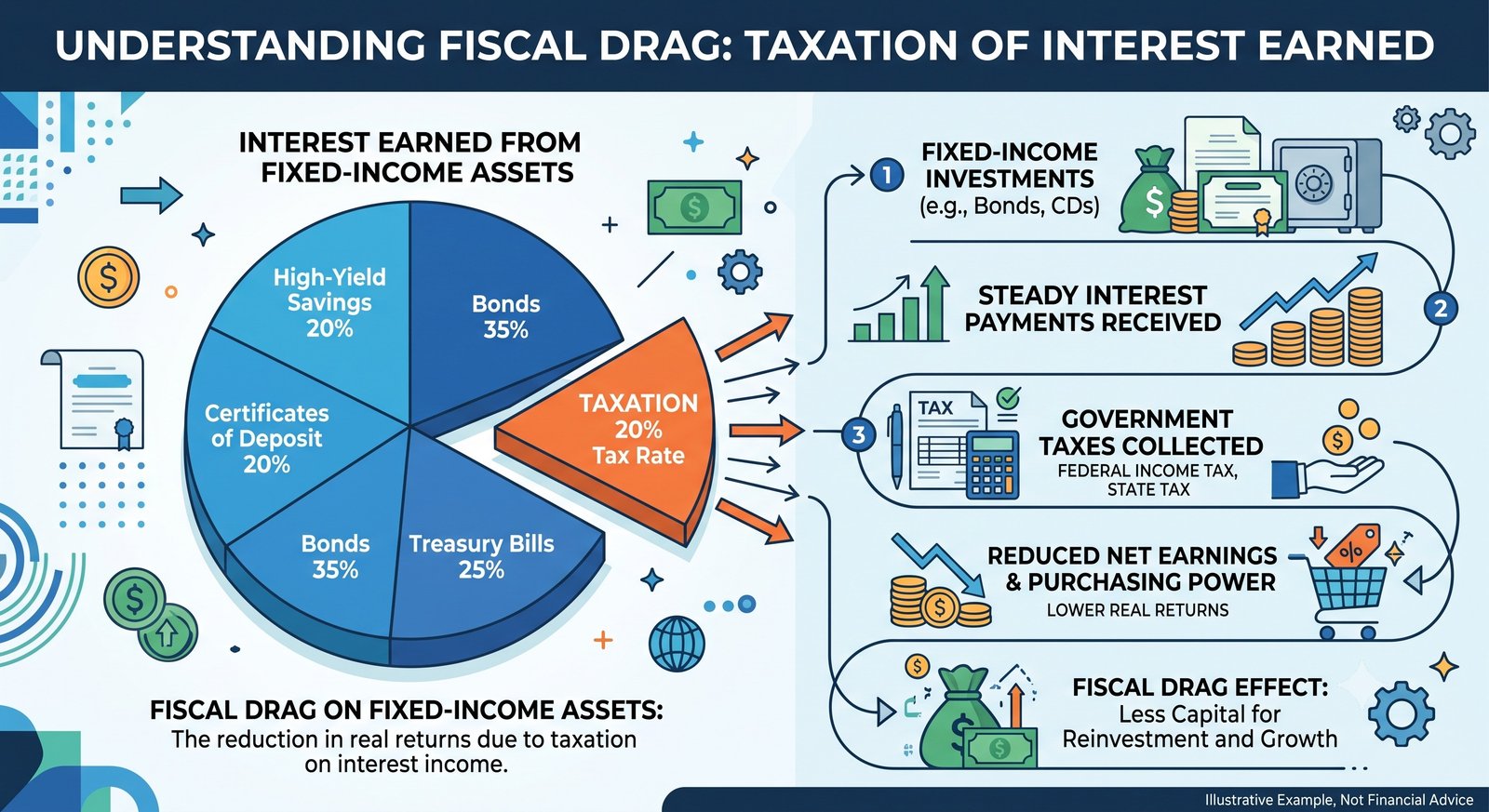
While recurring deposits offer unparalleled principal security and enforce behavioral discipline, they suffer from the exact same systemic, mathematical vulnerabilities that plague all standard fixed-income instruments: aggressive sovereign taxation and macroeconomic inflationary drag. These two factors operate in tandem to severely degrade the "Real Rate of Return," which is the actual growth of the asset's purchasing power.
In the vast majority of global tax jurisdictions (including the US and India), the interest generated by a recurring deposit is classified as ordinary interest income and is fully taxable at the individual's highest marginal tax bracket. Unlike long-term capital gains on equities, there is no preferential tax treatment for FD or RD interest. Furthermore, banking institutions are frequently mandated by law to deduct Tax Deducted at Source (TDS) or withholding tax automatically if the accrued interest exceeds a specific annual statutory threshold. This means a significant portion of the generated yield is siphoned off by the government before it can even compound in the account.
When this harsh taxation is combined with macroeconomic inflation, the net result is often zero or negative true wealth generation. If an RD offers a 7.5% nominal yield, but the investor sits in a 30% tax bracket, the Tax-Equivalent Yield (after-tax nominal yield) drops to a mere 5.25%. If the prevailing national inflation rate is simultaneously running at 6.0%, the Real Rate of Return becomes a negative -0.75%. Consequently, while the numerical, nominal balance of the RD is visibly increasing, the physical purchasing power of that capital is systematically eroding. Because of this undeniable mathematical drag, RDs must be classified strictly as defensive capital preservation tools or short-term sinking funds; they are fundamentally incapable of acting as primary wealth-building engines for retirement.
6. Actionable Strategy Guide: Executing an RD Ladder
To circumvent the rigid liquidity constraints inherent in term deposits while maximizing yield during shifting interest rate environments, sophisticated savers utilize an advanced structural technique known as RD Laddering.
- Step 1: Define the Liquidity Need. Determine how often you require access to lump sums of cash. For this example, assume you want a cash payout every 6 months to cover bi-annual college tuition bills or property taxes.
- Step 2: Stagger the Originations. Do not open a single massive RD. Instead, open a new RD every 6 months. In January, you open RD-1 with a 12-month tenor. In July, you open RD-2 with a 12-month tenor.
- Step 3: Manage the Concurrent Cash Flows. By July, you are funding both RD-1 and RD-2 simultaneously. Ensure your monthly budget can support the aggregate premium required for multiple active RDs.
- Step 4: The Maturity Waterfall. Fast forward to the following January. RD-1 matures, providing a massive, liquid lump sum. You use the necessary funds to pay your tuition bill. You immediately take any remaining surplus and roll it into a new 12-month RD-3. Six months later (July), RD-2 matures, providing the next necessary lump sum.
- Step 5: Capture Rate Fluctuations. Because you are initiating new RDs at different points throughout the year, you avoid locking all your capital at the bottom of an interest rate cycle. You naturally capture a blend of prevailing macroeconomic rates, smoothing out yield volatility.
7. Frequently Asked Questions (FAQ)
Q: What happens if I miss a monthly installment on my Recurring Deposit?
Missing an installment fundamentally breaks the consistency required for the RD to function. Banks will immediately levy a penal charge (often a fixed fee per delayed day or per defaulted installment). More critically, the final maturity value will be mathematically reduced because the missing principal did not have the required time to accrue compound interest. If you miss a predetermined consecutive number of installments (usually 3 to 6, depending on the bank), the institution holds the legal right to unilaterally terminate the RD, returning your accumulated principal with a heavily penalized, minimal interest rate.
Q: Can I change my monthly deposit amount halfway through the RD tenor?
In a standard, rigid Recurring Deposit, absolutely not. The monthly installment amount is fixed into the bilateral contract on day one. You cannot deposit $500 one month and $1,000 the next. If you require this functionality, you must open a specialized "Flexi-RD" or "Step-Up RD," which allows you to deposit any multiple of a core base amount depending on your monthly cash surplus. However, these flexible instruments often command a slightly lower base interest rate than standard, rigid RDs.
Q: Are Recurring Deposits insured if the bank goes bankrupt?
Yes. If the RD is held at a licensed, federally recognized commercial bank or credit union, it falls under the exact same sovereign deposit insurance umbrellas as savings and checking accounts. In the United States, it is backed by the FDIC (up to $250,000); in India, it is backed by the DICGC (up to ₹5,00,000). The principal and accrued interest are fully protected from institutional insolvency up to those statutory limits.
Q: Is a Mutual Fund SIP (Systematic Investment Plan) better than an RD?
They cannot be directly compared as "better" or "worse" because they serve entirely different temporal purposes. An RD is a zero-risk, fixed-income asset designed to protect principal for short-to-medium-term goals (e.g., buying a car in 2 years). An equity SIP is a high-risk, high-reward asset designed to generate wealth over a 10-to-30-year horizon (e.g., retirement). An SIP exposes you to stock market crashes, which is unacceptable for short-term goals. An RD guarantees your capital, but will lose purchasing power to inflation over a 30-year horizon. A balanced financial portfolio utilizes both simultaneously for different timelines.
See also
- Loading related topics...