Risk Tolerance & Capacity
1. The Crucial Duality of Investment Risk Profiling
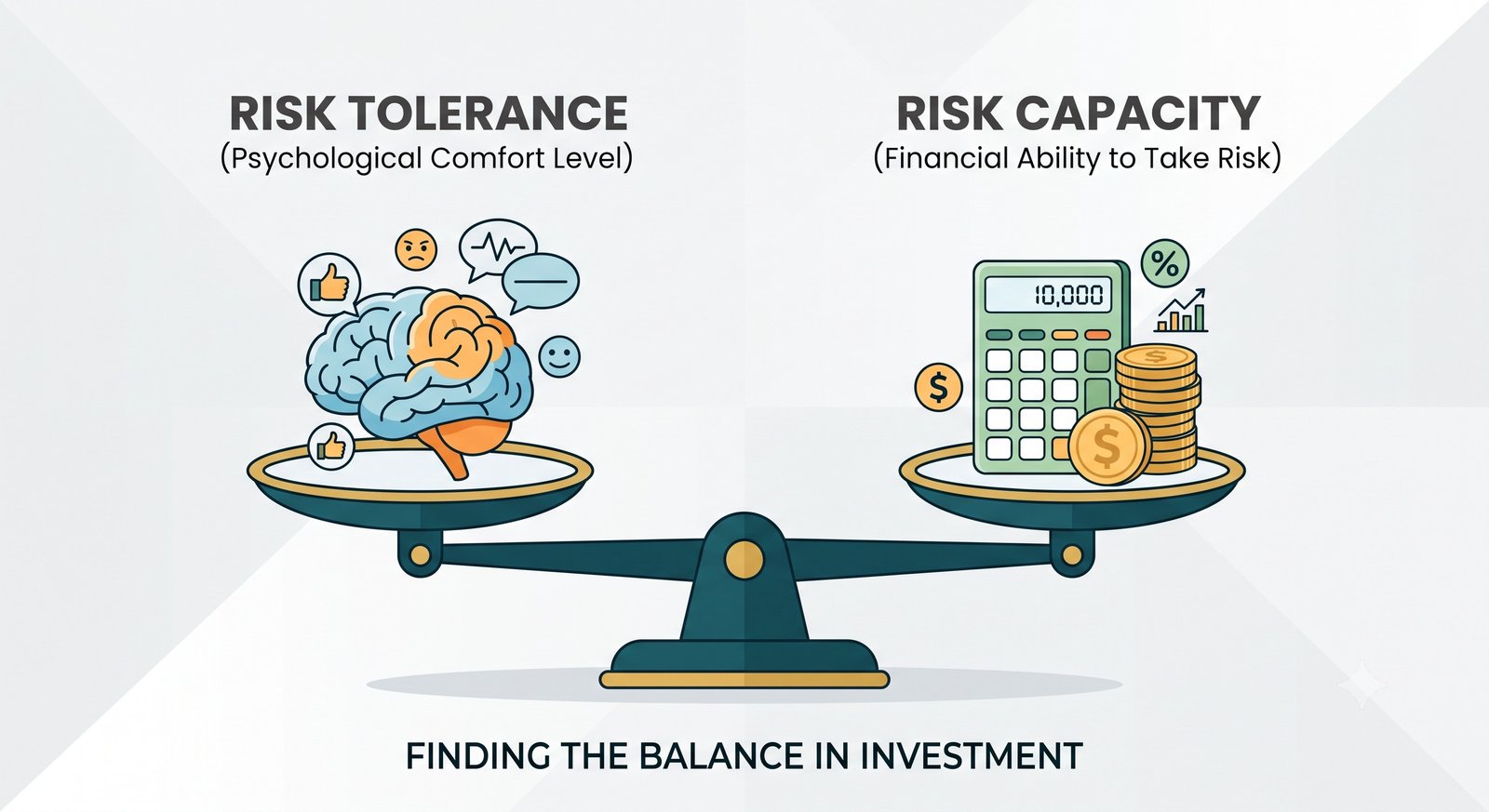
Within the discipline of wealth management and portfolio construction, the concept of "risk profile" is frequently, and dangerously, treated as a single monolithic metric. In reality, an investor's true risk profile is a bipartite framework consisting of two entirely distinct, often conflicting dimensions: Risk Tolerance and Risk Capacity. Understanding the divergence between these two metrics is the cornerstone of avoiding catastrophic behavioral errors during market volatility and ensuring long-term solvency.
Risk Tolerance is fundamentally psychological. It quantifies an investor's emotional and psychological comfort with uncertainty, portfolio volatility, and the prospect of capital loss. Rooted in behavioral finance—specifically Prospect Theory as developed by Daniel Kahneman and Amos Tversky[cite: 2]—it measures the degree to which an investor experiences the pain of a loss relative to the joy of a gain. An investor with high risk tolerance can watch their portfolio decline by 30% without deviating from their strategic plan or losing sleep.
Conversely, Risk Capacity is strictly mathematical and objective. It represents the actual financial ability of an investor to absorb a financial loss without derailing their essential life goals or suffering a decline in their standard of living. Capacity is governed by immutable variables: time horizon to liquidity need, stability of human capital (income), existence of emergency reserves, and the rigidity of upcoming liabilities. An investor's portfolio allocation must always be constrained by the lower of these two metrics. Equating the two is a fundamental failure of financial planning.
2. Deep-Dive Explanations & Formulas: The Mathematics of Capacity
To rigorously define Risk Capacity, modern financial theory utilizes a holistic balance sheet approach that integrates Financial Capital (FC) and Human Capital (HC). Financial Capital represents tangible liquid and illiquid assets (stocks, bonds, real estate). Human Capital represents the net present value of all future expected earnings generated by the investor's labor.
Total Wealth ($W$) is defined as:
$$W_t = FC_t + HC_t$$
A young professional possesses massive Human Capital but very little Financial Capital, giving them exceptionally high Risk Capacity for their financial investments; they have decades of income generation to offset any near-term market drawdowns. Conversely, a retiree's Human Capital is effectively zero. Their Total Wealth relies entirely on Financial Capital, resulting in a drastically compressed Risk Capacity.
Risk Capacity can be mathematically formalized through Asset-Liability Matching (ALM) and shortfall risk models. An investor's capacity is breached if the probability of their total wealth falling below their essential lifetime liabilities ($L$) exceeds an acceptable threshold ($\alpha$). This is modeled as:
$$P(W_T < L_T) \le \alpha$$
Where $W_T$ is the projected wealth at time $T$, $L_T$ is the present value of future liabilities, and $\alpha$ is the strict mathematical boundary of ruin. If an investor allocates assets so aggressively that the standard deviation of the portfolio pushes this probability above $\alpha$, they have exceeded their Risk Capacity, regardless of how courageous they feel psychologically.
3. Macroeconomic Mechanics: Sequence of Returns Risk
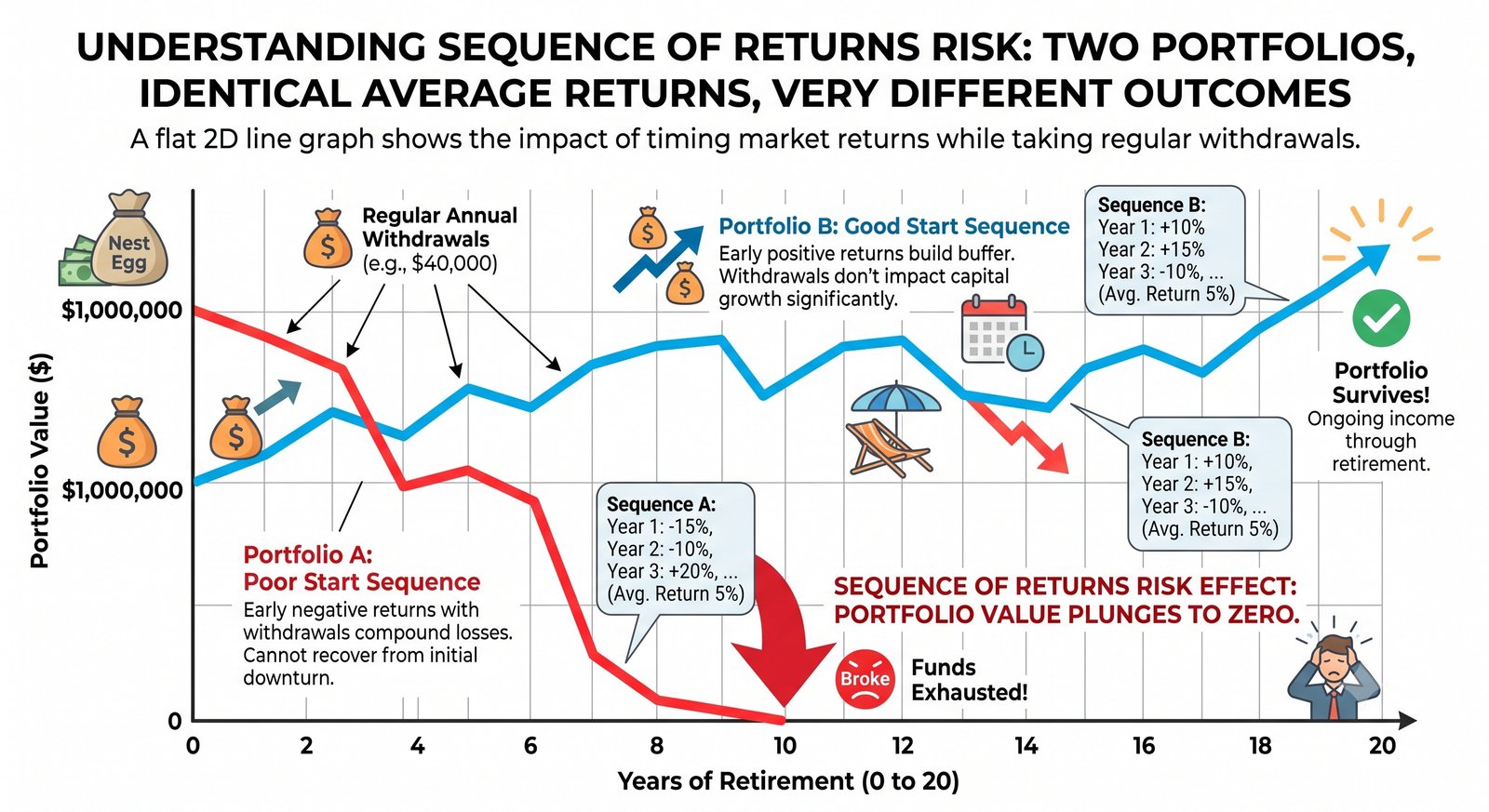
Risk Capacity is not static; it is fiercely tested by the macroeconomic environment, most notably through Sequence of Returns Risk (SRR). SRR is the vulnerability of an investor's portfolio to the specific order in which investment returns occur, particularly when they are withdrawing capital. This is the ultimate destroyer of mathematical capacity.
- The Accumulation Phase: When an investor is purely contributing capital (not withdrawing), the sequence of returns is mathematically irrelevant. A severe market crash early in life followed by a boom yields the exact same final portfolio value as a boom followed by a crash, assuming the same average compound annual growth rate (CAGR). During this phase, Risk Capacity is maximized.
- The Distribution Phase (Retirement): When an investor begins withdrawing funds for living expenses, sequence becomes critical. If a severe recession occurs in the early years of distribution, the investor is forced to liquidate a larger number of shares at depressed valuations to meet their fixed cash needs. This permanently impairs the portfolio's compounding base. Even if the market subsequently goes on a massive multi-year bull run, the portfolio may never recover because there are too few shares remaining to participate in the upside.
To defend Risk Capacity against macroeconomic shocks, investors must segment their capital by time horizon. Funds required within the next 1 to 3 years have zero capacity for equity market risk and must be held in absolute safe havens: liquid mutual funds, short-duration debt mutual funds, or high-quality fixed deposits (FDs). Funds needed in 3 to 7 years have moderate capacity and can handle a blend of sovereign bonds and conservative assets. Only capital with a time horizon exceeding 7 to 10 years possesses the mathematical capacity to endure the volatility inherent in equities.
4. Structured Comparison: Tolerance vs. Capacity
The distinction between these two metrics is easiest to understand when their inputs, mutability, and consequences are compared directly side-by-side.
| Feature | Risk Tolerance | Risk Capacity |
|---|---|---|
| Nature of Metric | Subjective, Psychological, Emotional. | Objective, Mathematical, Financial. |
| Primary Inputs | Personality, past experiences, financial literacy, behavioral biases. | Time horizon, liquidity needs, net worth, income stability, upcoming liabilities. |
| Mutability | Can be altered through education, market experience, and behavioral coaching. | Rigid. Dictated by the physics of time and hard financial realities. Cannot be "coached" higher. |
| Consequence of Mismatch | Taking risk above tolerance leads to panic selling at market bottoms (behavioral ruin). | Taking risk above capacity leads to inability to fund essential goals, even if the investor doesn't panic (financial ruin). |
5. Realistic Case Studies: The Mismatch in Action
To illustrate the critical interplay between these metrics, we examine two contrasting profiles that highlight the dangers of misaligned risk architecture.
- Case 1: The High-Octane Trader with Structural Constraints (High Tolerance, Low Capacity)
Profile: Arjun, 34, operates with immense psychological risk tolerance. He self-identifies as a beginner in active trading but aggressively pursues intraday stock setups, heavily utilizing demand and supply zone strategies. He is comfortable watching his margin positions fluctuate wildly on his multi-monitor setup. However, mechanically, Arjun has a hard requirement to withdraw $45,000 for a property down payment in less than 11 months.
The Conflict & Solution: Arjun’s tolerance is extremely high, but his actual capacity for the $45,000 is zero. If the broader market gaps down due to an overnight macroeconomic shock, his intraday positions could wipe out his property capital. To survive, Arjun must decouple his accounts based on capacity. His long-term core wealth—where capacity is high—is strictly allocated across diversified equity mutual funds, debt mutual funds, physical gold, the Employees' Provident Fund (EPF), and the National Pension System (NPS). His near-term $45,000 must be removed from the trading account and placed in a liquid mutual fund or a fixed deposit (FD), reflecting its zero-risk capacity. He can continue intraday trading, but only with highly isolated, expendable capital where he possesses both tolerance and capacity. - Case 2: The Anxious Professional (Low Tolerance, High Capacity)
Profile: Sarah, 28, is a software engineer with high income stability and over 35 years until retirement. Mathematically, her risk capacity is massive. However, she has an extremely low risk tolerance. During a recent 10% market correction, she experienced severe anxiety and logged into her brokerage account daily, contemplating moving her entire retirement portfolio into cash.
The Conflict & Solution: If Sarah builds a portfolio matching her emotional tolerance (e.g., 90% bonds/cash), she will fail to outpace inflation over 35 years, guaranteeing long-term purchasing power erosion. Because she possesses the mathematical capacity to hold equities, the solution is not to surrender to her low tolerance, but to elevate it through behavioral structure. This is achieved by creating a "sleep well at night" (SWAN) buffer. By maintaining an overly large emergency fund (12 months of expenses) in cash equivalents, her brain is tricked into feeling safe, allowing her to keep her 35-year retirement capital aggressively allocated to index funds without panicking during normal market cycles.
6. Actionable Strategy Guide: Reconciling Your Risk Profile
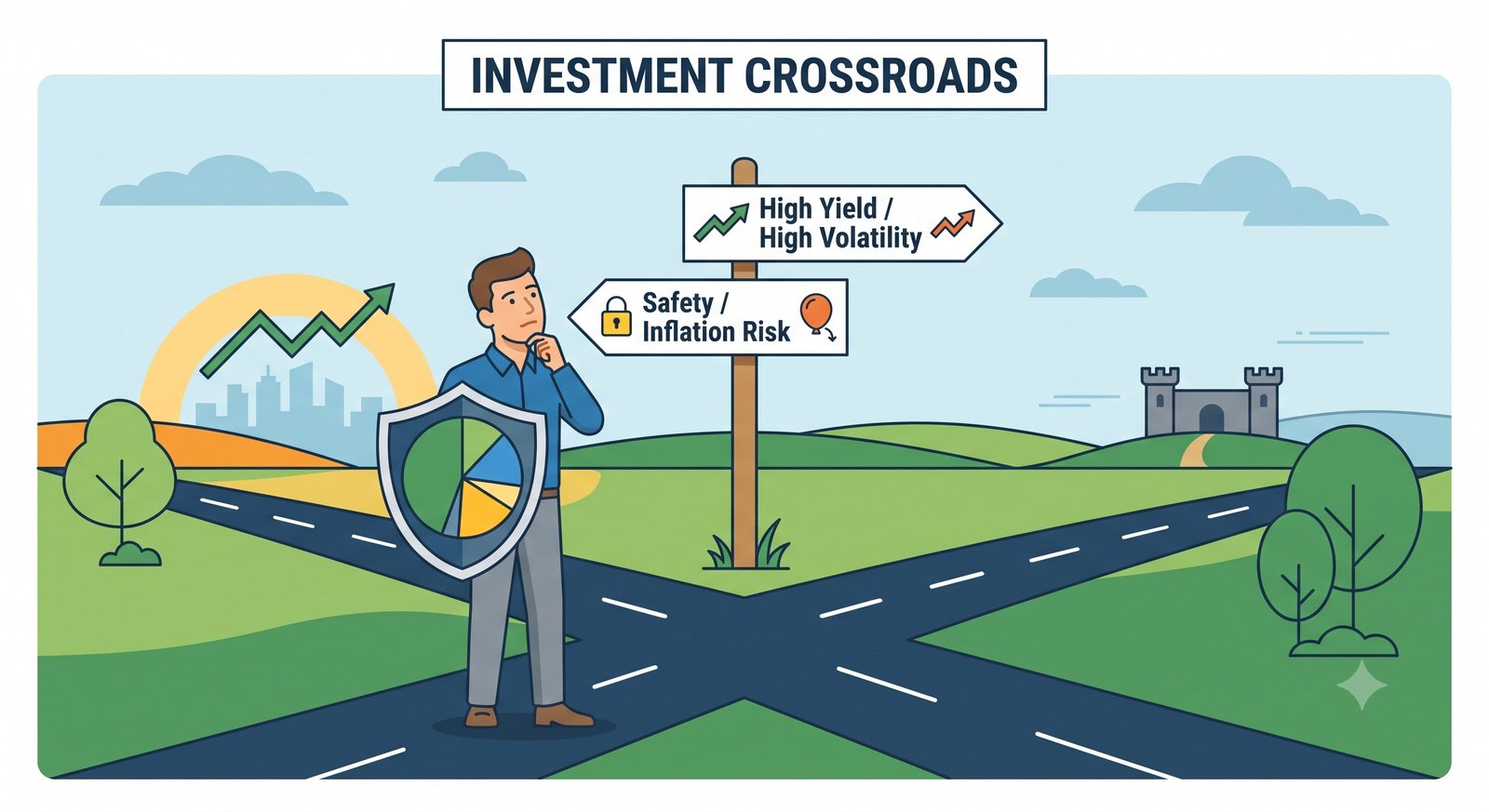
Building a resilient portfolio requires a deliberate, step-by-step process that maps your asset allocation to the strict boundaries of both tolerance and capacity. Follow this framework to avoid costly misalignments.
- Step 1: Map Your Timelines (Calculate Capacity). Categorize every dollar you own by when you will spend it. Create three buckets. Bucket A (0-3 years): Emergency funds, upcoming large purchases, short-term liabilities. Bucket B (4-9 years): Mid-term goals like children's education or a secondary property. Bucket C (10+ years): Retirement and legacy wealth building.
- Step 2: Assign Strict Asset Classes to Capacity Buckets. Bucket A must be deployed into zero-volatility assets: Liquid Mutual Funds, High-Yield Savings, or Fixed Deposits (FDs). Bucket B should utilize medium-duration debt mutual funds, sovereign bonds, and perhaps a small allocation of conservative equities or gold to preserve purchasing power. Bucket C is where true wealth is generated; it should be heavily allocated to broad-market equity index funds, EPF, and NPS components.
- Step 3: Stress-Test Your Tolerance. Look specifically at Bucket C (your long-term equities). Ask yourself: "If this bucket loses 40% of its value in a single month, will I panic and sell?" Do not answer idealistically; answer honestly based on your behavior in past downturns.
- Step 4: The Rule of the Lesser Metric. Reconcile the results. Your final portfolio risk can never exceed your lowest constraint. If your capacity says you can hold 90% equities, but your tolerance says you will panic at a 20% drawdown, you must dial back the equity allocation to perhaps 60% or 70%. It is mathematically sub-optimal, but behaviorally necessary. A sub-optimal portfolio you stick with during a crash is infinitely superior to a mathematically perfect portfolio that you abandon at the absolute bottom.
- Step 5: Isolate High-Risk Endeavors. If you engage in high-risk activities like crypto trading or intraday stock strategies, ring-fence this capital. It should represent no more than 5% to 10% of your total liquid net worth. This satisfies the psychological desire for high-octane engagement (tolerance) while completely protecting your structural financial foundation (capacity).
Frequently Asked Questions
Q: How often does my risk capacity change?
Risk capacity changes continuously as you move through life, though major shifts are typically tied to life milestones. Aging mechanically reduces capacity because your time horizon shrinks and your Human Capital (future earnings potential) diminishes. Additionally, life events like having a child, buying a home, or receiving a large inheritance immediately alter your liability framework, thereby shifting your capacity. You should recalculate your capacity annually or immediately following any major life event.
Q: Can a high risk tolerance ever compensate for a low risk capacity?
Absolutely not. This is one of the most common and dangerous errors in investing. Being emotionally unafraid of losing money (high tolerance) does not magically generate the time or income required to recover from a massive loss if you need that capital to pay for next year's tuition or a mortgage (low capacity). The physics of time and liquidity needs always supersede emotional courage.
Q: Is there a standardized questionnaire that can accurately determine both metrics?
While many financial institutions use basic risk profiling questionnaires, they are notoriously flawed because they conflate the two concepts. A question asking, "What would you do if your portfolio dropped 20%?" tests tolerance. A question asking, "When will you retire?" tests capacity. Poorly designed algorithms average these answers together to spit out a single "Moderate Risk" score, which is dangerous. Advanced financial planning requires separating these assessments entirely and managing to the stricter of the two.
Q: How do illiquid assets like locked government schemes or real estate affect risk capacity?
Assets like real estate, the Public Provident Fund (PPF), or the National Pension System (NPS) have high stability but low liquidity. They anchor your overall portfolio, providing immense baseline security, which theoretically increases your capacity to take risks with your liquid assets (like stocks). However, because you cannot easily sell them to meet immediate cash crunches, they do not help your short-term capacity. Short-term capacity relies strictly on highly liquid assets like cash, liquid funds, or FDs.
Q: How does inflation factor into risk capacity?
Inflation is the silent killer of purchasing power and introduces a paradox into risk capacity. If you construct an entirely "safe" portfolio of cash and short-term debt to protect your short-term capacity, you mathematically guarantee that you will lose money in real terms over decades due to inflation. Therefore, your long-term risk capacity actually requires you to take on equity market volatility to outpace the insidious, compounding degradation of inflation.
See also
- Loading related topics...