Savings vs Checking Accounts
The Definitive Guide to Cash Flow Architecture, Liquidity Management, and Yield Optimization
The foundation of modern retail banking and personal cash flow management rests upon two primary deposit vehicles: the checking account and the savings account. While both are fundamental financial instruments offered by commercial banks, credit unions, and digital financial institutions, they are engineered to serve diametrically opposed economic purposes. A checking account is fundamentally a transactional vehicle designed for extreme liquidity and high-frequency cash movements. In contrast, a savings account is an accumulation vehicle explicitly optimized for capital preservation, emergency reserves, and generating modest yields over time.
Understanding the structural differences, regulatory frameworks, and distinct macroeconomic utility of each account type is essential for sophisticated financial planning. Utilizing these accounts incorrectly can result in severe liquidity constraints, punitive institutional fees, and the gradual, invisible erosion of purchasing power known as "cash drag." A highly optimized financial architecture does not simply utilize these accounts as isolated storage units; it integrates them into a systemic flow of capital that protects the individual from exogenous shocks while maximizing the time value of money.
1. The Mechanics and Architecture of Checking Accounts
Checking accounts, historically referred to within institutional banking as Demand Deposit Accounts (DDAs), are purposefully engineered to facilitate the immediate, unrestricted movement of capital. In the broader scope of macroeconomic theory, funds held in checking accounts are classified as M1 Money Supply—the most liquid form of money available in an economy, effectively functioning identically to physical currency.
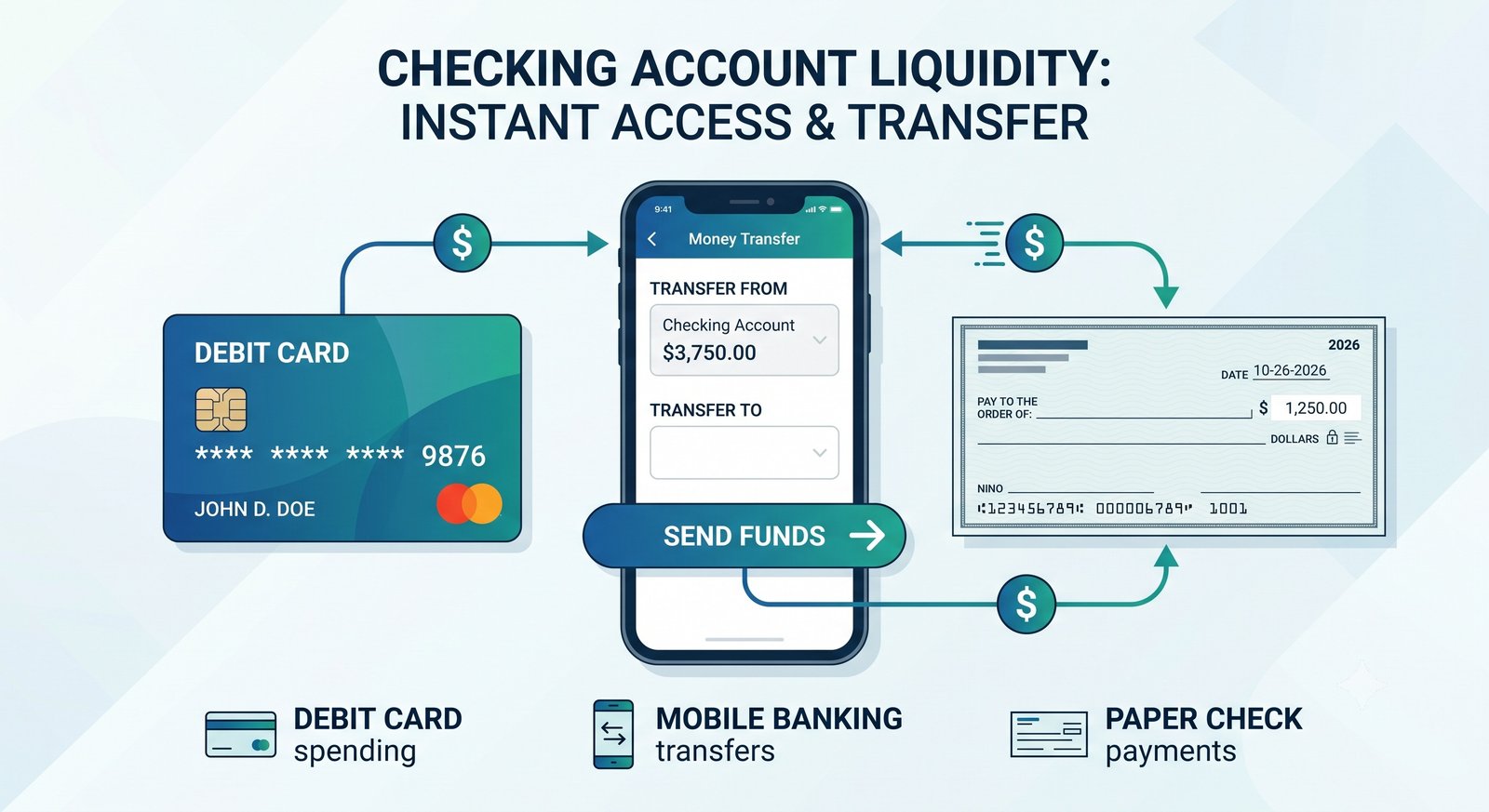
The checking account serves as the central hub of an individual’s or corporation’s financial ecosystem. It receives primary inflows such as payroll direct deposits, dividend payouts, and business revenues. Conversely, it acts as the primary dispatch center for outflows to cover daily living expenses, automated utility billing, and discretionary point-of-sale purchases. The defining characteristic of a checking account is its absolute, frictionless liquidity. Account holders are typically granted unfettered access to their funds at any time, 24 hours a day, without facing institutional withdrawal penalties, temporal delays, or regulatory velocity limits.
To support this high-velocity transactional environment, checking accounts are equipped with a massive array of access mechanisms. Depositors can execute transactions seamlessly via debit cards connected to global payment networks (Visa, Mastercard), withdraw physical fiat currency from Automated Teller Machines (ATMs), issue traditional paper checks, or initiate complex electronic transfers such as Automated Clearing House (ACH) payments and instantaneous SWIFT wire transfers.
The Economics of Zero-Yield: Because the administrative cost of processing thousands of localized micro-transactions per user is substantial, and because banks must maintain high capital reserve ratios for Demand Deposit Accounts to ensure absolute liquidity, traditional checking accounts rarely offer any interest or yield on deposited balances. The primary utility derived from the account is operational convenience and settlement speed, not capital growth.
Furthermore, the fee structure of checking accounts is primarily usage-based rather than holding-based. Financial institutions often impose monthly maintenance fees, which can frequently be legally waived by maintaining a stipulated minimum daily ledger balance or establishing a recurring direct deposit. However, the most punitive, wealth-destroying costs associated with checking accounts arise from cash flow mismanagement, specifically overdraft fees and non-sufficient funds (NSF) charges. When an account holder attempts to execute a transaction that exceeds their mathematically available ledger balance, the institution faces a credit risk. The bank may either decline the transaction outright (triggering an NSF fee, typically $25 to $35) or front their own capital to temporarily cover the deficit (triggering a costly overdraft fee). Over-reliance on checking overdrafts is one of the most toxic financial habits, functionally equating to a micro-loan with an annualized percentage rate (APR) that can effectively exceed 3,000%.
2. The Mechanics and Architecture of Savings Accounts
Conversely, savings accounts are explicitly designed for the deliberate accumulation and secure storage of surplus capital. Rather than facilitating high-velocity daily transactions, the savings account functions as a fortified financial reservoir. It is the optimal vehicle for housing emergency contingency funds, sinking funds for anticipated large capital expenditures (e.g., real estate down payments, annual tax liabilities), and short-term capital that must be aggressively shielded from the volatility of equity and fixed-income secondary markets. To incentivize depositors to park their capital and intentionally restrict their own liquidity, financial institutions pay an Annual Percentage Yield (APY) on the holding balance.
The economic rationale behind offering yield on savings deposits lies deeply embedded in fractional reserve banking. Commercial institutions aggregate the capital deposited into thousands of savings accounts and lend those pooled funds out to other consumers and corporations in the form of 30-year mortgages, auto loans, and commercial credit lines at a significantly higher interest rate. The interest paid to the savings account holder represents a minor fraction of the Net Interest Margin (NIM) the bank generates from deploying that capital. Consequently, the APY offered on savings accounts fluctuates dynamically based on prevailing macroeconomic conditions, specifically tracking the benchmark federal funds rate established by the central banking authority (e.g., the Federal Reserve).
The Mathematics of APY Compounding: Yield in a savings account is fundamentally different from a flat interest rate because it benefits from compounding—earning interest on previously earned interest. The mathematical formula for calculating the future value of a savings balance is:
FV = P(1 + r/n)^(nt)
Where:
FV = Future Value of the account
P = Principal (initial deposit)
r = Annual nominal interest rate (decimal)
n = Number of times interest is compounded per year (usually 12 or 365)
t = Time in years
Historically, the accumulation nature of savings accounts was strictly and legally enforced by federal regulations. In the United States, the Federal Reserve’s Regulation D strictly limited depositors to a maximum of six "convenient" withdrawals or outbound electronic transfers from a savings account per calendar month. Exceeding this statutory limit resulted in punitive fees or the forceful, non-consensual administrative conversion of the savings account into a zero-yield checking account. While the Federal Reserve indefinitely suspended the mandatory enforcement of the six-withdrawal limit in April 2020 to provide consumers with greater liquidity during pandemic-induced economic crises, many commercial banks voluntarily retain similar withdrawal thresholds in their internal Terms of Service to preserve the stability of their lending reserves.
3. The Macroeconomic Tradeoff: Liquidity vs. Yield
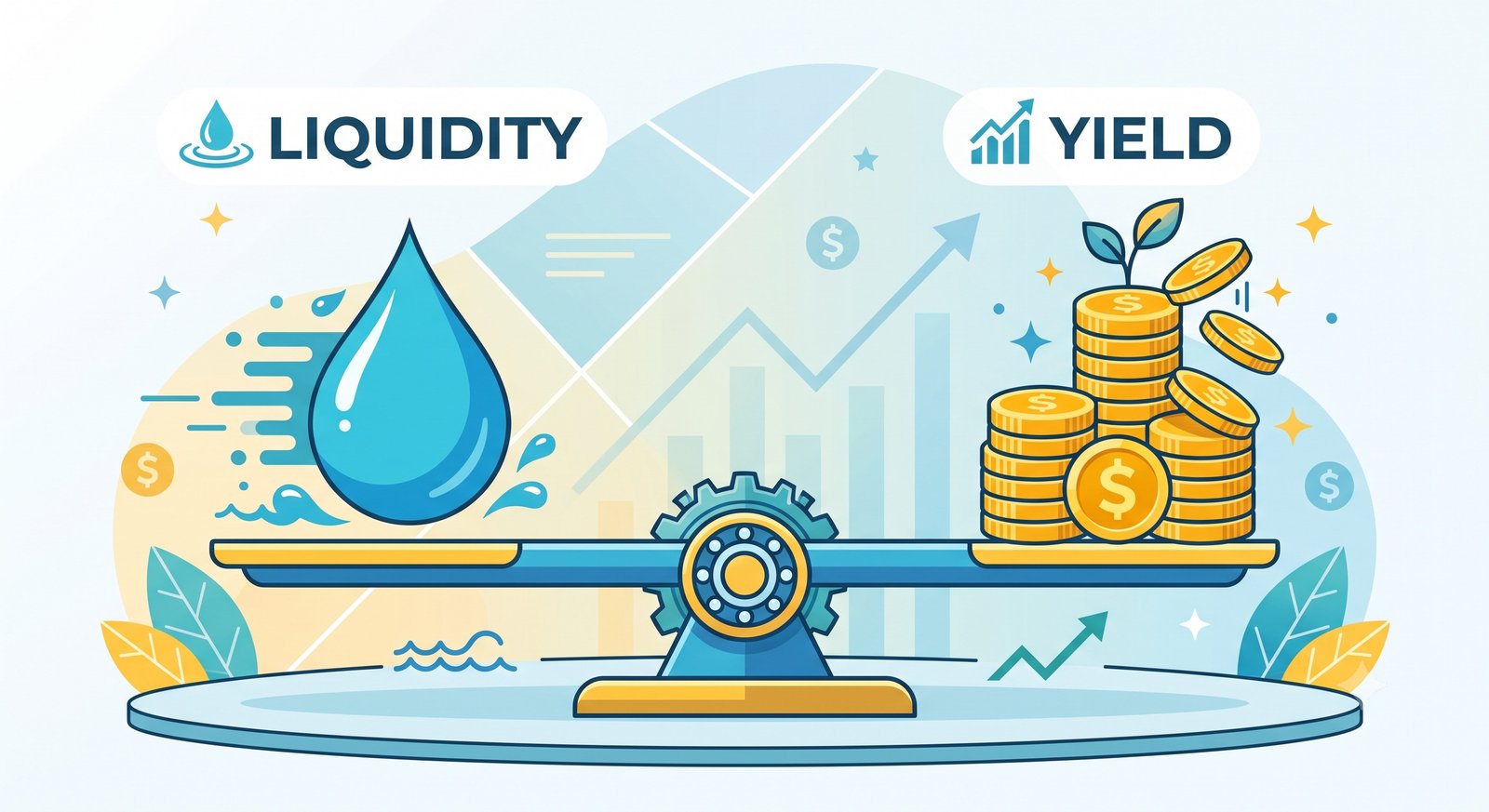
The dichotomy between checking and savings accounts represents a classic, fundamental financial tradeoff: liquidity versus yield. Liquidity refers to the speed, ease, and lack of transaction cost with which an asset can be converted into readily spendable cash without suffering a loss in principal value. Checking accounts offer maximum, instantaneous liquidity but zero yield. Savings accounts offer modest, risk-free yield but structurally impose operational friction on liquidity.
Attempting to utilize one account for the structural purposes of the other inevitably leads to systemic financial inefficiency. Holding excess capital in a checking account beyond what is strictly required for immediate transactional needs creates a wealth-destroying phenomenon known as "cash drag." Because macroeconomic inflation constantly erodes the underlying purchasing power of fiat currency, uninvested cash sitting in a zero-interest checking account is actively losing real economic value. If inflation runs at 3.0% annually, a $50,000 checking account balance loses $1,500 in purchasing power in a single year. By failing to transfer surplus capital into a yield-bearing savings environment, the depositor realizes a permanent, unforced opportunity cost.
Conversely, utilizing a savings account as a high-frequency transactional hub creates severe logistical friction and triggers institutional penalties. Because savings accounts universally lack direct point-of-sale capabilities (debit cards cannot draw from them at a retail register) and check-writing privileges, funds must first be manually routed back to a checking account via an internal transfer before they can be successfully deployed. Attempting to bypass this friction to pay daily bills directly from a savings account will quickly exhaust the allowable monthly transfer limits, triggering fee cascades.
| Feature / Metric | Traditional Checking Account | Traditional Savings Account | High-Yield Savings (HYSA) |
|---|---|---|---|
| Primary Purpose | Daily transactions, bill pay, POS purchases. | Capital storage, short-term reserves. | Aggressive capital preservation and inflation mitigation. |
| Liquidity Level | Absolute (T+0). Debit card and check access. | Moderate. Requires internal transfer to access. | Moderate (T+1 to T+2). Often requires ACH to external bank. |
| Yield / Interest (APY) | Typically 0.00%. | Extremely low (0.01% - 0.10%). | High (Tracks benchmark federal funds rate closely). |
| Withdrawal Limits | Unlimited. | Often capped at 6 per month (Bank policy). | Often capped at 6 per month (Bank policy). |
4. Specialized Variations and Hybrid Account Architecture
As consumer banking has evolved—particularly with the proliferation of digital-only "neobanks," decentralized finance protocols, and modern financial technology (fintech) brokerage platforms—the strict operational boundaries between savings and checking accounts have begun to blur significantly. The competitive financial market now offers several highly specialized variations designed to optimize both yield and liquidity simultaneously.
- High-Yield Savings Accounts (HYSA): Offered primarily by online, branchless banks. Because these institutions lack the massive overhead costs of physical brick-and-mortar real estate and tellers, they pass the savings onto the consumer via exponentially higher APYs, often exceeding the national average by a factor of 10x to 20x. They function identically to traditional savings accounts but are universally considered the premier fiduciary vehicle for housing Tier 1 and Tier 2 emergency funds.
- Money Market Accounts (MMA): An MMA is an institutional hybrid deposit account that blends the characteristics of both checking and savings vehicles. MMAs generally offer interest rates comparable to high-yield savings accounts, but provide enhanced liquidity features, often including limited physical check-writing privileges and a dedicated debit card. However, they frequently require substantially higher minimum balance thresholds (e.g., $10,000+) to avoid aggressive monthly maintenance fees.
- Rewards Checking Accounts: To heavily incentivize primary banking relationships (which allows the bank to cross-sell highly profitable mortgages and auto loans), some institutions offer rewards checking accounts that yield high interest rates or offer 1-2% cash-back on debit card purchases. However, these accounts require strict monthly behavioral hurdles, such as mandating a minimum of 15 debit card transactions per month and active direct deposits to qualify for the elevated yield. Failure to meet the hurdles drops the yield back to 0.00%.
- Cash Management Accounts (CMA): Typically offered by non-bank brokerage firms (like Fidelity, Vanguard, or Betterment) and robo-advisors. CMAs act as sweeping hubs. They aggregate client funds and programmatically sweep them into a network of highly regulated partner banks overnight. This complex legal structure allows the CMA to offer checking-like liquidity (debit cards, free ATM access, bill pay) alongside highly competitive yields, while simultaneously extending federal insurance coverage well beyond standard individual limits by spreading the risk across multiple banks.
5. Security, Federal Insurance, and Regulatory Frameworks
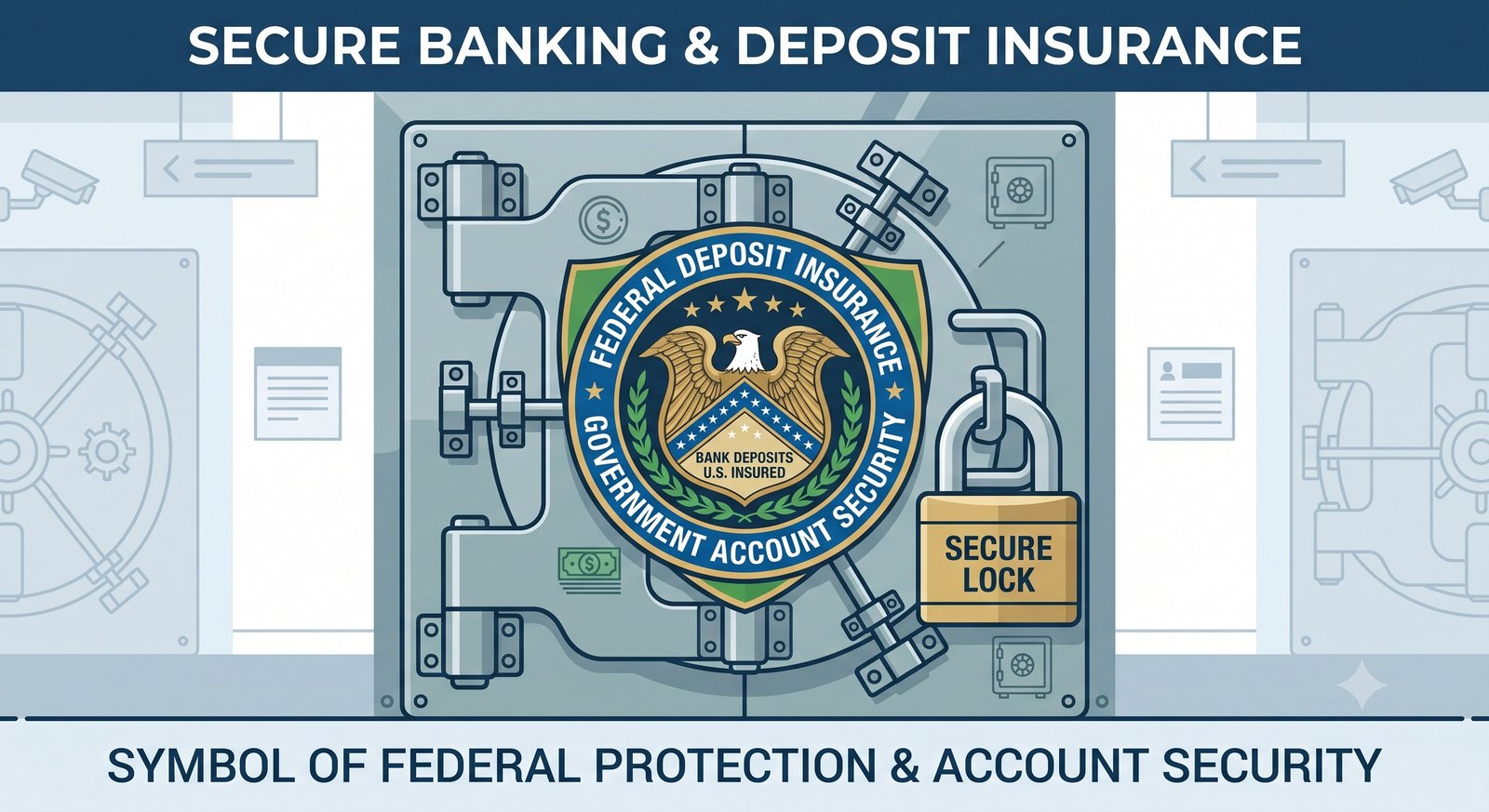
Regardless of the mathematical and structural differences between checking and savings vehicles, both account types share identical, uncompromising federal regulatory protections designed to strictly prevent consumer loss in the event of institutional insolvency. The bedrock of modern banking confidence is the elimination of the "bank run"—a scenario where panicked depositors simultaneously demand their cash, forcing a fractional reserve bank into immediate illiquidity and collapse.
In the United States, the Federal Deposit Insurance Corporation (FDIC) provides systemic backing for commercial bank deposits, while the National Credit Union Administration (NCUA) provides identical parallel regulatory protections for credit union deposits. Under current federal legislative guidelines, deposits held in both checking and savings accounts are fully insured up to $250,000 per depositor, per insured financial institution, for each account ownership category. This means that if a bank experiences a catastrophic liquidity crisis or fails completely, the federal government legally guarantees the complete, frictionless restitution of the consumer's capital up to the quarter-million-dollar threshold. (Note: Mutual funds, stocks, and crypto assets held in brokerage accounts carry zero FDIC protection).
Furthermore, checking and savings accounts are protected against unauthorized electronic fund transfers by the Electronic Fund Transfer Act (EFTA), implemented through Regulation E. This federal law actively limits consumer liability for fraudulent transactions, provided the account holder reports the unauthorized activity within specific, strictly enforced timeframes (typically within two business days to limit liability to $50). However, it is a vital operational note for financial planners that debit cards linked to checking accounts do not inherently offer the exact same robust fraud protection, instantaneous chargeback leverage, or capital security as credit cards, which are governed by the entirely separate and much stricter Fair Credit Billing Act (FCBA). If a debit card is compromised, the consumer's actual cash is drained from their checking account pending an investigation; if a credit card is compromised, only the bank's capital is at risk.
6. Empirical Case Studies in Cash Flow Management
To fully understand the mathematical impact of proper account selection, we must analyze the behavioral failures associated with mismanaging the liquidity-yield tradeoff.
Case Study 1: The High-Earner Cash Drag Trap
Scenario: John (42) earns a highly lucrative salary as an executive consultant. He is inherently risk-averse and dislikes financial complexity. He maintains a single traditional checking account at a legacy brick-and-mortar bank. All his salary deposits into this account, and all bills are paid from it. Because he earns far more than he spends, his checking account balance has swelled to $85,000. The account pays 0.00% APY. Inflation over the 5-year period averages 3.5% annually.
The Mathematical Failure: By leaving $85,000 in a zero-yield checking account for 5 years, John suffers massive purchasing power erosion. At 3.5% inflation, the real economic utility of his $85,000 drops to approximately $71,500. Had John utilized a hub-and-spoke model, keeping $10,000 in checking and sweeping $75,000 into a High-Yield Savings Account earning 4.0% APY, that $75,000 would have compounded to roughly $91,200. John’s refusal to manage his liquidity efficiently cost him nearly $16,200 in guaranteed, risk-free capital growth.
Case Study 2: The Over-Optimized Yield Chaser
Scenario: Sarah (28) recently discovered personal finance optimization. Wanting to maximize every single penny of yield, she moves 100% of her paycheck out of her checking account on payday, transferring it all to a remote HYSA that takes 2 business days to clear ACH transfers. She attempts to keep exactly $0.00 in her checking account until the exact day a bill is due.
The Mechanics of Friction: A long weekend delays her manual ACH transfer back to her checking account. Concurrently, an automated $1,200 mortgage payment hits her checking account on Tuesday. The account drops to -$1,200. The bank honors the payment but hits her with a $35 Overdraft Fee. Furthermore, because she had to make 8 separate transfers from her HYSA that month to cover various living expenses, she triggered a $15 Regulation D excess-withdrawal penalty from her online bank. Result: By attempting to earn an extra $4 in monthly interest by keeping her checking buffer at zero, Sarah triggered $50 in institutional penalties and severely damaged her internal bank rating. Total liquidity mismanagement.
7. Actionable Strategy Guide: Implementing the Hub and Spoke Model
The most efficient deployment of checking and savings accounts is achieved through a structural "Hub and Spoke" cash flow methodology. This setup mathematically isolates operational capital from accumulation capital, preventing accidental spending while optimizing yield.
- Step 1: Audit and Establish the Checking Hub. Open a zero-fee checking account to serve as the central hub. All income (salary, dividends) must flow directly into this hub. Calculate your total fixed and variable monthly expenses (e.g., $4,000).
- Step 2: Establish the Checking Buffer. You must maintain a baseline liquidity buffer in the checking hub equivalent to exactly 1.0 to 1.5 times your monthly expenses (e.g., $4,000 to $6,000). This cash generates zero yield, but it serves as an operational shock absorber, ensuring you never face overdraft fees due to mistimed automated billing cycles or delayed payroll.
- Step 3: Deploy the Savings Spokes. Open a High-Yield Savings Account (HYSA) at a separate, online institution. This physical separation introduces intentional "cognitive friction," preventing you from instantly transferring savings to your checking account via a mobile app while waiting in line to make an impulse purchase.
- Step 4: Automate the Capital Sweep. Once your checking ledger surpasses the mathematical buffer threshold (e.g., hits $6,500), configure an automated banking rule to immediately sweep the $500 surplus out of the checking hub and into the HYSA spoke.
- Step 5: Compartmentalize within the Spoke. Utilize digital "buckets" or sub-accounts within your HYSA to organize the capital. Do not mix your 6-Month Emergency Fund with your Annual Property Tax Sinking Fund. By isolating capital into clearly defined goals, you prevent the accidental cannibalization of critical funds.
8. Frequently Asked Questions (FAQ)
Q: Does opening a savings account or checking account help build my credit score?
No. Traditional checking and savings accounts are deposit vehicles, not credit vehicles. The major credit bureaus (Equifax, Experian, TransUnion) only track borrowed money, such as credit card utilization, mortgage payments, and personal loans. While a healthy savings balance is excellent for your personal net worth and can help you get approved for a mortgage during the underwriting process, it has absolutely zero mathematical impact on your FICO credit score.
Q: Can I use a savings account to pay off my credit card directly?
Technically yes, using the account's routing and account numbers to initiate an ACH pull from the credit card issuer. However, this is heavily discouraged. Because savings accounts are subject to withdrawal limits (traditionally 6 per month), using them to pay multiple credit cards, utility bills, and streaming services will rapidly trigger excess-withdrawal penalties. The standard operational procedure is to transfer the required lump sum from savings into checking, and then execute all external bill payments from the checking account.
Q: What happens to my money if my bank goes bankrupt?
If your institution is FDIC-insured (for banks) or NCUA-insured (for credit unions), the federal government guarantees the safety of your deposits up to $250,000 per depositor, per account type. If the bank fails, the FDIC usually steps in immediately, either orchestrating a buyout by a healthy bank (meaning your accounts transition seamlessly over the weekend) or mailing you a check for your insured balance within a few business days. You will not lose your principal capital.
Q: How does compound interest actually work inside a savings account?
Compound interest is the process of earning interest on your initial principal deposit, and then subsequently earning interest on the interest that has already been paid to you. For example, if you deposit $10,000 at a 5% Annual Percentage Yield compounding monthly, you will earn roughly $41 in the first month. In the second month, the bank calculates your 5% yield not on $10,000, but on $10,041. Over decades, this snowball effect generates massive, exponential capital growth without requiring any additional physical deposits from the user.
Q: Why do online banks offer so much more interest than traditional brick-and-mortar banks?
The discrepancy in yield is driven entirely by corporate overhead costs. Legacy brick-and-mortar banks must pay for physical real estate leases, property maintenance, localized marketing, and salaries for thousands of in-person tellers and branch managers. To maintain their profit margins, they pay depositors near-zero interest. Online-only banks (neobanks) have centralized operations and a fraction of the real estate and payroll expenses. They acquire customers and maintain their competitive edge by passing those massive operational savings directly back to the depositor in the form of a significantly higher APY.
See also
- Loading related topics...