Sovereign Gold Bonds (SGB)
The Definitive Guide to India's Sovereign-Backed, Yield-Generating Gold Investment Architecture
Gold has occupied a place of unparalleled socio-economic prominence in human history, functioning as a global store of value, an inflation hedge, and a universally accepted medium of exchange. In the Indian context, the affinity for gold transcends mere financial logic, deeply embedding itself into cultural traditions, marital customs, and intergenerational wealth transfer. However, the macroeconomic reality of this insatiable appetite for physical gold has historically placed severe strain on the Indian economy. To import massive quantities of gold, the nation must expend its foreign exchange reserves (primarily US Dollars), continuously widening the Current Account Deficit (CAD) and exerting downward pressure on the Indian Rupee.
To systematically resolve this macroeconomic vulnerability without disenfranchising the retail investor's desire to participate in gold's price appreciation, the Government of India, in consultation with the Reserve Bank of India (RBI), launched the Sovereign Gold Bond (SGB) Scheme under the Gold Monetization Initiative in November 2015. SGBs are government securities denominated in grams of gold. They serve as a perfect substitute for holding physical gold. Investors pay the issue price in cash, and the bonds are redeemed in cash upon maturity. By transforming a physical, idle asset into a highly efficient financialized security, the SGB scheme has revolutionized bullion investment, offering an unprecedented trifecta: capital appreciation mirroring physical gold, a fixed annual interest payout, and total exemption from capital gains tax upon maturity.
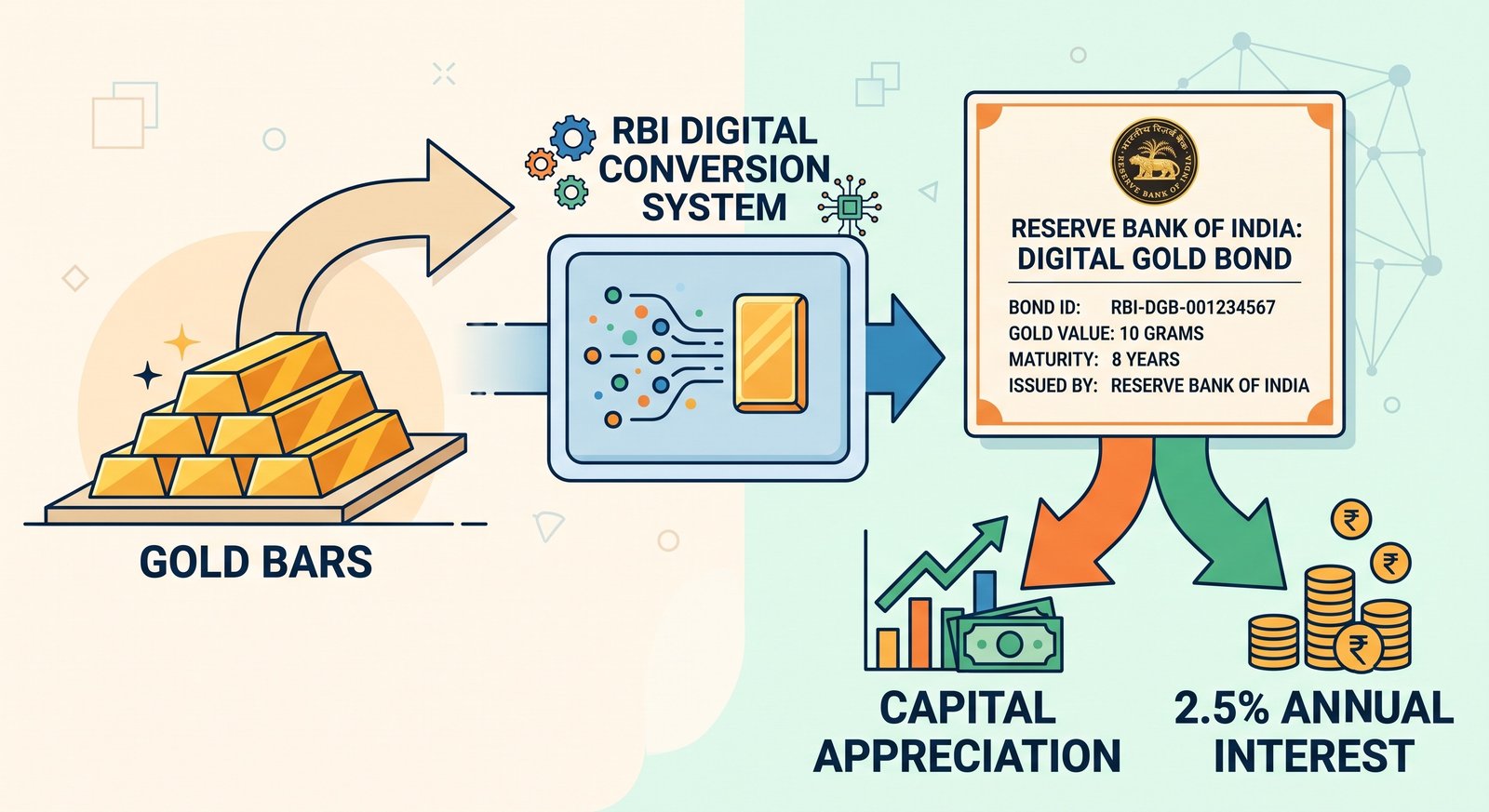
1. Macroeconomic Mechanics and RBI Issuance Architecture
Sovereign Gold Bonds are not available on tap throughout the year. They are issued in distinct "Tranches" authorized by the Government of India, with the RBI acting as the primary issuing agency. When the government announces a new tranche, a specific subscription window (usually a week) is opened for retail investors, Hindu Undivided Families (HUFs), trusts, universities, and charitable institutions.
The IBJA Pricing Mechanism: The most critical operational mechanic of the SGB is how its price is determined. The RBI does not arbitrarily set the price. The issue price is mathematically tethered to the spot market price of gold via the India Bullion and Jewellers Association (IBJA). The nominal value of the bond is calculated based on the simple average of the closing price of gold of 999 purity, published by the IBJA, for the last three working days of the week preceding the subscription period. To incentivize digital adoption, the RBI typically offers a flat discount (e.g., ₹50 per gram) to investors applying online and paying via digital modes.
Upon maturity, the redemption price is determined using the exact same IBJA methodology—averaging the closing price of 999 purity gold over the preceding three working days. This ensures that the investor experiences the exact same capital appreciation (or depreciation) as they would if they held physical 24-karat gold, but without the friction of GST, making charges, storage costs, or purity concerns.
2. Structural Anatomy: Interest, Tenure, and Limits
The SGB is a fixed-income instrument overlaid on a commodity derivative. To navigate this hybrid asset class, one must master its statutory parameters:
- The 2.5% Fixed Interest (Coupon): SGBs pay a fixed interest rate of 2.50% per annum. Crucially, this interest is calculated on the nominal issue value (the price at which you bought it), not on the fluctuating market value of gold. It is paid semi-annually directly into the investor's bank account.
- Tenure and Premature Redemption: The statutory tenure of an SGB is 8 years. However, the RBI provides an exit option starting from the 5th year onwards, executable only on the interest payment dates. If held in demat form, they can be traded on stock exchanges (NSE/BSE) at any time, providing secondary market liquidity.
- Investment Limits: To prevent monopolization of the sovereign guarantee by institutional giants, strict limits apply per financial year (April to March). The minimum investment is 1 gram. The maximum limit is 4 Kilograms (4,000 grams) for individuals and HUFs, and 20 Kilograms for trusts and similar entities.
- Collateral Utility: SGBs are highly recognized financial assets. They can be utilized as collateral for securing loans from banks, financial institutions, and Non-Banking Financial Companies (NBFCs). The Loan-to-Value (LTV) ratio is set equal to ordinary gold loans mandated by the RBI from time to time.
3. Deep-Dive Explanations & Mathematical Formulas
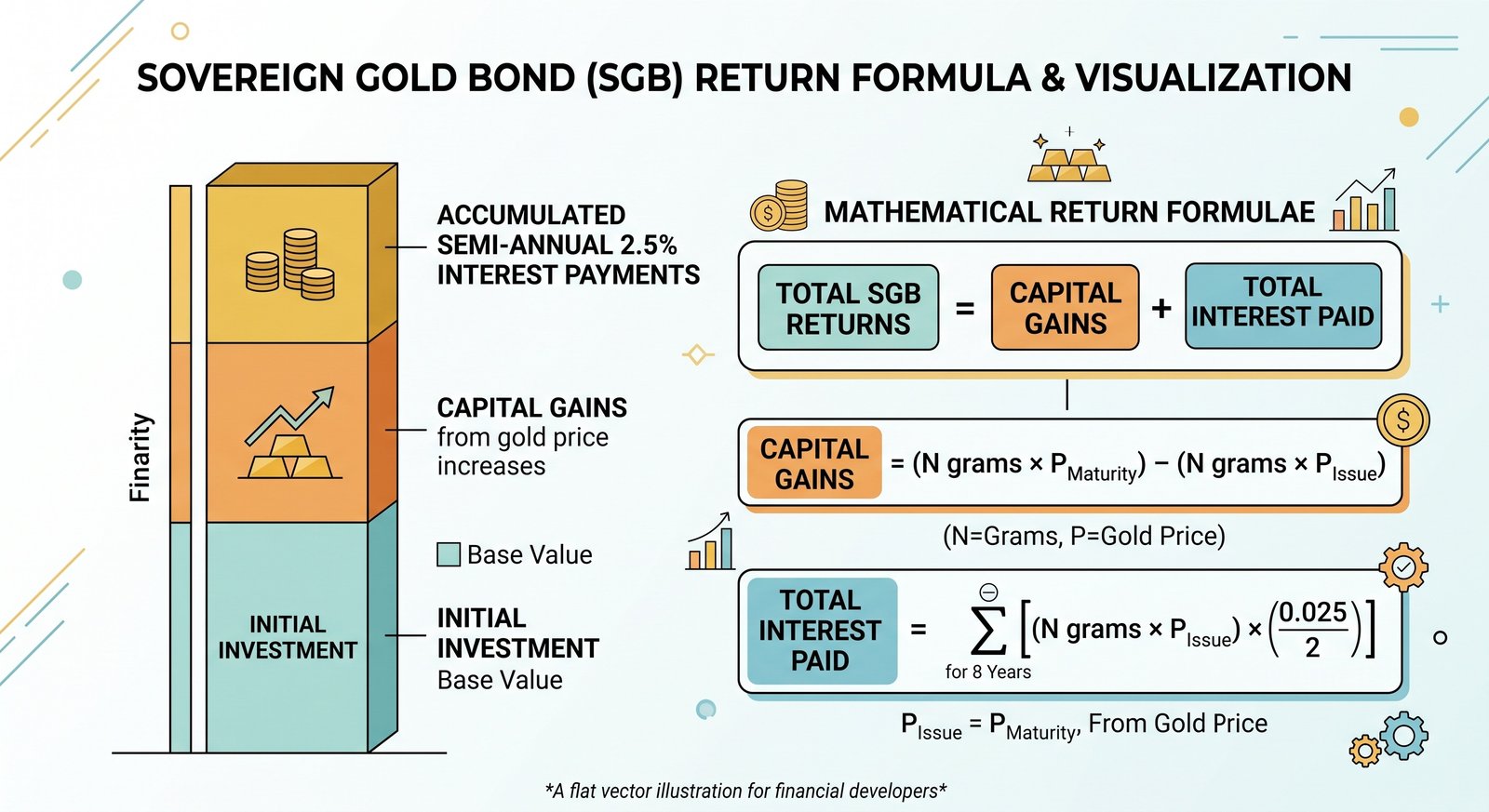
The true alpha of the SGB lies in its dual-return mechanism. Unlike physical gold, which generates a 0% internal rate of return until sold, an SGB provides periodic cash flows. To accurately calculate the absolute returns and the Extended Internal Rate of Return (XIRR) of an SGB portfolio, we must account for both the capital appreciation and the simple interest accrual.
The total nominal cash flow generated by an SGB at the end of its 8-year tenure (Total_Returns) is determined by the following formula:
Total_Returns = (Pmaturity - Pissue) + ∑n=116 [ Pissue × (0.025 / 2) ]
Where:
- Pissue: The initial purchase price of the bond (Issue Price).
- Pmaturity: The redemption price after 8 years based on the IBJA 999 purity average.
- 16: The number of semi-annual interest payout periods over 8 years.
- (0.025 / 2): The 2.5% annual interest rate divided by two for semi-annual distribution.
The Compounding Myth: It is critical to note that the 2.5% interest does not compound within the bond itself. It is a simple interest payout credited to your bank account. To achieve true exponential compounding, the investor must actively reinvest those semi-annual cash flows into other high-yielding assets (like equity mutual funds or debt instruments). If an investor spends the interest, their XIRR will be mathematically constrained compared to an investor who reinvests the payouts.
4. The Taxation Paradigm: Capital Gains and Interest Rules
The primary catalyst for the explosion in SGB adoption is its unparalleled tax architecture under the Indian Income Tax Act, 1961. The taxation is bifurcated between the interest earned and the capital gains realized.
- Taxation of Interest: The 2.5% annual interest payout is fully taxable. It is added to the investor's "Income from Other Sources" and taxed at their applicable marginal income tax slab rate (e.g., 30%). No Tax Deducted at Source (TDS) is applicable on SGB interest, meaning the investor must manually declare and pay this tax during their annual filing.
- Taxation of Capital Gains (Maturity): This is the golden goose. Under Section 47 of the Income Tax Act, if an individual investor holds the SGB until its statutory maturity (8 years), the entire capital gain (the difference between Pmaturity and Pissue) is 100% exempt from capital gains tax. This exemption also applies if the bond is redeemed via the RBI premature window between years 5 and 7.
- Taxation of Capital Gains (Secondary Market Sale): If an investor sells the SGB on the stock exchange (secondary market) before maturity, the transaction loses the Section 47 exemption. If sold within 12 months, Short-Term Capital Gains (STCG) apply at slab rates. If sold after 12 months, Long-Term Capital Gains (LTCG) apply at 12.5% (as per the latest union budget amendments) without indexation benefits.
5. Realistic Case Studies: Stress Testing the SGB Architecture
To translate theoretical mechanics into actionable financial intelligence, let us examine two edge-case scenarios demonstrating the severe impact of transaction friction and secondary market dynamics.
Case Study 1: Ramesh's Physical Gold vs. SGB Decision
Ramesh wants to invest ₹5,00,000 in gold for 8 years. The current price of 24K gold is ₹5,000 per gram. He contemplates buying physical coins versus an SGB.
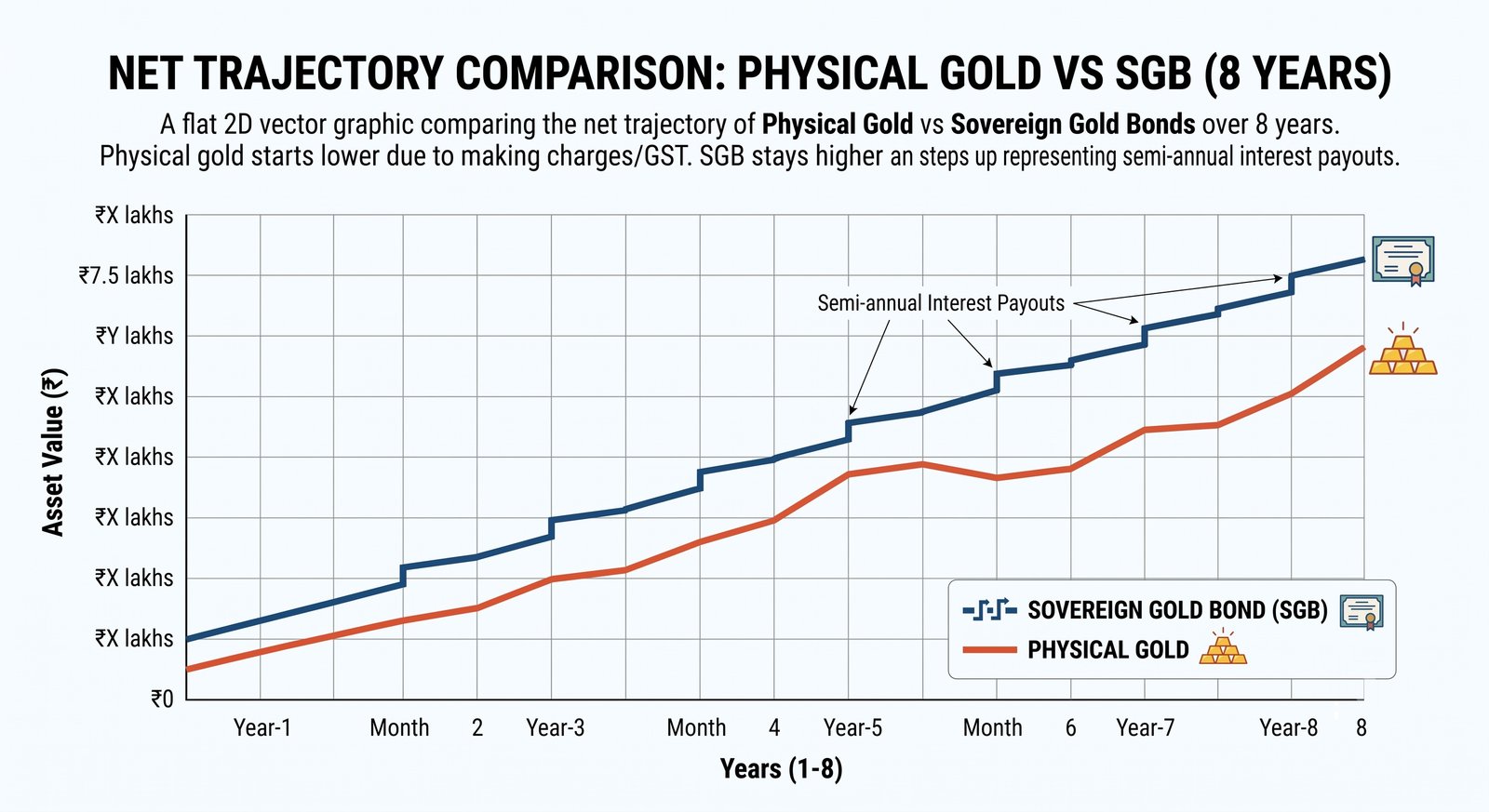
- Physical Gold Route: Ramesh buys coins. He immediately pays 3% GST (₹15,000) and an average of 5% in making charges/premium (₹25,000). His actual gold acquisition is worth only ₹4,60,000. Over 8 years, it sits in a bank locker costing ₹2,000 annually (₹16,000 total). If gold prices double to ₹10,000 per gram in 8 years, his physical gold is worth ₹9,20,000. He sells it, triggering Long Term Capital Gains tax at 12.5% on the profit. Net after-tax corpus is roughly ₹8,46,500.
- SGB Route: Ramesh buys 100 grams of SGB digitally for ₹4,95,000 (after a ₹50/gram digital discount). He pays 0% GST and 0% making charges. Every year, he receives 2.5% interest on ₹4,95,000 (₹12,375), totaling ₹99,000 in pre-tax interest over 8 years. At maturity, gold doubles to ₹10,000/gram. The RBI redeems his 100 grams for exactly ₹10,00,000. This capital gain is entirely tax-free. Total pre-tax return: ₹10,99,000. The SGB mathematically obliterates physical gold due to zero friction, accrued interest, and tax exemptions.
Case Study 2: Priya's Secondary Market Arbitrage
Priya is a sophisticated investor seeking to maximize yield. The current spot price of gold is ₹7,000/gram, and the RBI is not issuing a new tranche. Priya logs into her Demat account and looks at older SGB tranches trading on the NSE. She finds a tranche issued 3 years ago (with 5 years left to maturity) trading at a steep discount of ₹6,700 per gram, primarily because original investors are desperate for liquidity in an illiquid secondary market.
- The Execution: Priya buys 100 units on the exchange for ₹6,70,000. The original issue price of this specific bond was ₹5,000.
- The Interest Arbitrage: The 2.5% interest is paid on the original issue price (₹5,000), meaning she receives ₹125 per unit annually. However, because she paid ₹6,700, her effective current yield drops slightly below 2.5%, but this is irrelevant compared to the capital arbitrage.
- The Capital Arbitrage: By buying at ₹6,700 when the spot market is ₹7,000, Priya locks in an immediate, risk-free discount of roughly 4.2%. If she holds this bond for the remaining 5 years until RBI maturity, she receives the final redemption at the actual IBJA market price, completely tax-free. She successfully generated immense alpha by acting as a liquidity provider in the secondary market.
6. Structured Comparison Tables: The Gold Investment Triad
To optimize asset allocation, investors must view SGBs not in isolation, but relative to Physical Gold (bars/coins/jewelry) and Digital Gold (Gold ETFs / Mutual Funds). The table below delineates the structural differences across critical metrics.
| Feature / Metric | Sovereign Gold Bonds (SGB) | Physical Gold (Coins/Bars) | Gold ETFs / Mutual Funds |
|---|---|---|---|
| Annual Yield / Interest | 2.50% p.a. (paid semi-annually) on nominal value. | Nil (0%). Dead asset until sold. | Nil (0%). |
| Friction Costs & Fees | Zero GST. Zero making charges. Zero storage fees. | 3% GST + 5-15% Making Charges + Locker Fees. | Brokerage fees + Expense Ratios (approx. 0.5% to 1% p.a.). |
| Capital Gains Tax | 100% Tax-Free if held till RBI redemption (5+ years). | Fully Taxable (LTCG at 12.5%). | Fully Taxable (LTCG at 12.5% if held > 12 months). |
| Liquidity | Low. 8-year lock-in. Secondary market exists but is often illiquid. | High. Can be sold to jewelers instantly. | Extremely High. Traded like equities during market hours. |
7. Actionable Strategy Guide: How to Optimize SGB Investments
A passive approach to gold allocation yields average results. To maximize the institutional advantages of the SGB scheme, execute this step-by-step optimization framework.
- Step 1: Always Opt for Dematerialization. When applying for a primary SGB tranche through your bank or post office, ensure you provide your Demat (DP) ID. Holding SGBs in electronic Demat form is the only way to enable trading on the stock exchange before the 5-year lock-in expires. Physical certificates severely restrict liquidity.
- Step 2: Hunt for Secondary Market Discounts. Before subscribing to a new RBI tranche, check your broker platform for existing SGBs trading on the NSE/BSE. Look for bonds maturing in 3 to 6 years. Because institutional buyers avoid SGBs (they are primarily for retail), the secondary market suffers from a liquidity vacuum. Desperate sellers often dump their SGBs at a 3% to 7% discount to the spot price of gold. Buying at a discount acts as an instant, risk-free alpha generator.
- Step 3: Ladder Your SGB Portfolio. Do not buy 500 grams in a single year. Because SGBs lock capital for 8 years, you risk maturity coinciding with a cyclical bear market in gold prices. Instead, build an "SGB Ladder" by buying 50 to 100 grams every year. After 8 years, you will have a tranche maturing annually, providing continuous tax-free cash flow that averages out market volatility.
- Step 4: Reinvest the Interest Systematically. The 2.5% semi-annual interest will hit your savings account and quickly be absorbed by lifestyle inflation. Automate a process where the moment the SGB interest is credited, you sweep it into an Equity SIP or a high-yield liquid fund. This forces exponential compounding on what would otherwise be a simple interest cash drag.
8. Advanced Edge-Cases: Deflationary Risks and Fractional Holding
While the SGB is sovereign-backed, it is not immune to commodity risk. The Government of India guarantees the weight of the gold and the 2.5% interest, but it does not guarantee the price of gold. If an investor buys an SGB at ₹7,500 per gram, and 8 years later, global deflation or a massive shift to alternative reserve assets pushes the spot price of gold down to ₹5,000 per gram, the RBI will redeem the bond at ₹5,000. The investor suffers a massive nominal capital loss. The sovereign guarantee protects against credit default, not against market volatility.
Furthermore, investors utilizing the secondary market must be hyper-aware of record dates. When buying an old SGB on the stock exchange, the accrued interest is not priced into the transaction clearly. If you buy the bond just one day after the record date for the semi-annual interest payout, you will wait a full six months for your first cash flow, marginally depressing your yield calculations.
9. Frequently Asked Questions (FAQs)
Q: Can Non-Resident Indians (NRIs) invest in Sovereign Gold Bonds?
Under the Foreign Exchange Management Act (FEMA) guidelines, Non-Resident Indians (NRIs) are strictly prohibited from subscribing to new issues of Sovereign Gold Bonds. However, if a resident Indian acquires SGBs and subsequently changes their residential status to NRI, they are permitted to hold the existing bonds until premature redemption or maturity on a non-repatriable basis.
Q: If I sell my SGB in the secondary market (exchange) after 3 years, is the capital gain tax-free?
No. The total exemption from Capital Gains Tax under Section 47 applies only if the bond is redeemed by the RBI (either at 8-year maturity or via the premature withdrawal window after the 5th year). If you sell the SGB on the stock exchange to another investor at any point, it is treated as a transfer of a capital asset and will attract Long-Term Capital Gains (LTCG) tax at the prevailing statutory rates.
Q: What happens if the subscriber of the SGB passes away before maturity?
In the event of the death of the primary holder, the SGBs are seamlessly transferred to the nominee(s) designated during the application process. The nominee must submit the death certificate and the relevant claim forms to the receiving office (bank or post office). Once transferred, the nominee can choose to hold the bonds until the original maturity date to preserve the tax-free capital gains status, or they can opt for premature redemption under specific RBI succession clauses.
Q: Can I use SGBs to pledge for a loan, and how is the value calculated?
Yes, SGBs are eligible financial collateral. Banks and NBFCs accept them for secured loans. The Loan-to-Value (LTV) ratio is mandated by the RBI and is identical to the LTV limit set for physical gold loans (historically ranging between 75% and 90%). The valuation is calculated based on the prevailing IBJA spot price of gold, not the original issue price of the bond. Pledging a Demat SGB is significantly faster and requires zero purity checks compared to pledging physical jewelry.
Q: Are joint holdings allowed in SGBs, and how does the 4KG limit apply?
Yes, multiple individuals can apply for SGBs in joint names. However, the 4-Kilogram annual investment limit is strictly monitored and applied only to the first applicant (the primary holder). The secondary holder’s limits are not consumed. Therefore, a husband and wife can theoretically subscribe to a total of 8 Kilograms in a single financial year by opening two separate accounts where each is the primary holder on one account.
See also
- Loading related topics...