Stock Market Order Types
1. Introduction: The Language of Trade Execution
The stock market is a dynamic auction where millions of buyers and sellers continuously negotiate prices. However, a retail or institutional investor does not simply walk onto a trading floor to haggle. Instead, they communicate their exact intentions to the market through Order Types. An order type is a set of programmable instructions transmitted to a broker, dictating precisely how, when, and at what price a trade should be executed.
Mastering order types is not merely an administrative necessity; it is a fundamental pillar of risk management and trade optimization. Novice investors often rely exclusively on simple market orders, prioritizing speed over price, which leaves them vulnerable to high-frequency trading algorithms, illiquidity gaps, and severe slippage. Professional traders, conversely, utilize a surgical combination of limit, stop, and conditional orders to defend their capital, enter positions at mathematical support levels, and automate their trading psychology. Understanding the exact mechanical differences between an execution guarantee and a price guarantee is what separates a disciplined investor from a gambler.
2. The Baseline: Market Orders and the Bid-Ask Spread
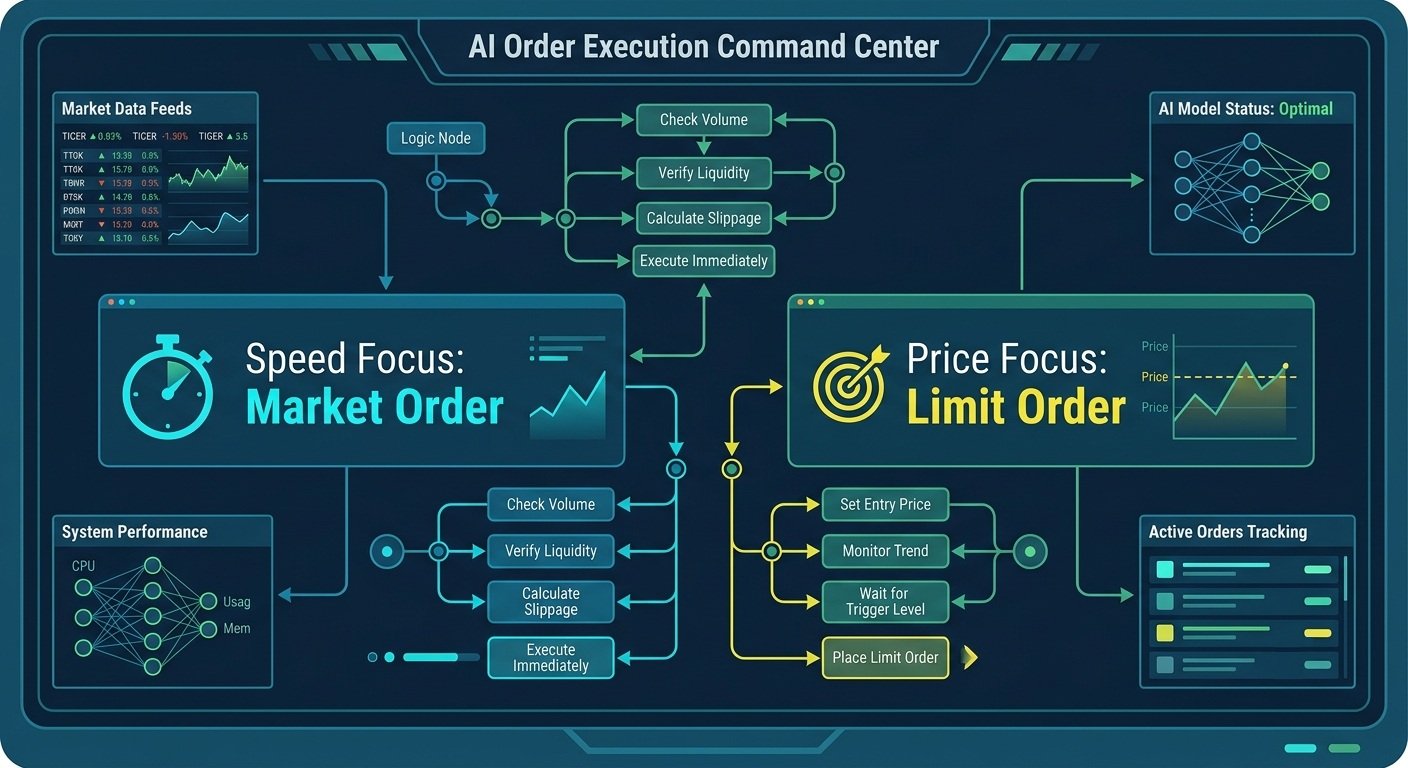
The most basic instruction an investor can issue is the Market Order. A market order instructs the broker to buy or sell a security immediately at the best available current price. It guarantees execution but provides absolutely zero guarantee regarding the price.
To understand the mechanical risk of a market order, one must understand the Bid-Ask Spread. The "Bid" is the highest price a buyer is currently willing to pay. The "Ask" (or Offer) is the lowest price a seller is currently willing to accept. When you place a Market Buy order, you are aggressively "crossing the spread" and paying the Ask price. When you place a Market Sell order, you are accepting the Bid price.
- The Mechanics of Slippage: Slippage occurs when the execution price of a trade differs from the expected price.
Formula: Slippage = Expected Execution Price - Actual Execution Price.
If you place a market order for 1,000 shares of a thinly traded stock where the Ask is $10.00 but there are only 200 shares available at that price, your order will consume those 200 shares and then aggressively sweep the order book upward, potentially buying the remaining 800 shares at $10.10, $10.25, or even higher.
3. Limit Orders: Retaining Pricing Power
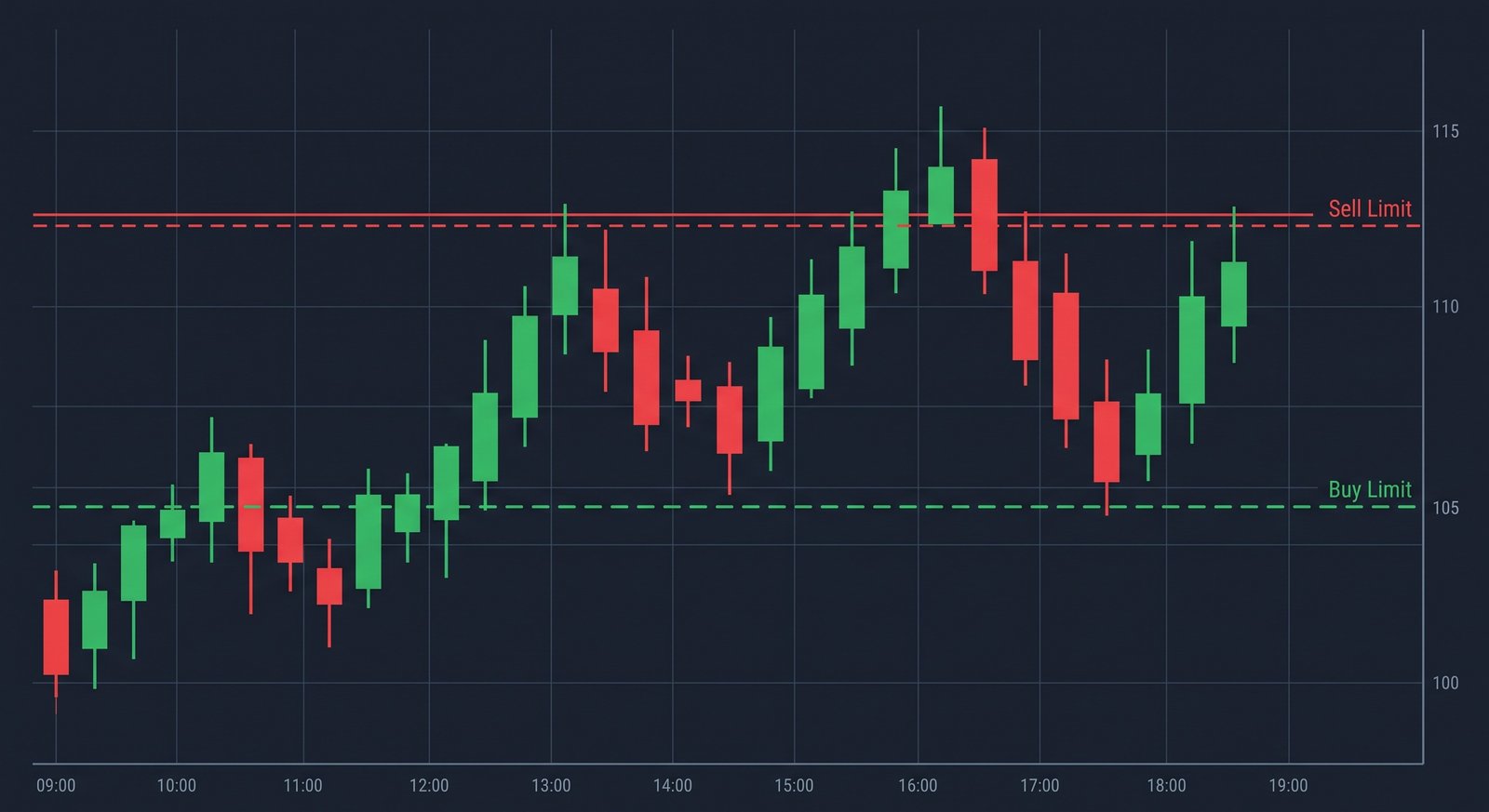
To combat slippage, institutional and savvy retail investors rely on the Limit Order. A limit order guarantees price but sacrifices the guarantee of execution. You are instructing the broker to execute a trade only at your specified price (the limit price) or better.
A Buy Limit Order can only be executed at the limit price or lower. Conversely, a Sell Limit Order can only be executed at the limit price or higher. For example, if a stock is trading at $50.00, but you only want to own it if it dips, you place a Buy Limit at $48.00. Your order sits in the exchange's order book. You have become a "liquidity provider." If the stock never drops to $48.00, your order is never filled, and you miss the trade entirely. This is the inherent opportunity cost of price control.
4. Stop Orders: The Defensive Mechanisms
While Limit orders dictate the terms of entry, Stop Orders (often called Stop-Loss orders) are conditional triggers designed primarily for risk management and protecting capital on an existing position. A stop order remains dormant until a specific price threshold (the Stop Price) is breached.
- Stop-Market Order: Once the stock trades at or past the stop price, the dormant order awakens and instantly converts into a standard Market Order. If you own a stock at $100 and set a Sell Stop at $90 to limit your risk, and the price hits $90, your broker will sell the shares immediately at the next available bid (which could be $89.95 or $89.50 in a fast-moving market).
- Stop-Limit Order: This combines two instructions. It requires a Stop Price (the trigger) and a Limit Price. If the stock hits the Stop Price, the order awakens and becomes a Limit Order, rather than a Market Order. This prevents severe slippage during a flash crash but carries a fatal flaw: if the market is crashing too fast, the price may gap directly past your limit, leaving you holding a plummeting asset because your order refused to trigger at the lower prices.
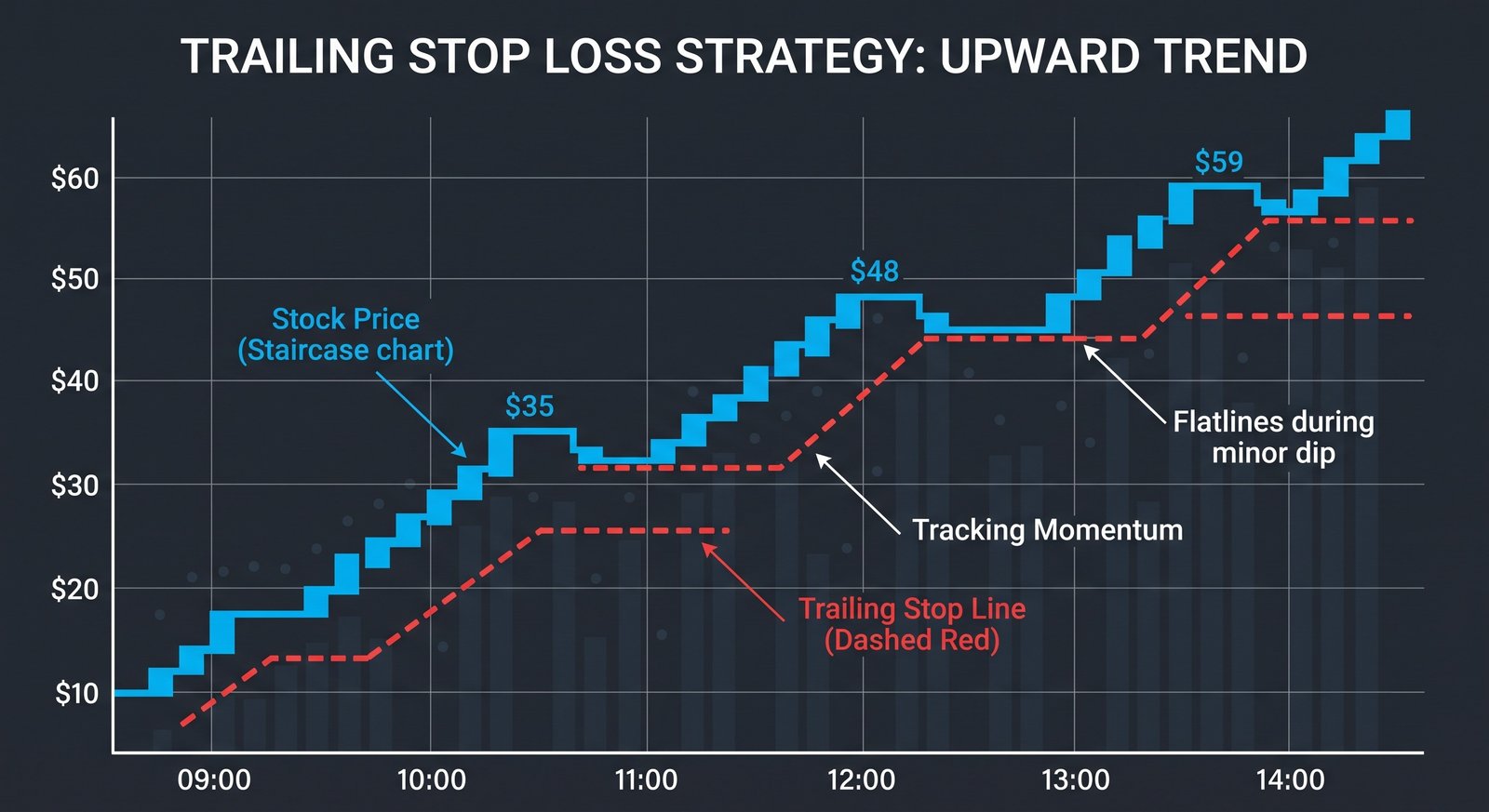
- Trailing Stop Order: A dynamic risk management tool. Instead of a fixed dollar amount, the stop price is set at a percentage or absolute dollar amount below the highest price the stock reaches after you buy it.
Formula: Current Trigger Price = Peak Market Price - (Peak Market Price × Trailing Percentage).
If the stock climbs, the stop price climbs with it, locking in profits. If the stock reverses, the stop stays fixed at its highest calculated point and triggers if breached.
5. Advanced Modifiers: Time in Force (TIF)
Order types dictate the "price" constraint, but investors must also define the "time" constraint. This is known as Time in Force (TIF). Without a specified TIF, a limit or stop order could theoretically sit in the exchange's order book for decades. The most common TIF modifiers include:
- Day Order: The default setting for most brokerages. The order remains active only during the current regular trading session. If it is not filled by the 4:00 PM EST closing bell, it is automatically canceled.
- Good-'Til-Canceled (GTC): The order remains active indefinitely across multiple trading days until it is either filled, explicitly canceled by the investor, or until it hits the broker's maximum duration limit (usually 60 to 90 days).
- Immediate-or-Cancel (IOC): Requires that all or part of the order be executed instantaneously. Any portion of the order that cannot be filled immediately is canceled. This is heavily used by algorithmic traders scanning for fleeting liquidity.
- Fill-or-Kill (FOK): An aggressive absolute. The broker is instructed to execute the entire order immediately. If the full quantity of shares is not available at the specified price, the entire order is canceled. Partial fills are strictly prohibited.
6. Case Study 1: The Slippage Trap and the Gap Down
To fully grasp the critical distinction between a Stop-Market and a Stop-Limit order, we must examine a real-world edge case known as the "Gap Down." Consider a fictional biotechnology company, NovaGen Therapeutics (NGT), trading at $50.00.
Two investors, Alice and Bob, each buy 1,000 shares of NGT at $50. Both want to limit their downside risk to roughly $5,000, so they decide to set a defensive trigger at $45.00.
- Alice uses a Stop-Market Order with a trigger at $45.00.
- Bob uses a Stop-Limit Order with a trigger at $45.00 and a limit price of $44.50.
After the market closes, NovaGen announces that their flagship drug completely failed FDA trials. The next morning, panic ensues in the pre-market. When the opening bell rings at 9:30 AM, there are zero buyers at $45. The stock immediately "gaps down" and opens at $30.00.
Alice's Outcome: Because the stock traded below $45, her Stop-Market order immediately activated and converted to a Market Order. Her broker aggressively dumped her 1,000 shares into the chaos, executing at the best available bid: $29.50. Alice lost $20,500. It is painful, but she is successfully exited from a collapsing asset.
Bob's Outcome: Because the stock crossed $45, his Stop-Limit order activated, placing a Sell Limit order at $44.50 into the market. However, the stock is currently trading at $30.00, and falling. No one is willing to pay Bob his $44.50 limit. Bob's order sits unfilled. As NovaGen bleeds out to $15 over the coming weeks, Bob remains trapped in the stock holding an unrealized loss of $35,000, entirely because he prioritized price control in a scenario that demanded absolute execution.
7. Case Study 2: Precision Execution with Trailing Stops
Conversely, dynamic order types are incredibly powerful for securing upside. Let us look at Hyperion Tech, a momentum stock experiencing a massive rally. An active trader, David, identifies a breakout and places a Buy Limit Order at $105.00, acting as a pullback entry. The stock retraces, fills his order precisely at $105, and continues its rally upward.
Hyperion surges to $130 over the next month. David does not want to cap his upside by selling prematurely, but he also refuses to let a $25-per-share gain turn into a loss. He implements a Trailing Stop-Market Order set at 10%.
When Hyperion peaks at $140, the trading algorithm calculates David's hidden stop price at $126 ($140 - 10%). The stock experiences minor volatility, dipping to $132, but because it does not hit $126, David remains in the trade. A week later, Hyperion experiences a parabolic blow-off top, hitting $160. David's trailing stop automatically recalculates to $144 ($160 - 10%). Finally, the momentum breaks, and the stock reverses sharply. When it drops to $144, the order converts to a Market Sell, executing at $143.90. David secured a massive $38.90 per share profit without having to stare at a monitor all day, allowing his winners to run while mechanically protecting his equity curve.
8. Structured Comparison: Order Types at a Glance
To build an effective trading or investing system, you must know the inherent trade-offs of the primary order types. The table below delineates the absolute guarantees and risks associated with each execution instruction.
| Order Type | Execution Guarantee? | Price Guarantee? |
|---|---|---|
| Market Order | YES (Assuming liquidity exists) | NO (Vulnerable to severe slippage) |
| Limit Order | NO (Price may never reach the limit) | YES (Will only fill at limit or better) |
| Stop-Market Order | YES (Once triggered) | NO (Will gap down during flash crashes) |
| Stop-Limit Order | NO (Will freeze if price crashes past limit) | YES (Will only fill at limit or better) |
9. Actionable Strategy Guide: When to Use Which Order
The misuse of order types is a primary reason retail investors underperform. By applying this sequential logic framework before clicking "Buy" or "Sell," you can drastically reduce unforced errors and capital bleed.
- Step 1: Evaluate Market Liquidity. Are you trading a Mega-Cap stock like Apple (AAPL) or a micro-cap penny stock? If trading a highly liquid Mega-Cap during normal hours, a Market Order is generally safe, as the Bid-Ask spread is likely a single penny. If trading illiquid small-caps, options, or after-hours markets, never use a Market Order; you must use a Limit Order to defend against wide spreads.
- Step 2: Define the Urgency (Entry vs. Exit). Are you trying to enter a position based on long-term fundamental value? There is no rush. Use a Good-'Til-Canceled (GTC) Buy Limit Order placed at structural support levels. Let the market come to your price. Are you trying to exit a burning building (e.g., bad earnings, SEC investigation)? Do not haggle over pennies. Use a Market Order to get out instantly.
- Step 3: Establish Hard Risk Parameters. The moment your Buy Limit order is filled and you own the stock, immediately submit a Stop-Loss order. For long-term portfolios, a Stop-Market order placed 15-20% below your entry prevents catastrophic, permanent losses.
- Step 4: Protect Profits Mechanically. Once a trade is deeply in profit (e.g., up 30%), cancel your original Stop-Loss and replace it with a Trailing Stop (e.g., trailing by 10%). This guarantees you will walk away with a profit without forcing you to manually guess the top of the rally.
- Step 5: Beware the Earnings Report Gap. Never hold a tight Stop-Limit order through a binary event like a quarterly earnings call. The stock will likely open drastically higher or lower than the previous day's close, entirely bypassing your limit triggers and leaving you exposed. If you must hold through earnings, consider using options to hedge risk instead of relying on stop orders.
10. Frequently Asked Questions (FAQs)
Q: Can a Limit Order be executed at a better price than what I specified?
Yes. This is known as "Price Improvement." A Limit Order represents your worst-case scenario. If you place a Buy Limit at $50.00, and there is a sudden influx of sellers willing to dump shares at $49.95 exactly when your order reaches the exchange, the broker is obligated by National Best Bid and Offer (NBBO) regulations to execute your trade at the superior $49.95 price.
Q: Do Stop-Loss orders completely guarantee I will not lose more than my specified amount?
No, they do not. A Stop-Loss (Stop-Market) order guarantees execution, but it does not guarantee price. If you hold a stock at $100 and set a stop at $90, but the company goes bankrupt overnight and opens the next morning at $10, your stop triggers and sells your shares at $10. Your risk management plan fails during overnight gaps or flash crashes.
Q: What happens to my GTC (Good-'Til-Canceled) limit orders if a stock splits or pays a dividend?
Typically, during corporate actions like stock splits or significant special dividends, the exchange or your brokerage will automatically cancel all resting open orders to prevent erroneous executions caused by the mathematical adjustment in the stock price. You will need to manually re-enter your GTC orders at the new, adjusted price levels.
Q: Why did my Stop-Limit order fail to execute during a market crash?
This is the inherent flaw of the Stop-Limit order. If you set your stop trigger at $50 and your limit at $49.50, you are telling the broker: "Sell my shares, but accept no less than $49.50." If the market is crashing violently and the price blows past $50 and immediately drops to $48, your limit order goes into the book at $49.50, but because the stock is already trading lower, no buyers will match it. Your order remains unfilled as the stock continues to crash.
See also
- Loading related topics...