Systematic Investment Plans
1. The Core Mechanics and Behavioral Framework

A Systematic Investment Plan (SIP) is a highly structured, automated investment vehicle offered by asset management companies (AMCs) that allows retail and institutional investors to allocate a fixed, pre-determined amount of capital into a specific mutual fund at regular intervals—typically weekly, monthly, or quarterly. Rather than requiring a massive upfront capital outlay, an SIP operates on the principle of micro-allocations, democratizing access to broad market wealth creation.
The macroeconomic significance of the SIP cannot be overstated. Historically, capital markets were plagued by acute retail volatility; inexperienced investors would pour capital into the market during euphoric bull runs and panic-sell during bearish downturns, effectively buying high and selling low. The SIP was designed as a behavioral finance remedy to this exact phenomenon. By automating the deduction of funds directly from an investor's bank account regardless of current market conditions, an SIP mathematically removes human emotion from the equation, enforcing financial discipline.
Furthermore, SIPs provide critical liquidity and stability to the broader equity markets. When millions of retail investors commit to monthly SIPs, fund managers receive a predictable, continuous stream of inward cash flow. This allows institutional managers to deploy capital efficiently without the fear of sudden, mass redemptions, ultimately dampening systemic market volatility.
2. Deep-Dive: Mathematical Formulas Governing SIPs
The true power of a Systematic Investment Plan relies on two fundamental mathematical concepts: Dollar-Cost Averaging (or Rupee-Cost Averaging) and the Future Value of an Annuity Due. Understanding these mechanics is essential for grasping how wealth scales non-linearly over time.
- Dollar-Cost Averaging (DCA): This is the mechanic by which an SIP neutralizes market volatility. Because the investment amount is fixed, the investor automatically purchases more units of a mutual fund when the Net Asset Value (NAV) drops, and fewer units when the NAV rises.
Average Cost per Unit = Total Amount Invested / Total Number of Units Accumulated.
Over multiple market cycles, this inherently drives the average purchase price down below the median market price. - Future Value of an Annuity (FVA) Formula: An SIP is mathematically classified as an annuity due, because payments are made at the beginning of each period. The formula to calculate the future maturity value of an SIP is:
FV = P × [((1 + r)n - 1) / r] × (1 + r) - Variable Breakdown: In the FVA formula, FV is the Future Value. P represents the periodic investment amount (e.g., $500/month). r is the periodic rate of return (annual expected return divided by 12 months). n is the total number of periods (years multiplied by 12). The final (1 + r) multiplier accounts for the fact that investments are made at the beginning of the month, thus earning an extra month of interest.
3. Case Study 1: DCA in a Volatile Market Environment
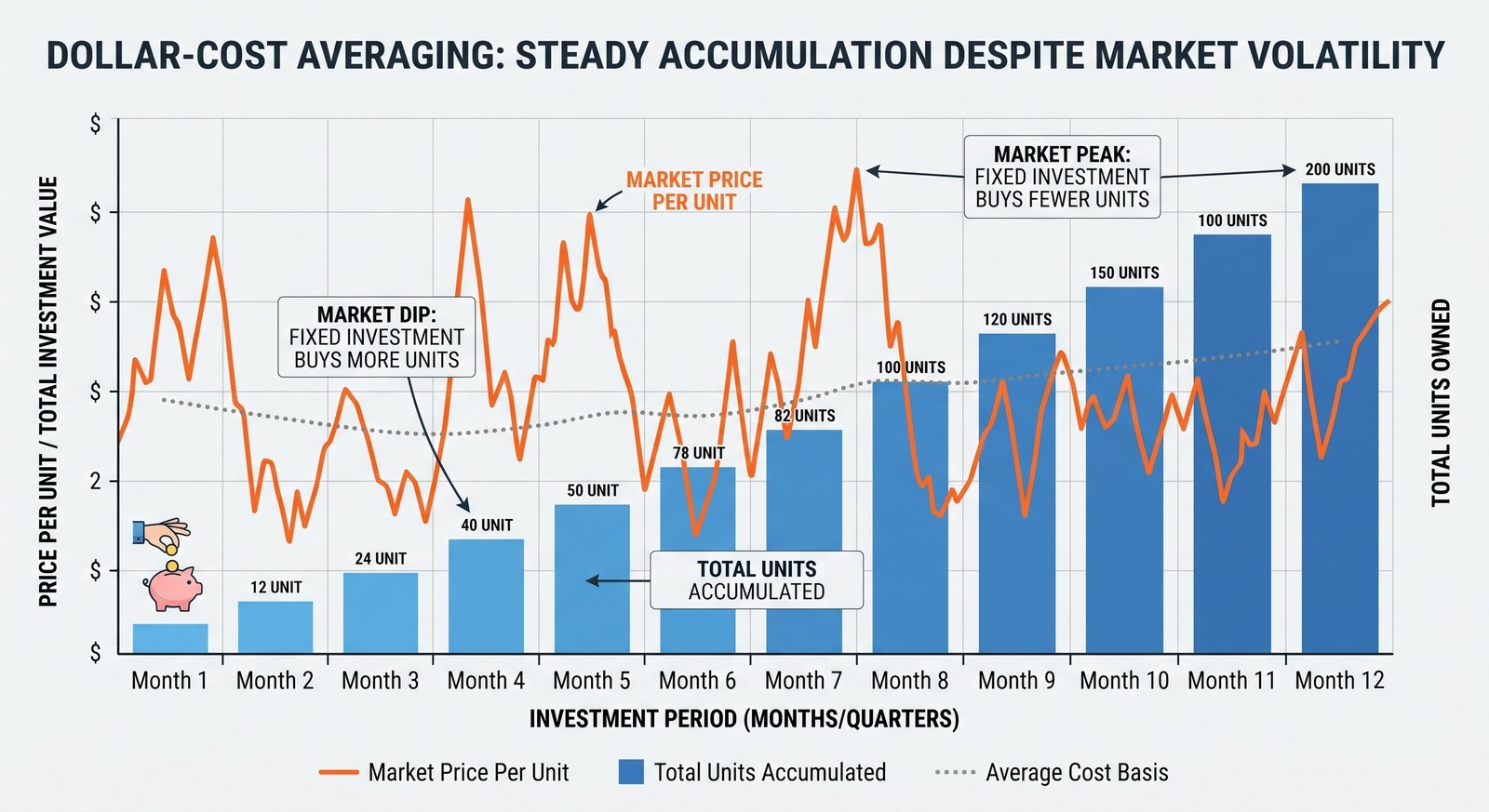
To illustrate the protective mechanism of Dollar-Cost Averaging, let us examine a highly volatile edge-case scenario where the market effectively goes nowhere over a specific period, but the SIP investor still generates a profit.
Scenario: Jonathan sets up a monthly SIP of $1,000 into a Mid-Cap Equity Fund. At the start of the year (Month 1), the fund's NAV is $50, meaning his $1,000 buys exactly 20 units. However, a sudden geopolitical crisis causes a severe market crash. Over the next three months, the NAV drops to $40, then $25, and then hits rock bottom at $20. By Month 6, the crisis resolves, and the market recovers perfectly back to the original NAV of $50.
A lump-sum investor who bought at Month 1 would have endured a terrifying 60% drawdown and, at Month 6, would merely be sitting at a 0% return (break-even). Let us look at Jonathan's SIP accumulation.
The Outcome: Month 1: $1000 / $50 = 20 units. Month 2: $1000 / $40 = 25 units. Month 3: $1000 / $25 = 40 units. Month 4: $1000 / $20 = 50 units. Month 5: $1000 / $40 = 25 units. Month 6: $1000 / $50 = 20 units.
Jonathan invested a total of $6,000 over six months. He accumulated a total of 180 units. His average purchase cost is $6,000 / 180 = $33.33 per unit. When the market recovers to $50 in Month 6, his 180 units are now worth $9,000. Despite the market ending exactly where it started, Jonathan's SIP generated a massive $3,000 profit (a 50% absolute return) purely by capitalizing on the lower NAVs during the downturn.
4. Structural Comparison: SIP vs. Lump Sum vs. STP
Investors often struggle to decide between deploying capital all at once (Lump Sum), spreading it out (SIP), or moving it between funds (Systematic Transfer Plan). The optimal strategy depends entirely on market valuation, psychological risk tolerance, and current liquidity.
| Investment Metric | Systematic Investment Plan (SIP) | Lump Sum Investment |
|---|---|---|
| Market Timing Risk | Extremely Low. Averages out volatility over time. | Very High. Susceptible to immediate market crashes. |
| Capital Requirement | Low. Can start with micro-amounts monthly based on cash flow. | High. Requires a large cache of investible surplus upfront. |
| Mathematical Advantage | Outperforms Lump Sum in a falling, volatile, or sideways market. | Outperforms SIP in a relentlessly rising, unbroken bull market. |
| Behavioral Impact | Enforces discipline; removes emotion and panic from investing. | Can induce heavy anxiety if the portfolio suffers immediate drawdowns. |
5. Case Study 2: The Step-Up SIP (Combating Inflation)
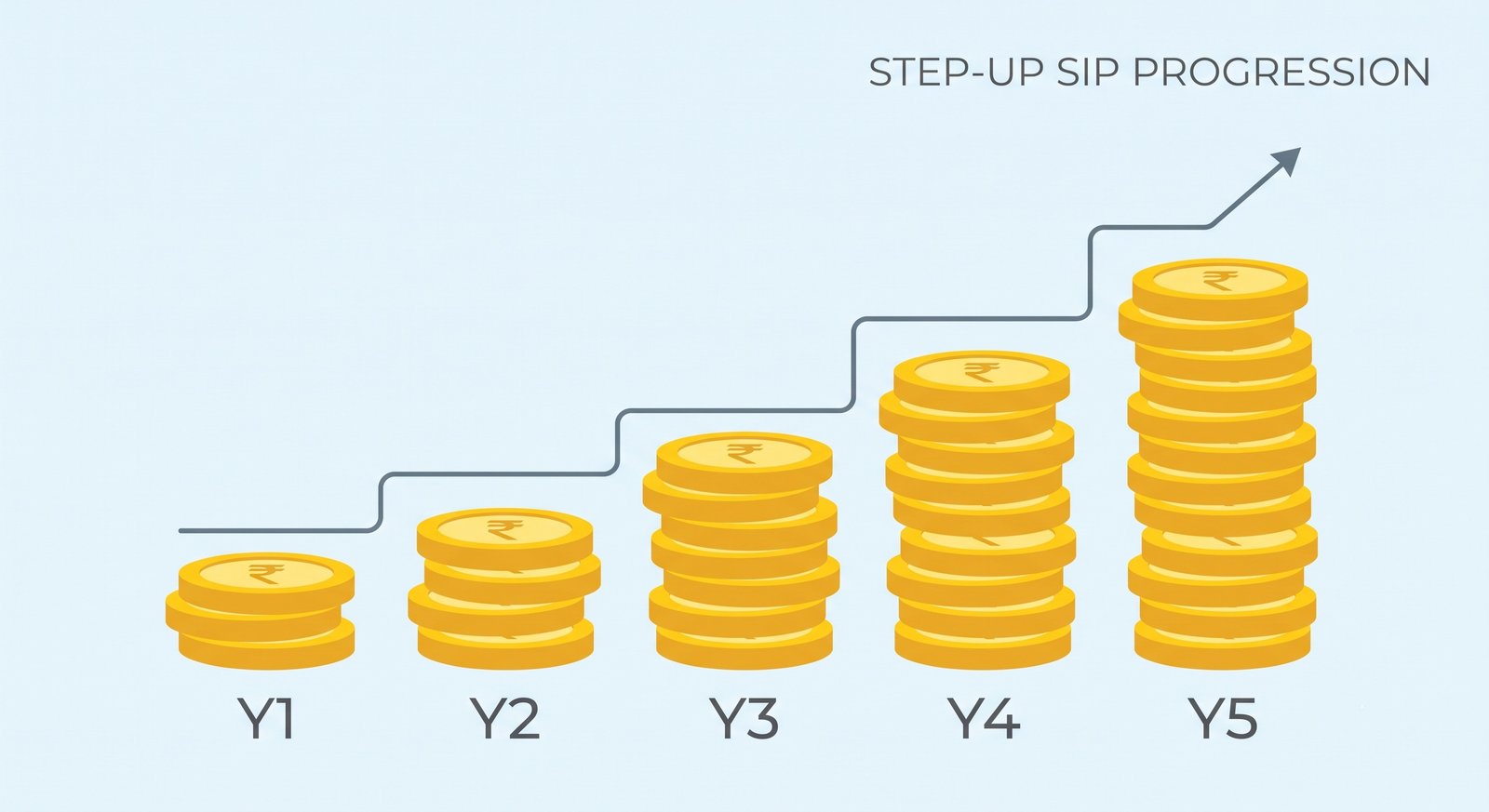
A standard SIP is excellent, but it possesses a critical flaw over multi-decade horizons: it does not account for inflation or the investor's rising income. As an investor progresses in their career, their salary increases. If their SIP remains static, they are effectively under-allocating capital in their prime earning years. The advanced solution is the Step-Up SIP (or Top-Up SIP), where the monthly contribution automatically increases by a fixed percentage or amount every year.
Scenario: Maya, age 25, wants to retire at 55. She starts a standard SIP of $500 per month into an S&P 500 Index Fund, assuming an annualized return of 10%. Over 30 years, she will invest $180,000, and her final portfolio will be worth approximately $1.13 million.
However, Maya realizes that a 3% annual salary raise is standard in her industry. She decides to use a Step-Up SIP, committing to increase her $500 contribution by just 10% every single year. So, in Year 2, her monthly SIP becomes $550; in Year 3, it becomes $605, and so on.
The Outcome: By aggressively scaling her investments alongside her income growth, the mathematics fundamentally shift. Over 30 years, Maya's total out-of-pocket investment scales to $986,000. Her final portfolio value, supercharged by the escalating compounding effect, explodes to over $3.4 million. By making a simple administrative tweak to increase her savings rate slightly every 12 months, Maya tripled her final wealth without ever feeling a pinch in her daily budget, as the increases were perfectly aligned with her salary bumps.
6. Edge Cases and Macro-Market Anomalies
While mathematically robust, SIPs are not invincible against extreme macroeconomic anomalies. One such edge case is a "Lost Decade"—a prolonged period of zero or negative real returns, such as the Japanese Nikkei 225 from 1990 to 2010, or the US market from 2000 to 2010.
If an investor begins an SIP at the absolute peak of an epic macro-bubble right before a 10-year flatline, their portfolio will not experience the traditional J-curve of compound growth. However, the SIP structure actually acts as the only saving grace in a Lost Decade. Because the investor is constantly accumulating units at severely depressed prices for 10 years, the very moment the market finally breaks out to new all-time highs, the portfolio undergoes a violent, exponential snap-back. The risk is not necessarily financial ruin, but rather the behavioral fatigue of paying into a stagnant portfolio for years on end, causing many to capitulate right before the recovery.
Another anomaly is the Sequence of Returns Risk in Late Accumulation. DCA is incredibly powerful in the first 15 years of an SIP when the principal is small. However, in Year 25, when the portfolio is vast (e.g., $1,000,000), a new $500 monthly SIP contribution is statistically meaningless (0.05% of the portfolio). At this stage, market volatility dominates the portfolio, and a 20% market crash wipes out $200,000—a loss that no amount of $500 monthly SIPs can quickly average down. This requires the investor to manually shift asset allocation away from pure equities into debt as maturity approaches.
7. Actionable Strategy Guide: Optimizing Your SIP
To translate this encyclopedia knowledge into practical wealth creation, follow this definitive step-by-step framework to establish an optimized Systematic Investment Plan.
- Step 1: Quantify the Surplus and Emergency Buffer. Before starting an SIP, ensure you have 6 months of living expenses in a liquid savings account. Calculate your net monthly income minus fixed expenses and discretionary spending. The remainder is your investible surplus. Commit 70% of this surplus to your SIP, leaving 30% for short-term liquidity.
- Step 2: Date Optimization (The "Pay Yourself First" Rule). Never schedule your SIP deduction for the end of the month; you will likely spend the money before it can be invested. Schedule the auto-deduct date precisely 1 to 3 days after your salary hits your bank account. This enforces artificial scarcity, forcing you to live on the remainder.
- Step 3: Asset Class Selection based on Horizon. If your financial goal is 1-3 years away, direct the SIP into a Liquid or Short-Duration Debt Fund. If the goal is 3-5 years away, choose a Balanced/Hybrid Fund. If the goal is 7+ years away, direct the SIP into a Broad-Market Equity Index Fund to maximize long-term compounding.
- Step 4: Register the OTM (One-Time Mandate). Most modern platforms use an electronic mandate with your bank. Ensure the mandate limit is set significantly higher than your current SIP amount. This allows you to easily utilize a Step-Up SIP later without having to file new banking paperwork.
- Step 5: Embrace the "Ignorance is Bliss" Protocol. Once the automated system is running, delete the investment tracking apps from your daily routine. Checking an equity SIP weekly triggers anxiety during market corrections. Review the portfolio strictly once a year to execute the Step-Up percentage increase.
8. Frequently Asked Questions (FAQ)
Q: What happens if I miss a monthly SIP installment due to low bank balance?
Missing an SIP installment does not mean your account is closed or penalized by the mutual fund company. The mutual fund simply skips the purchase for that month. However, your local bank may charge you a modest "mandate bounce" fee (similar to a bounced check fee) for insufficient funds. If you miss three consecutive installments, many AMCs will automatically cancel the SIP mandate, though your existing accumulated units remain perfectly safe and invested.
Q: Can I pause or stop my SIP at any time, or am I locked in?
Unlike traditional insurance endowments or fixed-term deposits, standard mutual fund SIPs are completely flexible. You can pause, modify, or stop your SIP instruction at any time without paying a penalty to the AMC. This flexibility is vital during unexpected life events or temporary job losses.
Q: Is it better to have a daily, weekly, or monthly SIP?
Extensive historical back-testing reveals that there is a negligible mathematical difference in returns between daily, weekly, and monthly SIPs over a 10+ year horizon. The micro-volatility captured by a daily SIP does not meaningfully outperform a monthly SIP in the long run. Therefore, a monthly SIP is globally recommended purely for administrative ease, as it perfectly aligns with standard monthly salary cycles.
Q: How are SIP investments taxed when I finally decide to sell?
Taxation operates on a "First-In, First-Out" (FIFO) accounting method. Each individual monthly SIP installment is treated as a separate, distinct purchase. For example, to qualify for Long-Term Capital Gains (LTCG) tax rates (which usually require holding the asset for over one year), each specific SIP installment must complete its own 365-day journey. You cannot sell units bought last month and claim LTCG just because the SIP itself started 5 years ago.
Q: Does starting an SIP guarantee that I will not lose money?
No. An SIP is a method of investing, not a guarantee of principal protection. Because equity mutual funds are subject to market risks, if the entire market crashes and remains depressed for an extended period, the current market value of your SIP portfolio can indeed fall below your total invested capital. The SIP framework mitigates risk through averaging, but it does not completely eliminate macroeconomic risk.
See also
- Loading related topics...