Systematic Withdrawal Plans
The Definitive Guide to Creating Sustainable, Tax-Efficient Income Streams from Investments
The transition from wealth accumulation to wealth decumulation is one of the most critical phases in an investor's financial lifecycle. During the accumulation phase, the primary objective is growth, often achieved through tools like Systematic Investment Plans (SIPs) and compounding. However, when an investor enters retirement or requires a steady stream of passive income, the objective shifts toward capital preservation, liquidity, and inflation protection. Enter the Systematic Withdrawal Plan (SWP).
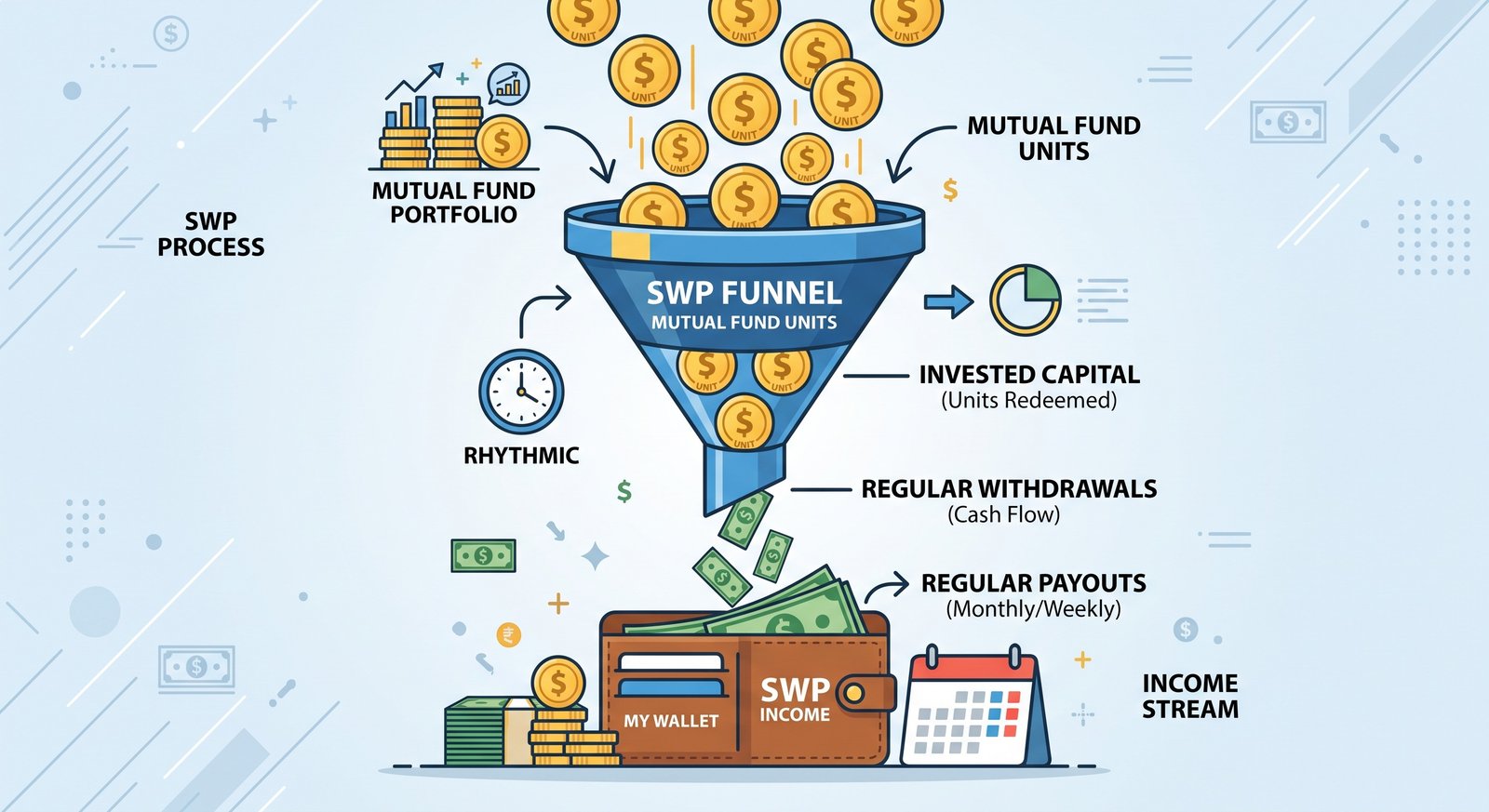
An SWP is a financial mechanism offered by mutual fund houses that allows investors to withdraw a predefined amount of money from their accumulated investment corpus at regular intervals—be it monthly, quarterly, semi-annually, or annually. Unlike dividend payouts, which are entirely dependent on the fund's market performance and the fund manager's discretion, an SWP places the control of cash flow firmly in the hands of the investor.
1. The Macroeconomic Mechanics of SWPs
To truly master Systematic Withdrawal Plans, one must understand the underlying macroeconomic forces and market mechanics at play. An SWP is not merely an ATM; it is a dynamic process of liquidating fractional units of a fluctuating asset to generate a static cash flow.
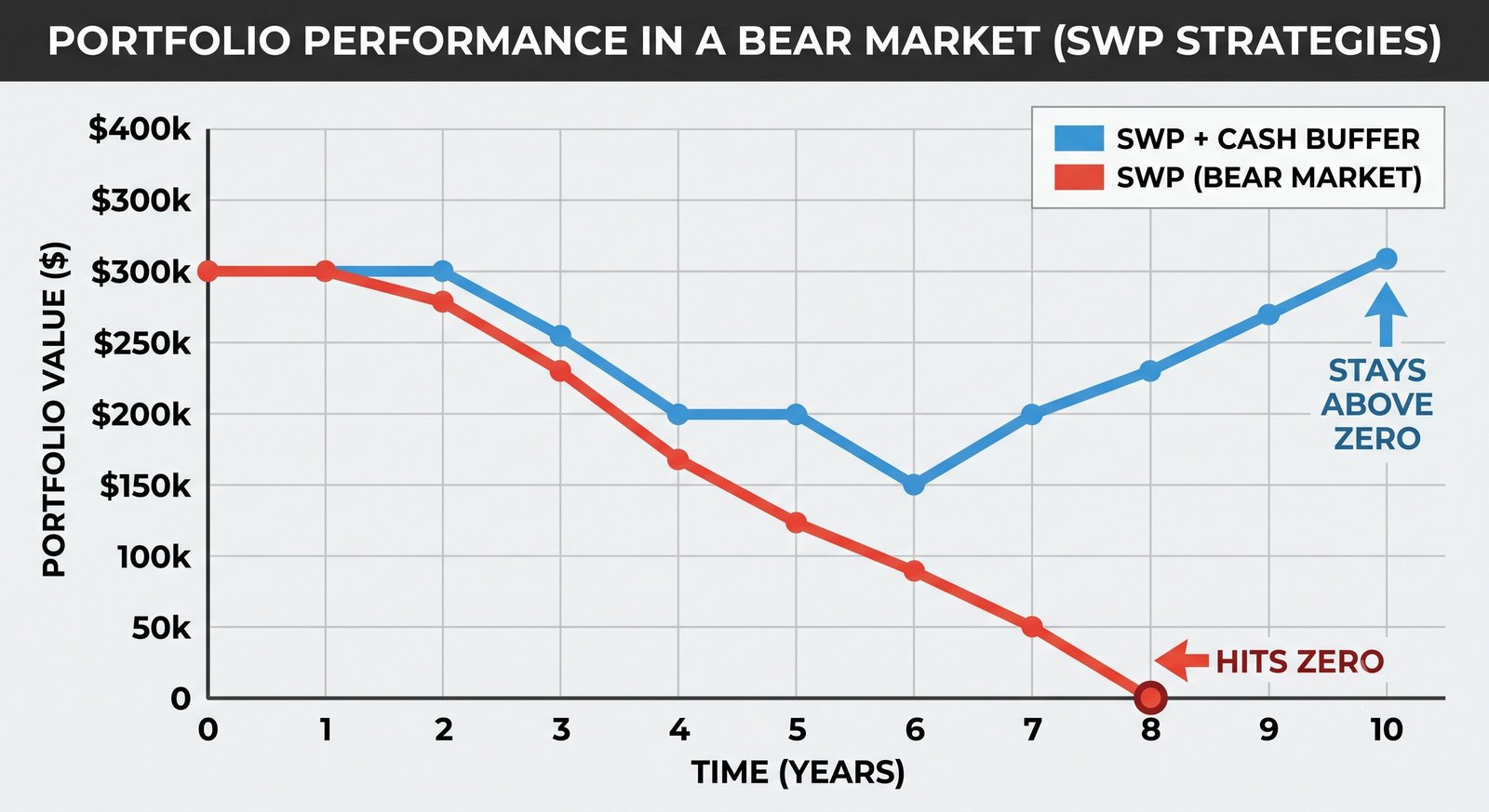
Rupee/Dollar Cost Averaging in Reverse: During an accumulation strategy like an SIP, market volatility is your friend. When the Net Asset Value (NAV) drops, your fixed investment buys more units. When NAV rises, it buys fewer. Over time, this averages out the cost of acquisition. An SWP does the exact opposite. Because you are withdrawing a fixed amount, you are forced to sell more units when the market is down and fewer units when the market is up. This phenomenon can accelerate the depletion of a portfolio during prolonged bear markets, a critical vulnerability known as Sequence of Returns Risk.
Sequence of Returns Risk (SORR): SORR is the danger that the timing of withdrawals from a retirement account will have a negative impact on the overall rate of return available to the investor. If a severe market downturn occurs in the early years of an SWP, the investor is selling a disproportionately large number of units at depressed prices. Even if the market subsequently rebounds to achieve the "average" expected return over a 20-year period, the portfolio may have suffered permanent impairment because there are too few units left to capture the upside of the recovery.
The Role of Inflation: Another macroeconomic headwind is inflation. If an investor sets a fixed SWP of $2,000 per month, the purchasing power of that $2,000 will steadily erode over a 20-year retirement. Therefore, advanced SWP strategies must account for an annual step-up in withdrawal amounts to maintain a constant standard of living, which places additional stress on the underlying portfolio.
2. Deep-Dive Explanations & Mathematical Formulas
To determine the longevity of a portfolio subjected to a Systematic Withdrawal Plan, financial planners rely on variations of the present value of an annuity formula. The core question is: How long will my money last given a specific withdrawal rate and an assumed rate of return?
The remaining balance of an investment portfolio (Pn) after n periods of fixed withdrawals can be calculated using the following deterministic formula:
Pn = P0(1+r)n - W × [((1+r)n - 1) / r]
Where:
- Pn: Portfolio balance after n periods.
- P0: Initial investment corpus.
- r: Rate of return per period (e.g., if annual return is 8% and withdrawals are monthly, r = 0.08 / 12).
- n: Number of withdrawal periods.
- W: Fixed withdrawal amount per period.
To find the number of periods (n) it takes to deplete the portfolio (where Pn = 0), the formula is algebraically rearranged to solve for n:
n = ln(W / (W - P0 × r)) / ln(1+r)
The 4% Rule Contextualization: This mathematical foundation is what led to the famous "4% Rule," conceptualized by financial advisor William Bengen in 1994. Bengen tested historical market data and found that a portfolio consisting of 50% stocks and 50% bonds could sustain a withdrawal rate of 4% of the initial portfolio value (adjusted annually for inflation) for a 30-year retirement without running out of money, even during severe market downturns like the Great Depression. However, in low-yield environments, modern planners often suggest a more conservative 3.3% to 3.5% withdrawal rate.
3. Realistic Case Studies
To move beyond theory, let us examine two practical edge-case scenarios demonstrating how an SWP behaves under different market conditions and portfolio compositions.
Case Study 1: Raj's Conservative Retirement Decumulation
Raj (age 60) retires with a corpus of $1,000,000. He requires a monthly income of $4,000 ($48,000 annually), equating to a 4.8% withdrawal rate. To minimize volatility, he invests the corpus in a Conservative Hybrid Fund (75% Debt, 25% Equity). Let's assume the fund generates an annualized return of 7%.
- Year 1: Initial Corpus: $1,000,000. Withdrawals: $48,000. Growth at 7%: $70,000. End of Year Balance: $1,022,000.
- Year 5: Due to steady moderate growth exceeding his withdrawal rate, Raj's corpus grows to approximately $1,118,000.
- The Catch: Raj did not account for inflation. While his corpus is growing, the purchasing power of his fixed $4,000 monthly withdrawal is shrinking. If inflation is 4%, by Year 10, his $4,000 will only buy what $2,700 bought at retirement. If Raj dynamically steps up his SWP by 4% annually, his withdrawal in Year 10 becomes $71,050 annually. In this scenario, his withdrawal rate eventually outpaces the 7% conservative growth, and the principal begins to amortize.
Case Study 2: Priya's Aggressive Supplemental Income with SORR Impact
Priya (age 45) achieves FIRE (Financial Independence, Retire Early) with a corpus of $500,000. She invests aggressively in a pure Equity Index Fund, expecting a long-term average return of 10%. She sets up an SWP for $2,500/month (6% annual withdrawal rate). Unfortunately, Priya retires at the onset of a global recession.
- Year 1 (The Crash): The market drops 20%. Her portfolio shrinks to $400,000 due to market forces. Simultaneously, she withdraws $30,000. End of Year Balance: $370,000.
- Year 2 (Stagnation): The market remains flat (0% return). She withdraws another $30,000. End of Year Balance: $340,000.
- Year 3 (The Recovery): The market bounces back by 20%. Her $340,000 grows to $408,000, but she withdraws $30,000. End of Year Balance: $378,000.
- The Result: Despite a 20% drop followed by a 20% gain (an arithmetic return of 0%, though geometrically lower), Priya's portfolio is permanently scarred. Because she was forced to sell highly depreciated units in Year 1 and 2 to fund her SWP, her portfolio cannot fully recover. This perfectly illustrates why equity-only SWPs are dangerous without a cash buffer.
4. Structured Comparison Tables
Investors often weigh SWPs against traditional income-generating assets like Fixed Deposits (FDs), Immediate Annuities, and Mutual Fund Dividend Plans. The following table provides a structural comparison to highlight the distinct advantages and disadvantages of each vehicle.
| Feature / Metric | Systematic Withdrawal Plan (SWP) | Immediate Annuity (Life Pension) |
|---|---|---|
| Control of Capital | Full liquidity. The investor can stop, start, or withdraw the entire lump sum at any time. | Locked in. Capital is surrendered to the insurance company in exchange for a lifelong payout. |
| Income Predictability | Extremely high predictability for the withdrawal amount, but portfolio longevity is variable based on market performance. | Absolute guarantee. The payout amount is fixed for life, regardless of market crashes. |
| Tax Efficiency | Highly efficient. Withdrawals are considered a return of principal first. Only the capital gains portion is taxed. | Inefficient in most jurisdictions. Annuity payouts are generally treated as ordinary income and taxed at marginal slab rates. |
| Inflation Protection | High. The underlying mutual fund (especially hybrid/equity) can grow to outpace inflation, allowing for stepped-up SWPs. | Low. Standard annuities offer fixed payouts that rapidly lose purchasing power. Inflation-adjusted annuities start with very low initial yields. |
5. Advanced Strategies & Edge-Case Scenarios
Basic SWPs involve a fixed monetary withdrawal. However, sophisticated investors utilize advanced mechanics to protect their downside risk and optimize tax outflows.

The Bucket Strategy (Asset Liability Matching): To completely neutralize Sequence of Returns Risk, investors should not run an SWP directly from a volatile equity fund. Instead, they divide their corpus into three "buckets."
- Bucket 1 (Years 1-3): Invested in ultra-safe, highly liquid assets (Liquid Funds, Cash). The SWP is drawn exclusively from this bucket.
- Bucket 2 (Years 4-8): Invested in moderate-risk assets (Corporate Bond Funds, Balanced Advantage Funds).
- Bucket 3 (Years 9+): Invested purely in high-growth Equity Funds.
- The Mechanic: As Bucket 1 depletes to fund the SWP, it is periodically refilled by selling assets from Bucket 2. Bucket 2 is refilled by harvesting gains from Bucket 3. If the equity market crashes, the investor stops refilling from Bucket 3, allowing it time to recover, while continuing to live off the safe funds in Buckets 1 and 2.
Dynamic Percentage SWP (Endowment Model): Instead of withdrawing a fixed fiat amount (e.g., $1,000/month), the investor withdraws a fixed percentage of the portfolio's current value (e.g., 0.4% per month). If the portfolio value drops, the withdrawal amount drops, preserving capital. If the portfolio grows, the investor gets a "raise." While mathematically superior for preserving the corpus into perpetuity (the portfolio can never mathematically hit zero), it requires the investor to have flexible living expenses, as their monthly income will fluctuate.
Capital Appreciation SWP: In this edge-case scenario, the investor instructs the fund house to withdraw only the capital gains generated in a specific period, leaving the original principal untouched. If the NAV does not increase during a given period, no withdrawal is made. This is strictly for supplemental income, as the cash flow is highly erratic.
6. Actionable Strategy Guide: Setting Up Your SWP
Implementing a Systematic Withdrawal Plan requires precision. Follow this step-by-step framework to engineer a sustainable income stream.
- Step 1: Calculate Your Required Yield. Determine your annual living expenses and subtract any guaranteed income (like pensions or rental income). The remainder is the funding gap your SWP must fill. Divide this gap by your total corpus to find your required withdrawal rate. If it exceeds 4-5%, you must either reduce expenses or increase your corpus before retiring.
- Step 2: Optimize Fund Selection for Stability. Do not set up an SWP from a Small Cap or Mid Cap equity fund. The volatility will destroy your capital. Opt for Debt Funds, Multi-Asset Allocation Funds, or Conservative Hybrid Funds that offer steady, low-volatility returns.
- Step 3: Account for Taxation via FIFO. Understand that mutual fund houses process SWPs on a First-In-First-Out (FIFO) basis. The units you bought first are the ones sold first. Ensure your initial investments have crossed the threshold for Long-Term Capital Gains (LTCG) tax treatment to minimize your tax burden.
- Step 4: Execute the Mandate. Log into your mutual fund portal or broker platform. Select the target fund, choose the "SWP" option, input your fixed withdrawal amount, select the frequency (monthly is ideal for managing household budgets), and pick a withdrawal date (e.g., the 5th of every month).
- Step 5: Conduct Annual Reviews. An SWP is not "set and forget." Once a year, review the remaining corpus. If the market has experienced a massive bull run, you may choose to take a one-time bonus withdrawal or increase your monthly SWP to match inflation. If the market has crashed, temporarily reduce your SWP or pause it entirely, relying on cash reserves until the NAV recovers.
7. Tax Implications of Systematic Withdrawals
One of the most compelling arguments for utilizing an SWP over interest-bearing instruments (like Fixed Deposits) is tax arbitrage. When you receive interest from a bank deposit, the entire amount is taxed according to your marginal income tax slab. In contrast, an SWP is treated as a redemption of mutual fund units.
Every withdrawal consists of two components: Principal (the original money you invested) and Capital Gains (the profit). You are only taxed on the capital gains portion. Because the initial withdrawals contain a large portion of principal and only a small fraction of capital gains, the effective tax rate on your early SWP cash flow is remarkably low.
Furthermore, because mutual funds use the First-In-First-Out (FIFO) accounting method, the units sold first are typically the ones held the longest. This usually qualifies the gains for Long-Term Capital Gains (LTCG) tax, which is significantly lower than Short-Term Capital Gains (STCG) or ordinary income tax rates in most global jurisdictions. (Note: Tax laws vary by jurisdiction, and investors should consult a certified tax professional regarding the specific LTCG rates, indexation benefits, and exemption limits applicable in their country.)
8. Frequently Asked Questions (FAQs)
Q: Can a Systematic Withdrawal Plan deplete my principal corpus to zero?
Yes, absolutely. If your withdrawal rate (e.g., 8% annually) is consistently higher than the net rate of return of your mutual fund (e.g., 5% annually), you are amortizing the principal. Over time, the balance will decline, and eventually, the portfolio will be completely depleted. To prevent this, your withdrawal rate must be lower than your conservative expected return, accounting for inflation.
Q: Is it better to choose a Dividend Payout option or an SWP for monthly income?
An SWP is almost universally superior to a Dividend Payout option. Dividends are not guaranteed; mutual funds only declare them when they realize a profit, and the fund manager decides the quantum. This leads to erratic income. Furthermore, in many jurisdictions, mutual fund dividends are taxed at your ordinary income tax slab, whereas SWP withdrawals benefit from favorable capital gains taxation. SWPs provide predictable cash flow and better tax efficiency.
Q: Can I set up an SWP from an aggressive Equity Mutual Fund?
While you can technically set up an SWP from any open-ended mutual fund, doing so from a pure equity fund is highly discouraged due to volatility. Equity markets can undergo prolonged bear phases. Selling equity units during a crash to fund an SWP results in heavy capital destruction. If you wish to use equity for growth, employ the "Bucket Strategy" outlined above, routing the money through a liquid or debt fund first.
Q: How does the First-In-First-Out (FIFO) rule impact my SWP taxation?
When a fund house processes your monthly SWP, it redeems the units you purchased earliest. If you accumulated a corpus over 10 years via an SIP, your first SWP withdrawal will sell the units you bought in Year 1. Because these units have been held for a long time, the gains on them will qualify for Long-Term Capital Gains (LTCG) tax, which is typically taxed at a lower rate than short-term investments.
Q: What happens if the fund's NAV drops below my fixed withdrawal amount?
An SWP operates by redeeming the required number of units to meet your fixed monetary request. If the NAV drops significantly, the fund house must redeem a much larger number of units to generate the same amount of cash. If the total value of your remaining units falls below your requested withdrawal amount, the fund will liquidate the entire remaining balance, send you whatever is left, and the SWP will automatically terminate.
See also
- Loading related topics...