Understanding IFSC & MICR
The Definitive Guide to Digital Routing, Check Truncation, and Global Payment Settlement Architecture
In the complex and hyper-connected architecture of modern banking, the seamless, secure, and error-free transfer of vast capital reserves across disparate institutional networks is absolutely paramount. Trillions of dollars navigate complex national and international clearinghouses on a daily basis, demanding a standardized routing framework that is completely immune to geographic confusion, typographical ambiguity, or systemic misallocation[cite: 24]. Within the Indian macroeconomic banking system specifically, this flawless digital and physical routing of liquidity is strictly governed and facilitated by two critical alphanumeric coding structures: the Indian Financial System Code (IFSC) and Magnetic Ink Character Recognition (MICR) codes[cite: 24].
While laypersons and retail banking consumers frequently conflate the two acronyms due to their consistent co-location on standard physical bank check leaves, they are structurally engineered for entirely distinct operational modalities[cite: 24]. IFSC is fundamentally a digital routing protocol; it is explicitly designed to identify specific branch endpoints during instantaneous electronic fund transfers across the national financial grid[cite: 24]. Conversely, MICR operates as a physical security and processing protocol utilizing highly specialized magnetic ink, engineered to aggressively automate the physical clearing of paper checks at central processing hubs[cite: 24]. Together, these two parallel mechanisms form the unyielding backbone of both analog capital clearing and instantaneous digital capital settlements.
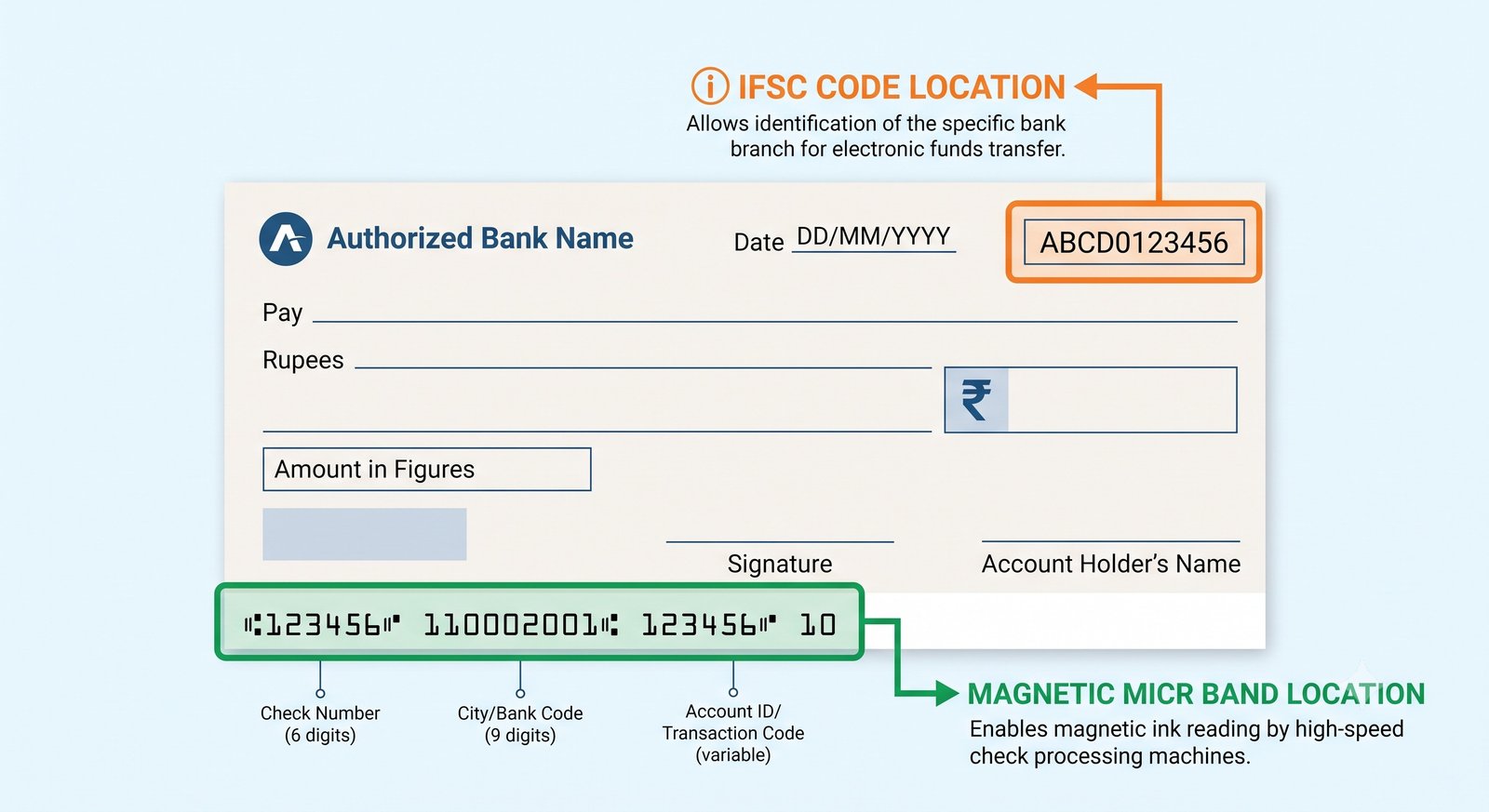
This comprehensive, encyclopedic analysis deeply dissects the specific alphanumeric architecture of both IFSC and MICR codes, details their exact functional utility within massive national payment switchboards like NEFT and RTGS, examines the magnetic oxide technology driving modern physical check truncation, and explores their structural equivalents operating in global international banking networks.
1. The Cryptography and Architecture of IFSC
The Indian Financial System Code (IFSC) is a rigid, 11-character alphanumeric string established, tightly monitored, and regulated by the Reserve Bank of India (RBI)[cite: 24]. Its singular operational objective is to uniquely and unequivocally identify every individual bank branch participating in the national electronic funds transfer network[cite: 24]. Without a universally accurate and standardized IFSC protocol, centralized digital switchboards would be completely incapable of determining exactly which local branch ledger a specific cash transfer should be deposited into, leading to catastrophic systemic gridlock[cite: 24].
The 11-character code is not generated arbitrarily; it is systematically compartmentalized into three distinct informational segments designed to be parsed sequentially by clearinghouse algorithms[cite: 24]:
- Bank Identifier (Characters 1-4): The first four characters of the code are entirely alphabetical and exist to explicitly denote the parent banking institution[cite: 24]. For instance, 'SBIN' universally identifies the State Bank of India across all databases, while 'HDFC' explicitly identifies HDFC Bank[cite: 24]. This allows the primary switchboard to immediately route the data packet to the correct corporate data center.
- Control Character (Character 5): The fifth character of every IFSC is strictly a numerical zero ('0')[cite: 24]. It serves as a vital mathematical control variable, reserved unilaterally by the central bank for potential future expansion or structural modifications to the national system grid[cite: 24]. It also acts as a programmatic separator within legacy banking software parsing strings.
- Branch Identifier (Characters 6-11): The final six characters, which can be entirely numeric or alphabetical depending on the bank's internal classification methodology, specifically identify the exact local branch of the parent institution[cite: 24]. This segment pinpoints the definitive geographical and systemic endpoint of the capital route, effectively acting as the final destination port[cite: 24].
2. Mechanics of Digital Switchboards: NEFT, RTGS, and IMPS
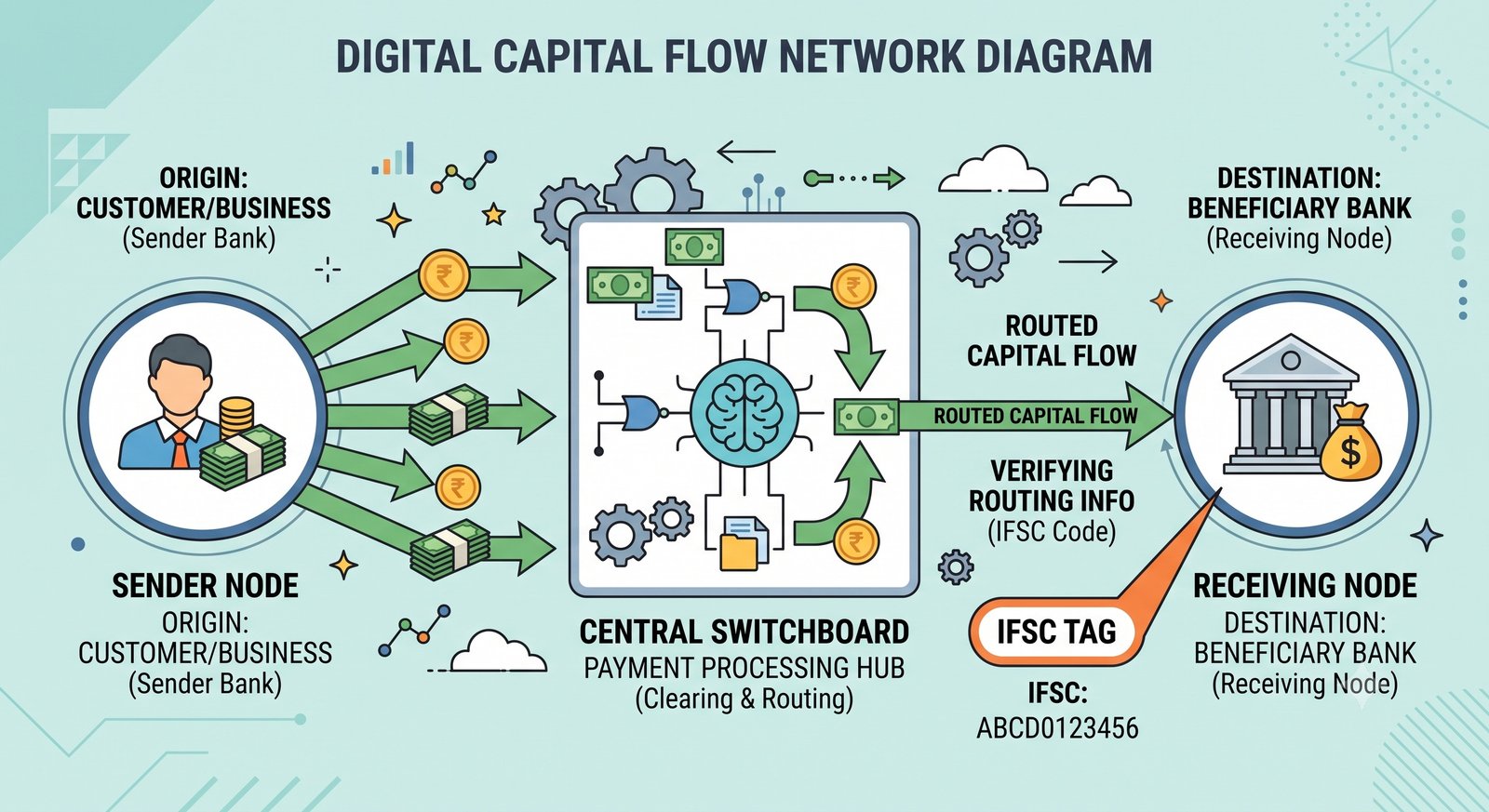
The primary utility of the IFSC architecture is to frictionlessly facilitate the three main arteries of India's electronic payment infrastructure: National Electronic Funds Transfer (NEFT), Real-Time Gross Settlement (RTGS), and the Immediate Payment Service (IMPS)[cite: 24]. Each of these networks operates under different liquidity parameters, but all rely universally on the IFSC for directional orientation.
When a consumer, corporation, or institutional treasurer initiates a digital transfer via mobile banking, automated payroll software, or an internet portal, they are mandatorily required to input the recipient's exact account number strictly alongside the corresponding branch IFSC[cite: 24]. Upon authorization of the debit, the central clearinghouse utilizes the IFSC as a precise digital mapping coordinate[cite: 24]. The central server reads the first four letters to route the capital to the correct institutional ledger (e.g., ICICI Bank's central corporate servers), and then instantly reads the final six characters to funnel the capital precisely into the specific branch ledger where the recipient holds their individual account[cite: 24].
If an invalid, outdated, or mismatched IFSC is submitted into the user interface, the central switchboard structurally rejects the transaction during the preliminary handshake protocol[cite: 24]. This hard-coded validation prevents catastrophic capital misallocation and massively mitigates systemic accounting errors across the national grid[cite: 24]. Without this immediate rejection mechanism, millions of dollars would enter a suspended "limbo" state, requiring intense manual reconciliation by bank compliance officers.
3. The Function, Structure, and Chemistry of MICR
While IFSC completely dominates the realm of digital routing, Magnetic Ink Character Recognition (MICR) remains the undisputed technological standard driving the physical, analog clearing of paper checks and demand drafts[cite: 24]. Developed in the mid-20th century to combat check fraud and processing bottlenecks, the MICR code is a 9-digit numerical string permanently printed along the bottom edge of a check leaf[cite: 24].
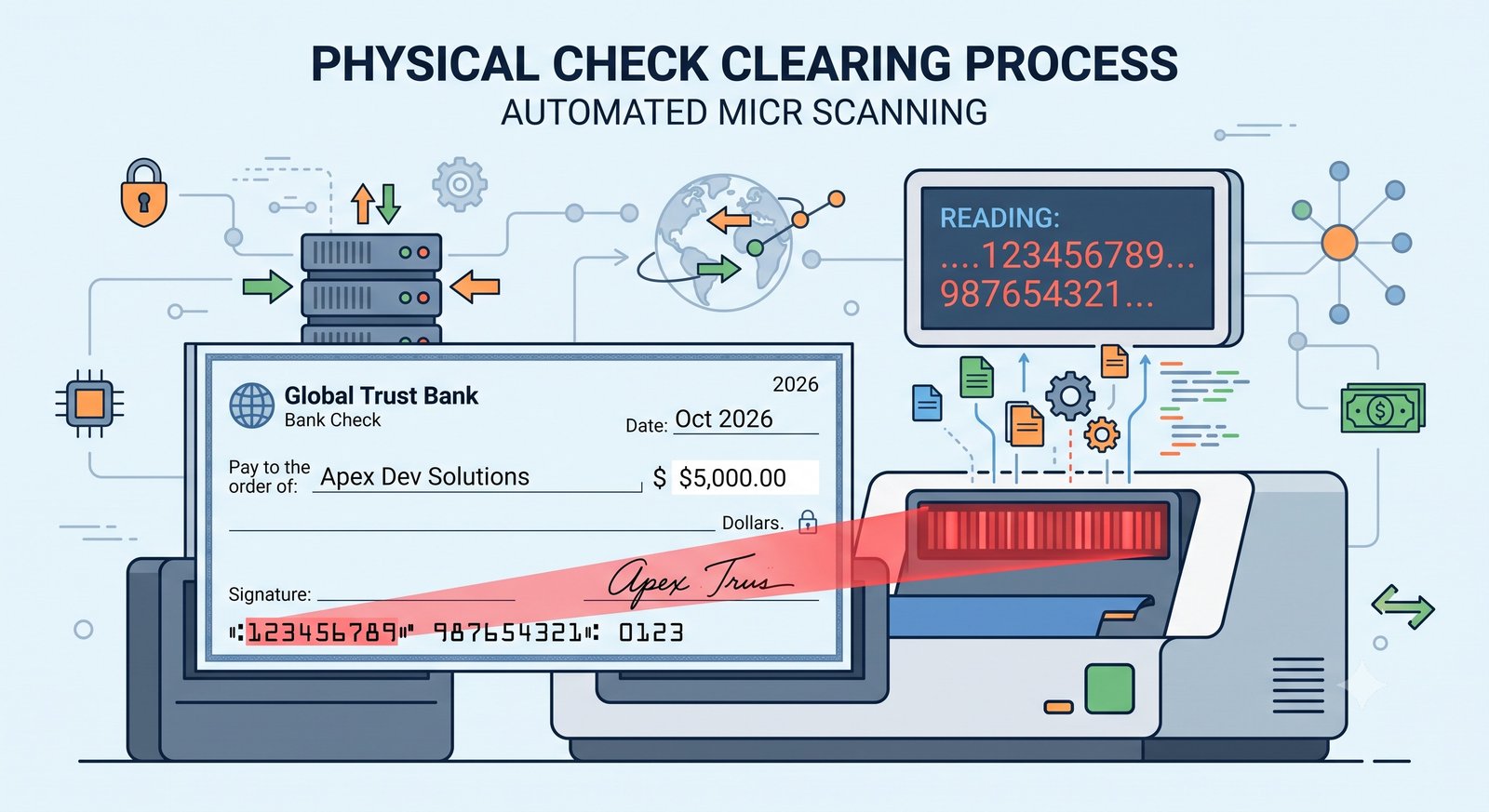
Crucially, this string is printed using highly specialized, iron-oxide-infused magnetic ink[cite: 24]. This specific chemical ink formulation is critical to the clearing process; it allows high-speed sorting machines at centralized clearinghouses to accurately read, magnetize, and process tens of thousands of physical checks per hour[cite: 24]. The magnetic signature can be read flawlessly even if the physical paper is stamped over, stained, or slightly mutilated by human handling, completely eliminating the sluggish friction and massive error rates inherent in manual human data entry[cite: 24].
Similar to the architectural logic of the IFSC, the 9-digit MICR string is strictly compartmentalized into three distinct segments to provide rapid geographic and institutional identification to the automated sorting hardware[cite: 24]:
- City Code (Digits 1-3): The first three digits of the MICR band align perfectly with the postal PIN code format[cite: 24]. This instantly identifies the specific metropolitan city where the issuing bank branch is physically located, allowing sorting machines to bundle localized physical assets[cite: 24].
- Bank Code (Digits 4-6): The middle three digits uniquely represent the parent banking institution[cite: 24]. This allows the sorting machine to bundle checks intended for the same corporate ledger for consolidated settlement[cite: 24].
- Branch Code (Digits 7-9): The final three digits identify the exact local branch within that specific city, concluding all the necessary routing variables required for physical settlement[cite: 24].
4. Structural Comparison: IFSC vs. MICR
It is critical for financial professionals and retail consumers to completely separate the operational jurisdictions of these two codes[cite: 24]. They are fundamentally not interchangeable[cite: 24]. A consumer attempting to initiate an instantaneous RTGS digital transfer using a 9-digit MICR code will trigger an immediate, hard-coded system failure[cite: 24]. Conversely, writing an 11-character IFSC on the magnetic band of a physical check will physically jam or logically confuse automated clearing hardware in the sorting facility[cite: 24].
| Operational Metric | IFSC (Indian Financial System Code) | MICR (Magnetic Ink Character Recognition) |
|---|---|---|
| Format & Length | 11-Character Alphanumeric (A-Z, 0-9) | 9-Digit Strictly Numeric (0-9) |
| Primary Transfer Medium | Digital / Electronic (NEFT, RTGS, IMPS, UPI) | Analog / Physical (Paper Checks, Demand Drafts) |
| Technology Utilized | Server-side API Routing & Database Mapping | Magnetic Iron-Oxide Ink & Hardware Scanners |
| Data Structure | Bank (4) + Control (1) + Branch (6) | City (3) + Bank (3) + Branch (3) |
The primary systemic difference lies heavily in their integration with the Check Truncation System (CTS)[cite: 24]. Modern banking infrastructure rarely transports physical paper checks across the country in armored trucks anymore[cite: 24]. Instead, local banks run the deposited paper check through a high-speed MICR scanner, which reads the magnetic routing data, captures a secure, high-resolution image of the check, and electronically transmits that encrypted data packet to the central clearinghouse[cite: 24]. Therefore, while IFSC handles purely digital transactions originating from mobile devices or internet portals, MICR acts as the vital technological bridge that digitizes and routes legacy physical paper instruments into the modern grid[cite: 24].
5. Empirical Case Studies in Routing Mechanics
Case Study 1: The Corporate Payroll Mismatch (IFSC Error Mitigation)
Scenario: A corporate treasury department initiates a massive batch of NEFT salary payments for 500 employees. For one specific employee, the HR database holds a valid 12-digit account number but an outdated IFSC code, representing a branch that the parent bank closed and merged six months prior.
The Mechanics of Rejection: When the corporate API transmits the batch file, the RBI's central NEFT clearinghouse immediately parses the metadata. It maps the outdated IFSC against the current master database. The system detects a null endpoint. Because the capital cannot be mathematically funneled to a non-existent branch ledger, the specific transaction is isolated and structurally rejected. The funds are automatically "Returned to Origin" (RTO) to the corporate treasury account within the T+1 settlement window. This automated safety net, reliant entirely on IFSC validation, prevents the employee's salary from vanishing into systemic limbo.
Case Study 2: The Mutilated Check and CTS Recovery
Scenario: A retail customer attempts to deposit a high-value paper check into an ATM scanner. The bottom right corner of the check has been heavily stained with coffee, visually obscuring the last three digits of the printed MICR line (the Branch Code).
The Mechanics of Truncation: When the bank processes the check via the Check Truncation System (CTS), traditional optical character recognition (OCR) fails due to the severe visual stain. However, the MICR scanner relies on magnetism, not optical optics. Because the iron-oxide ink particles retain their unique magnetic flux signatures beneath the coffee stain, the hardware scanner successfully reads the full 9-digit string. The physical check is truncated locally, and the digital packet is routed flawlessly to the drawee bank for settlement, saving the customer days of administrative delays.
6. Global Equivalents: SWIFT, IBAN, and Routing Numbers
The highly regimented structural concepts underlying IFSC and MICR are not unique to the Indian subcontinent; similar rigorous logical frameworks are deployed across global banking networks to guarantee secure capital transmission[cite: 24]. Understanding these equivalents is critical for executing international treasury operations.
- The United States (ABA Routing Transit Number): In the US, the Federal Reserve relies heavily on the ABA Routing Transit Number[cite: 24]. This is a 9-digit code functionally identical to an IFSC, utilized for routing domestic wire transfers, ACH direct deposits, and physical check clearing[cite: 24]. It is standardized by the American Bankers Association.
- The European Union (IBAN): Across Europe, the SEPA (Single Euro Payments Area) system utilizes the IBAN (International Bank Account Number)[cite: 24]. The IBAN is highly advanced; it completely merges the routing code, the country code, and the specific customer account number into a single, massive alphanumeric string up to 34 characters long[cite: 24]. This ensures flawless, single-line cross-border euro settlements[cite: 24].
- Global Operations (SWIFT / BIC): For massive international, cross-border capital injections—such as repatriating corporate profits from foreign subsidiaries or wiring foreign direct investment—the undisputed global standard is the SWIFT/BIC code (Society for Worldwide Interbank Financial Telecommunication)[cite: 24]. While an IFSC routes capital strictly within the closed loop of India's domestic borders, a SWIFT code is required to accurately identify specific banking institutions across the highly disparate regulatory networks of international borders[cite: 24].
Together, these highly standardized, meticulously regulated alphanumeric structures completely mitigate systemic routing errors, forming the invisible, mathematical bedrock of global financial commerce[cite: 24].
7. Actionable Strategy Guide: Corporate Treasury Integration
For small business owners and corporate treasury departments processing thousands of vendor payments and payroll distributions, manually verifying routing codes is an operational failure. Implement this systemic blueprint to automate payment validation and eliminate returned transactions:
- Step 1: Implement Input Masks. On your vendor onboarding or HR payroll portals, implement HTML/JS input masks that strictly limit the IFSC field to exactly 11 characters. Enforce regex logic that mandates the first 4 characters are letters, the 5th character is a '0', and the final 6 are alphanumeric. This instantly blocks 90% of basic typographical errors.
- Step 2: API Validation. Integrate your Enterprise Resource Planning (ERP) software with a banking API that cross-references the entered IFSC against the central bank's live master database. If the API returns a 'Null' or 'Branch Closed' status, lock the onboarding process until the vendor updates their banking details.
- Step 3: Account Name Verification (Penny Drop). Before executing massive bulk RTGS payments, utilize a "Penny Drop" API service. This automated system routes exactly ₹1 to the provided Account Number + IFSC combination. It then returns the actual registered name on the destination bank account. If the returned name does not match the vendor/employee name on file, halt the payment to prevent fraud or misallocation.
- Step 4: Check Truncation Preparation. If your business receives high volumes of paper checks, do not manually key in the data. Invest in desktop CTS-compliant MICR hardware scanners for your accounting department. These devices instantly read the magnetic ink, validate the routing numbers, and allow for bulk digital deposits directly to your corporate account without ever visiting a physical branch.
8. Frequently Asked Questions (FAQ)
Q: If my bank branch merges or relocates, does my IFSC change?
Yes. Because the IFSC explicitly maps to a geographical branch endpoint, corporate bank mergers or physical branch relocations often necessitate the generation of a new IFSC. However, to prevent mass payment failures, central banks mandate a lengthy transition period where the old IFSC is digitally mapped to the new IFSC on the backend switchboard. Eventually, the old code will be deprecated, and any transactions utilizing it will be structurally rejected and returned to the sender.
Q: Can I find a bank's MICR code if I only have their IFSC?
While they are distinct codes, they are intrinsically linked in the central bank's master database. You can utilize public financial directories or RBI portals to cross-reference an IFSC to find the corresponding 9-digit MICR code for that specific branch. However, remember that for digital transfers (NEFT/IMPS), only the IFSC is required; the MICR code is irrelevant for digital initiation.
Q: Why is the fifth character of the IFSC always a zero?
The fifth character ('0') is a structural control mechanism embedded into the architecture of the string[cite: 24]. It acts as a permanent placeholder reserved for future systemic expansion[cite: 24]. If the banking network grows exponentially and requires a 12th or 13th character logic in the future, the central bank can modify the protocol surrounding the control character without breaking legacy software databases that parse 11-character strings. It also helps basic validation scripts instantly identify incorrectly formatted data entries.
Q: Is the IFSC code sensitive security information like a password?
No. An IFSC is completely public, non-sensitive routing data. Its only purpose is directional mapping. Providing someone with your account number and IFSC only enables them to deposit or route funds into your account. They cannot withdraw, debit, or compromise your capital using an IFSC. It acts identically to a public mailing address; anyone can send a letter there, but they cannot open the mailbox.
Q: Do international wire transfers use the IFSC code?
Generally, no. International inbound wire transfers rely primarily on the SWIFT/BIC code to successfully navigate the capital across global borders and land it at the correct parent institution[cite: 24]. However, once the capital hits the domestic clearinghouse (Nostro/Vostro accounts), the receiving bank may utilize the IFSC internally to execute the final "last-mile" domestic routing to your specific local branch ledger. As a sender, you generally only need to provide the SWIFT code and Account Number for international routing.
See also
- Loading related topics...