Understanding Loan EMIs
The Definitive Guide to Amortization Mechanics, Interest Front-Loading, and Prepayment Arbitrage
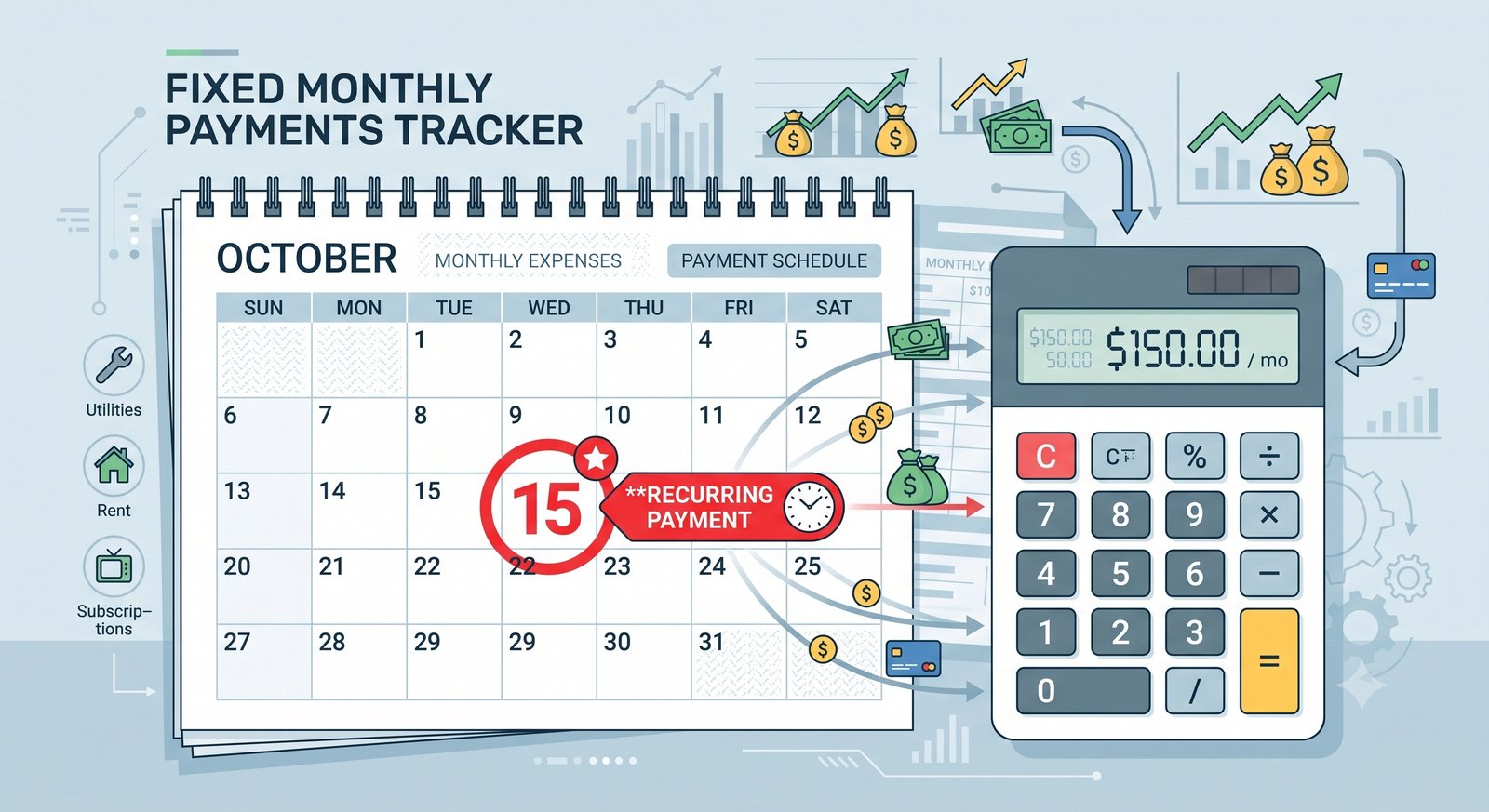
The Equated Monthly Installment (EMI) is the foundational, mathematical financial mechanism governing the structured repayment of nearly all modern consumer and commercial installment loans. Whether an individual is financing a 30-year residential mortgage, securing a 60-month auto loan, or capitalizing a business expansion via an unsecured personal loan, the EMI dictates the exact velocity of capital extraction from the borrower to the lender. By strict definition, an EMI is a fixed, non-variable payment amount made by a borrower to a lending institution on a specific, contractually mandated date each calendar month.
The psychological and operational brilliance of the EMI structure lies entirely in its predictability: despite the complex, dynamic internal mathematics of compounding interest and aggressively depreciating principal balances occurring behind the scenes, the borrower pays the exact same flat, nominal amount every single month until the debt is systematically drawn down to absolute zero. This engineered stability allows households and corporations to confidently forecast cash flow and adhere to strict zero-based budgets without facing erratic, fluctuating debt service obligations.
However, while the outward-facing payment amount remains perfectly static, the internal composition of that payment is highly dynamic and aggressively skewed to favor the institutional lender. Deconstructing an EMI reveals a highly sophisticated interplay between the time value of money, amortization schedules, and institutional risk mitigation. Understanding the hidden mechanics behind an EMI calculation is not merely an academic exercise; it empowers borrowers to execute superior financial decisions regarding optimal loan tenures, evaluating interest rate types, and deploying aggressive principal prepayment strategies to save hundreds of thousands of dollars in unearned interest.
1. The Deep-Dive: The Mathematical Formula of an EMI
An EMI is not calculated by simply dividing the principal by the number of months and adding a flat interest fee. It is calculated using the present value of an ordinary annuity formula. This complex algebraic equation guarantees that the principal balance will amortize (reduce) to exactly zero on the final month of the designated loan term, while simultaneously ensuring the bank receives its precisely required yield on the outstanding capital each month.
The Universal Institutional EMI Formula:
EMI = [P × R × (1+R)^N] / [(1+R)^N - 1]
To successfully operationalize this equation, one must understand its constituent variables:
- P (Principal): The total initial amount of fiat capital borrowed from the lender at the inception of the contract.
- R (Rate of Interest): The strictly monthly interest rate. Because banks globally quote loans using an Annual Percentage Rate (APR), this number must be mathematically divided by 12 to find the monthly compounding factor before being plugged into the formula. For example, an advertised 6.0% annual mortgage rate becomes a 0.5% monthly rate, which must be inputted into the equation as the decimal 0.005.
- N (Number of Periods): The total loan tenure (duration) strictly expressed in total months. A 30-year residential mortgage equates to an 'N' value of 360 periods; a 5-year auto loan equates to an 'N' value of 60 periods.
Mathematical Example: If a consumer borrows $300,000 (P) for a 30-year mortgage (N = 360) at a fixed annual rate of 5.0% (R = 0.05 / 12 = 0.004166), the equation is: EMI = [300,000 × 0.004166 × (1+0.004166)^360] / [(1+0.004166)^360 - 1]. The formula resolves to an exact EMI of $1,610.46. The borrower will pay this exact amount 360 times, resulting in a total payout of $579,765.60, meaning the bank harvests nearly $280,000 in pure interest.
2. Amortization Mechanics: The Shift from Interest to Principal
Although the outward-facing EMI amount remains perfectly identical every month, the internal mechanism detailing how the bank allocates that money shifts dramatically and non-linearly over the life of the loan. This exact month-by-month breakdown is documented in an Amortization Schedule.
The fundamental rule of lending is that interest is always calculated solely on the currently outstanding principal balance. Consequently, because the principal is at its absolute highest on Day 1, the very first EMI payment consists almost entirely of interest charges flowing directly to the bank's profit ledger, with only a minuscule, fractional amount applied to reducing the actual principal.
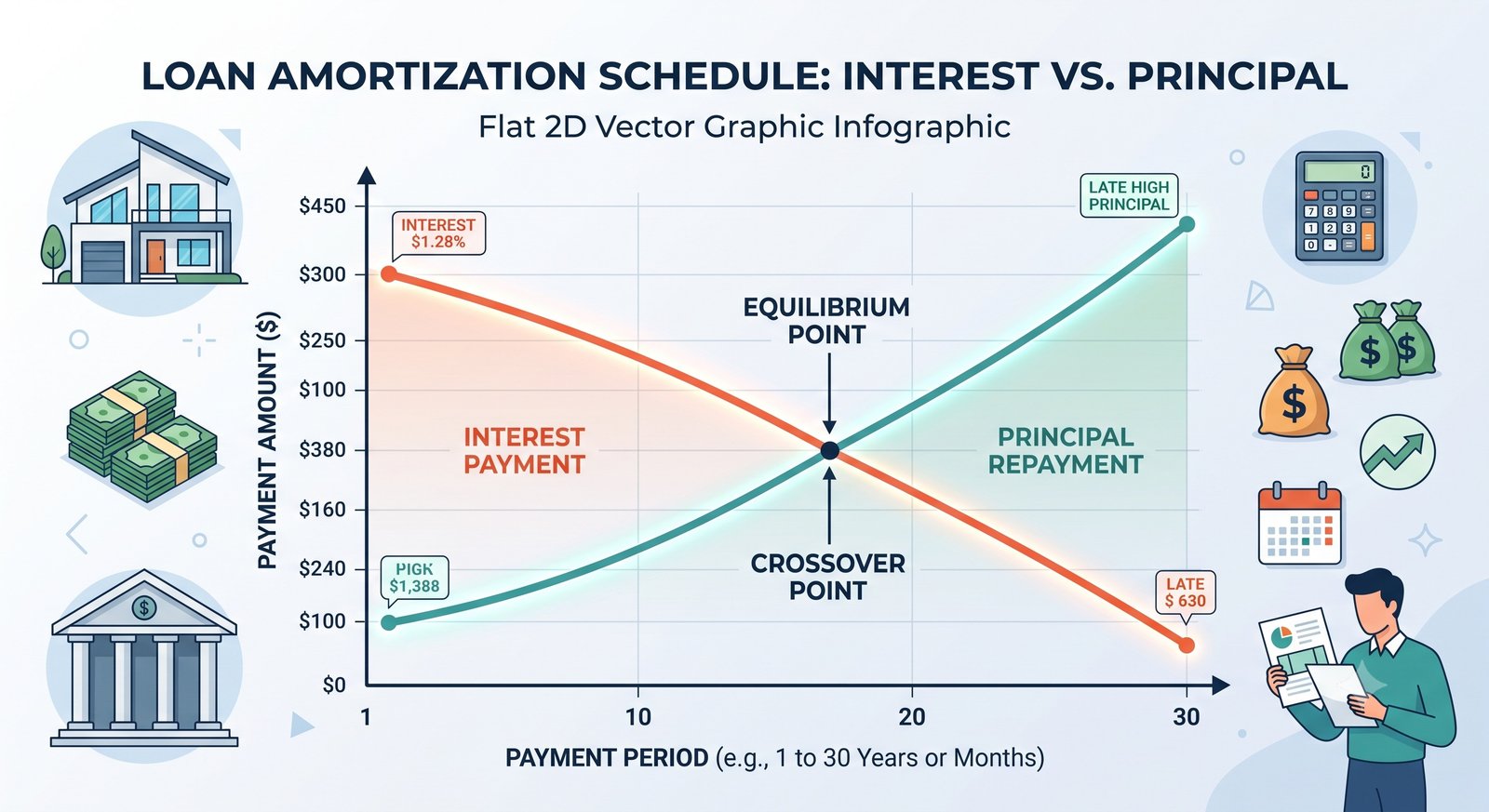
This aggressively front-loaded interest structure ensures that the bank inherently secures the vast majority of its profit early in the loan's lifecycle. Using the previous $300,000 mortgage example, in Month 1, the interest charge is $1,250. Out of the $1,610.46 EMI, the bank takes $1,250 as profit, and only $360.46 goes toward reducing the debt. For the first several years of a standard 30-year mortgage, the borrower bleeds a staggering amount of capital to interest while barely making a dent in the equity balance.
However, as that $360.46 slowly decreases the principal month by month, the interest calculated on that marginally smaller balance also decreases in month two. By the final years of the loan (e.g., Year 28), the mathematical ratio entirely flips: the vast majority of the $1,610.46 EMI goes directly to paying down the remaining principal, with only pennies going toward interest.
3. The Massive Impact of Loan Tenure (N Variable)
The variable that retail borrowers have the most unilateral control over during the loan origination and underwriting process is the tenure, or duration (N). Selecting the optimal loan tenure requires a critical, mathematical tradeoff between immediate monthly cash flow preservation and long-term total wealth preservation.
| Loan Tenure | Monthly EMI | Total Interest Paid to Bank | Total Cost of Loan |
|---|---|---|---|
| 15 Years (180 Months) | $2,372.38 | $127,028 | $427,028 |
| 30 Years (360 Months) | $1,610.46 | $279,767 | $579,767 |
Choosing a vastly extended long tenure (e.g., a 7-year auto loan or a 30-year mortgage) drastically stretches out the repayment timeline. This mathematically forces the monthly EMI down to a highly affordable, artificially suppressed level, freeing up short-term cash flow. However, because the principal is being paid off at a microscopic pace, the bank has significantly more time to charge compounding interest on a massive outstanding balance. Ultimately, a longer tenure drastically and aggressively increases the total, cumulative sunk cost of the loan. Conversely, a short tenure causes the monthly EMI to spike but ruthlessly limits the total amount of interest the bank can harvest over the lifecycle of the asset.
4. Fixed vs. Floating (Variable) Interest Rates
The long-term stability and predictability of an EMI is entirely dependent on the specific type of interest rate regime attached to the loan contract during underwriting.
A Fixed-Rate Loan mathematically guarantees that the interest rate (R) will never change under any circumstances, ensuring the nominal EMI remains absolutely identical for the entire 30-year tenure. This provides perfect household budgeting predictability and structurally shields the borrower from macroeconomic inflation and aggressive central bank rate hikes. It acts as a perfect hedge; if inflation surges to 8%, the borrower continues paying 4%, actively devaluing the bank's real yield.
A Floating or Variable-Rate Loan (such as an Adjustable-Rate Mortgage or ARM) transfers the macroeconomic risk from the bank directly onto the borrower. The interest rate is artificially pegged to a benchmark economic index (such as the Secured Overnight Financing Rate [SOFR] or a central bank's repo rate). If the broader economy dictates a sudden rise in interest rates to combat inflation, the bank will automatically and unilaterally increase the rate on the consumer's loan.
When floating rates rise, banks typically attempt to shield the borrower from "payment shock." Instead of immediately raising the EMI, the bank will quietly extend the tenure of the loan (e.g., silently turning a 20-year loan into a 24-year loan) to keep the borrower's out-of-pocket EMI the same. However, if macroeconomic rates rise aggressively, the bank will eventually hit maximum statutory tenure limits. At that breaking point, the bank is forced to recalculate the formula and significantly increase the actual monthly EMI to ensure the loan amortizes properly before terminal maturity. This phenomenon has triggered mass defaults during rapid inflation cycles.
5. The Exponential Power of Prepayments (Arbitrage Strategy)
Because of the heavily front-loaded nature of interest in a standard amortization schedule, borrowers hold a devastating, highly effective mathematical weapon against the bank: the principal prepayment. A prepayment is any extra, unmandated fiat capital paid to the bank above and beyond the required, scheduled monthly EMI.
Because the required EMI has already fully satisfied the bank's profit (interest) obligations for that specific month, 100% of the prepayment goes directly toward reducing the raw, underlying principal balance. When the principal balance is artificially and violently reduced via a prepayment, the bank is mathematically forced to calculate next month's interest on a significantly smaller number.
The 13-Payment Strategy: Making even one extra EMI payment per year (effectively making 13 payments in a 12-month calendar) can strip nearly five to six full years off a standard 30-year mortgage and save the borrower tens of thousands of dollars in unearned, compounding interest. Advanced borrowers and real estate investors utilize robust, scheduled prepayment strategies to rapidly collapse long-term loan tenures and build untouchable home equity at an exponentially accelerated pace.
6. Actionable Strategy Guide: Optimizing Your EMI Architecture
To prevent a loan from acting as a permanent drain on your net worth, execute the following fiduciary-level strategies when underwriting or managing an EMI-based liability:
- Step 1: Audit for Prepayment Penalties. Before deploying surplus cash to attack a loan, aggressively read the loan's Promissory Note. Many commercial and subprime auto loans include "Prepayment Penalties," where the bank legally fines you for paying the loan off early, guaranteeing their yield. If no penalty exists, proceed to attack the principal.
- Step 2: The "Fake 15" Strategy. If you cannot comfortably afford the high EMI of a 15-year mortgage, secure a 30-year mortgage to lock in the lower mandatory EMI (protecting your baseline cash flow in case of job loss). Then, voluntarily pay the 15-year EMI amount every month. You retain the safety net of the lower requirement while mathematically achieving the rapid 15-year payoff.
- Step 3: Bi-Weekly Arbitrage. Instead of paying your EMI once a month, split the payment in half and pay it every two weeks (aligned with bi-weekly payroll). Because there are 52 weeks in a year, you will make 26 half-payments, which mathematically equates to 13 full payments per year. This invisible, painless extra payment goes entirely to principal reduction.
- Step 4: Refinancing Triggers. Monitor central bank rates. If prevailing macroeconomic interest rates drop 1.0% to 1.5% below your fixed rate, execute a refinance. Crucial Caveat: When refinancing, never reset the clock. If you are 5 years into a 30-year mortgage, refinance into a 25-year or 20-year mortgage. Resetting to a new 30-year term resets the amortization schedule, forcing you to pay front-loaded interest all over again.
7. Frequently Asked Questions (FAQ)
Q: Why does my principal balance barely go down in the first few years of my mortgage?
This is the direct result of the mathematical Amortization Schedule. The bank calculates your monthly interest charge based on your total outstanding balance. In Year 1, your balance is at its absolute maximum, meaning the interest calculation is massive. Your fixed EMI pays that massive interest charge first, leaving very few dollars to actually reduce the principal. As the years progress and the principal slowly drops, the monthly interest charge drops with it, allowing more of your EMI to attack the principal.
Q: If I make a large lump-sum prepayment, does my monthly EMI amount decrease?
Generally, no. By default, when you make a principal prepayment, the bank keeps your monthly EMI exactly the same, but drastically shortens the total tenure (length) of the loan, saving you years of payments. If your goal is to lower your required monthly EMI obligation to free up cash flow, you must explicitly ask the bank to "Recast" or "Re-amortize" the loan. A recast takes your new, lower principal balance and recalculates a new, lower EMI spread out over your originally remaining tenure.
Q: Is it mathematically smarter to prepay a 3% mortgage or invest that money?
From a strict, emotionless mathematical standpoint, investing is vastly superior. If you have extra cash, using it to prepay a 3% mortgage yields a guaranteed 3% return (by saving 3% interest). However, if you deploy that exact same cash into a broad-market S&P 500 index fund, historical averages suggest it will yield 8% to 10% annually. By paying off the low-interest mortgage early, you suffer a massive "opportunity cost" (a negative arbitrage spread) by forfeiting the 5% to 7% difference you could have captured in the equity markets. You only prepay low-interest debt for psychological peace of mind, not mathematical optimization.
Q: What happens if the central bank raises rates on my floating-rate loan, but I cannot afford a higher EMI?
Initially, the bank will automatically extend the tenure of your loan (e.g., pushing your payoff date from 2035 to 2040) to absorb the higher interest charges without raising your monthly out-of-pocket EMI. However, if rates rise too aggressively, extending the tenure is no longer mathematically sufficient to cover the monthly interest. The loan experiences "Negative Amortization." At this point, the bank is legally required to recalculate the loan and aggressively raise your mandatory monthly EMI. If you cannot afford the new payment, you must either refinance, sell the asset, or default.
See also
- Loading related topics...